
Fiberglass Cloth vs. Mat: Strength, Resin and Uses
Compare fiberglass cloth vs. mat for structural repairs, resin compatibility, thickness buildup, contours and finish, with a practical decision tool.
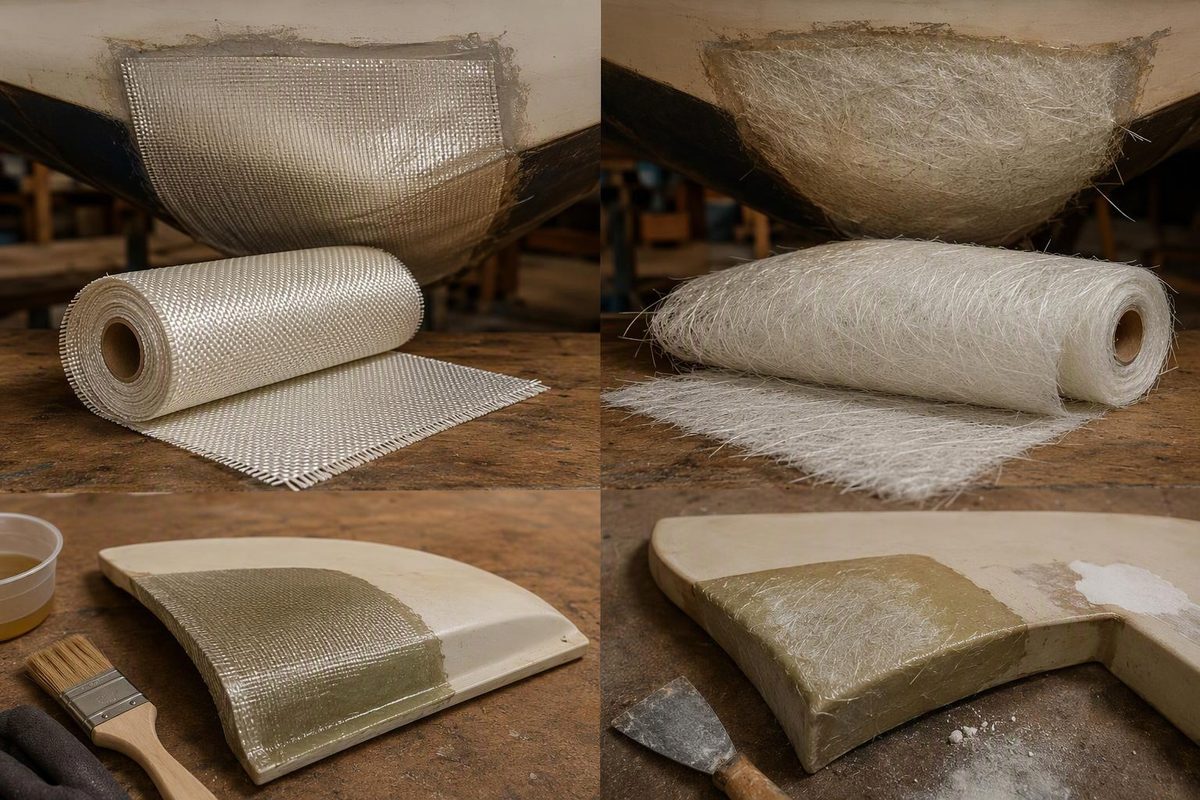
Fiberglass cloth is usually the better primary reinforcement for a structural patch because its continuous yarns carry loads in defined directions. Chopped-strand mat (CSM) is better suited to compatible laminate schedules that need thickness buildup, contouring or print control. The resin can settle the choice first: never use mat unless its current technical data sheet names your resin.
Choose the repair job, resin and mat documentation; the selector will identify the safer starting point.
Cloth or Mat Selector
Use the exact mat data sheet when answering the compatibility question.
Use cloth or directional fabric.
A structural repair needs continuous fibers across sound laminate. Do not add unidentified mat to the epoxy layup.
Why this result?
Cloth restores fibers in defined directions. Mat can serve a secondary role only when the repair schedule calls for it and the exact product is approved for the resin.
Source basis: WEST SYSTEM fiberglass repair guidance and the reinforcement product data sheets cited in the article.
Cloth and Mat Compared
| Check | Fiberglass cloth | Chopped-strand mat |
|---|---|---|
| Fiber form | Continuous yarns, commonly woven at 0°/90° | Short strands distributed randomly |
| Load behavior | Strongest along yarn directions; plies can be rotated | More nearly uniform in-plane, but short fibers carry loads less efficiently |
| Typical role | Structural skins, patches, sheathing and tabbing | Buildup, print control, mold work and specified laminate layers |
| Shape handling | Plain weave may bridge over tight compound curves | Can be torn and worked around contours after wet-out |
| Surface | Weave may print through and require fairing | Random fibers help obscure heavier woven patterns |
| Resin use | Generally achieves a higher fiber-to-resin ratio in hand layup | Commonly needs more resin relative to its glass weight |
| Epoxy use | Common, subject to sizing and resin-maker approval | Only when the exact mat is expressly approved for epoxy |
Fibre Glast describes woven fabric as directional reinforcement and CSM as short, randomly oriented fibers commonly used to build thickness and conceal print-through. It also explains that reinforcement carries most of a composite panel’s load (Fibre Glast).
WEST SYSTEM’s repair manual says a fiberglass boat skin depends on fiber continuity and that a structural repair must restore enough load-carrying fibers across the damaged area (WEST SYSTEM fiberglass repair manual).
“Mat” Does Not Identify One Material
A roll described as mat might be emulsion-bound CSM, powder-bound CSM, continuous-filament mat, a light surfacing veil or mat stitched to biaxial fabric. These products are not interchangeable.
Owens Corning’s M7 is an emulsion-bound CSM specified for unsaturated polyester and vinyl ester systems (M7 data sheet). Fibre Glast’s 1.5 oz/ft² CSM states that its binder prevents proper bonding with epoxy and limits the product to polyester or vinyl ester resin (Fibre Glast product specification).
Epoxy-compatible mat does exist. An older Jushi powder-bound CSM sheet expressly lists epoxy, polyester and vinyl ester compatibility (Jushi powder CSM data sheet). That example does not establish compatibility for an unidentified roll or a current product with a similar name.
The working rule is simple: use mat only with a resin named on that mat’s current data sheet. Do not put unidentified mat into a consequential repair. See why conventional mat can resist epoxy wet-out for more on the binder issue.
Structural Repairs Need Continuous Fibers
A hole or crack through the laminate, damaged hull skin, broken tabbing or reinforcement around a loaded fitting needs continuous fibers spanning sound material. Woven cloth can provide them, although biaxial, triaxial or unidirectional fabric may match the original fiber directions better than a 0°/90° weave.
Do not choose a structural patch solely by whichever material feels thickest. The repair schedule must account for the original laminate, fiber directions, bevel or scarf area, resin system and expected loads. WEST SYSTEM recommends duplicating the original thickness and reinforcement types as closely as practical while restoring fiber continuity across the damage.
Mat can be part of a structural laminate when the design calls for it, but random short fibers do not replace the continuous reinforcement removed by damage. Adding thickness is not the same as restoring the original load path.
Stop before laminating if the panel moves, the crack opens under light pressure, the core is wet or crushed, or damage reaches a stringer, transom, bulkhead or other structural member. Below-waterline and load-bearing boat repairs with uncertain extent require assessment of the complete damage, not merely a cloth-versus-mat choice.
Compatible Mat Suits Buildup and Print Control
Compatible CSM can make sense in polyester or vinyl ester mold construction, in a laminate designed with alternating mat and woven reinforcement, or behind a cosmetic surface where random fibers help limit weave print.
Owens Corning specifies M7 for open-mold hand layup and cites conformability and rapid air release among its product characteristics. Those statements apply to that product and its specified resin systems, not every material sold as mat.
Mat is not a finish coat. It must be fully wetted and consolidated, and the cured surface generally needs a designed surface layer or fairing before the final coating.
Plain-weave cloth is stable and easy to orient, but it may resist tight compound curves and bridge over corners. Twill and stitched fabrics drape differently. Material that will not lie against the prepared surface is a poor choice regardless of its nominal strength.
Cloth and Mat Can Share a Planned Schedule
Cloth and mat are often combined rather than treated as rivals. WEST SYSTEM documents traditional boat skins made from alternating chopped-strand mat and woven roving, while some biaxial reinforcements are sold with mat backing.
Reproduce known construction where appropriate, but verify every layer against the chosen resin. Adding mat merely to imitate an old laminate can increase resin use without restoring its fiber architecture. A mat backing attached to biaxial fabric also needs the same compatibility check as a separate CSM layer.
When the original schedule is unknown, identify what the repair must accomplish before selecting reinforcement. Structural continuity, finished thickness and surface appearance are separate requirements and may call for different layers.
Cloth and Mat Ounce Ratings Use Different Areas
U.S. listings commonly describe woven cloth in ounces per square yard and CSM in ounces per square foot. A “1.5-ounce” mat is therefore not lighter than a “6-ounce” cloth. The conversion is 1.5 oz/ft² multiplied by 9 ft²/yd², which equals 13.5 oz/yd².
These figures are dry reinforcement weights, not cured thicknesses. One hand-layup reference lists the following average cured-ply thicknesses:
| Reinforcement | Listed weight | Average thickness |
|---|---|---|
| Woven cloth | 6 oz/yd² | About 0.010 in |
| Biaxial fabric | 17 oz/yd² | About 0.035 in |
| Biaxial with mat | 24 oz/yd² | About 0.042 in |
The reference cautions that these are averages derived from multiple layers (Jamestown Distributors). They do not establish the cured thickness of another product or layup process.
Use figures for the actual reinforcement and resin when designing thickness or buying material. Once the schedule is known, calculate resin from fabric weight and usable area.
Select and Lay Up the Reinforcement in Sequence
- Expose and identify the damage. Separate a stable coating defect from broken fibers, delamination or core damage.
- Identify the resin system. Confirm that the repair resin suits the cured substrate, exposure and finish.
- Read the reinforcement data sheet. Check resin compatibility, weight unit, width, binder or sizing, and intended process.
- Rebuild the required fibers. Use cloth or directional fabric to bridge structural damage. Use compatible mat only where random reinforcement, buildup or print control belongs in the schedule.
- Dry-fit every ply. Confirm orientation, overlap and conformity before mixing resin. Fabric bridging over a corner leaves a void rather than useful reinforcement.
- Wet out and consolidate without flooding. Saturate the glass and remove trapped air, but do not treat extra resin as extra strength. If voids remain, correct them instead of burying them; their significance depends on location and laminate function.
- Follow the resin’s cure instructions. Mix ratio, temperature limits, recoat window and time before sanding or loading come from the resin system, not the cloth or mat.
Cutting and sanding fiberglass can expose the eyes, skin and lungs to fibers and dust. NIOSH advises reading labels and safety data sheets and controlling exposure at its source (NIOSH fibrous-glass guidance). Follow the resin SDS as well because polyester, vinyl ester and epoxy systems have different ventilation and protective-equipment requirements.