
Fiberglass Material: What It Is and How to Choose It
Understand fiberglass material, compare cloth, mat and biaxial fabric, and check resin compatibility, damage depth and cure before buying repair supplies.
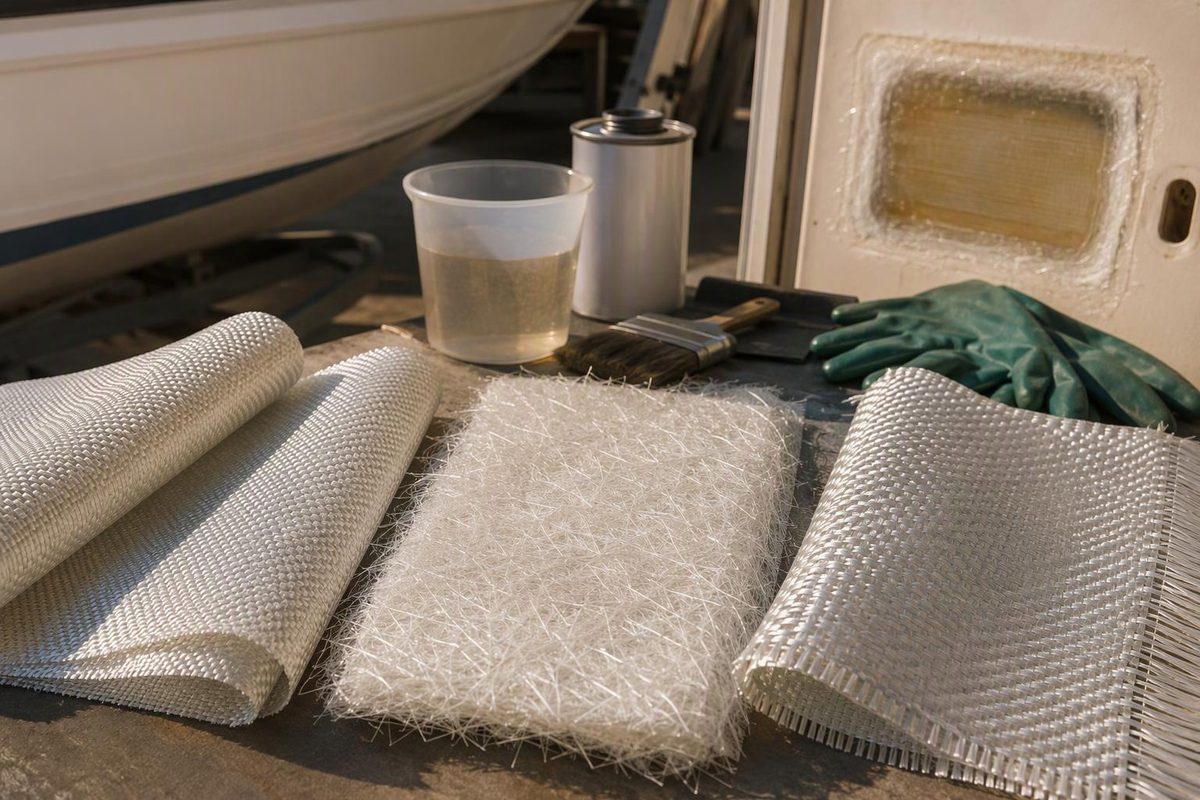
Fiberglass is glass-fiber material; in repair and fabrication, the name also commonly refers to glass fibers combined with cured plastic resin. The dry cloth or mat is one component; the rigid panel made from it is the finished composite, called glass-reinforced plastic (GRP). It belongs to the broader category of fiber-reinforced plastic (FRP).
The fibers carry most of the structural load. The resin holds them in position and helps transfer loads through the laminate. That is why buying a bottle labeled “fiberglass resin” is not the same as buying everything needed to rebuild damaged fiberglass. WEST SYSTEM’s boat repair manual explains the roles of fibers and resin.
For a boat, deck or household fixture, choose the reinforcement, resin and finish as a compatible system—not as three unrelated purchases.
First, identify which material you need
“Fiberglass” can describe products with very different jobs:
- Dry reinforcement: Cloth, tape, mat or stitched fabric that will be saturated with resin.
- Cured laminate: The existing rigid skin or panel you are repairing.
- Insulation: Batts or loose-fill products selected for resistance to heat transfer, not a structural repair layup. The Department of Energy’s insulation guidance describes this separate use.
For a repair, inspect an accessible edge, opening or back surface and check the product’s documentation. Establish whether you are working on a finish, solid laminate or a skin over a core. Do not assume a tub or door’s visible surface is bare fiberglass simply because the product is marketed as “fiberglass.”
Choose the reinforcement by its job
| Material | What it offers | What to check before buying |
|---|---|---|
| Woven fiberglass cloth | Continuous yarns running in two principal directions; useful for reinforcing repairs and making parts | Fabric weight, weave, ability to follow the contour and fiber orientation |
| Fiberglass tape | Narrow fabric with finished edges, useful where a strip fits the work | Width and weight; laminating tape is not necessarily adhesive-backed |
| Stitched biaxial fabric | Fiber bundles arranged in two specified directions without the over-and-under crimp of woven cloth | Fiber angles, weight and whether it includes mat backing |
| Chopped-strand mat | Random short fibers, useful for thickness buildup and reducing fabric print-through | Binder compatibility with the chosen resin; do not substitute it for continuous-fiber reinforcement without a suitable layup specification |
| Surfacing veil | A thin surface layer that helps reduce print-through | It is not a replacement for structural fabric |
These distinctions are described in Fibre Glast’s composite fundamentals and Fiberglass Warehouse’s reinforcement guide.
Fabric weight alone does not specify a finished panel’s strength or thickness. The layer count, fiber directions, resin content and construction all matter. For a structural repair, use a repair schedule that restores the original laminate’s load-carrying ability rather than choosing the heaviest fabric available. WEST SYSTEM recommends matching the original thickness and material types as closely as practical in its damaged-skin repair guidance.
For a closer comparison, see fiberglass cloth vs. mat or biaxial fiberglass cloth selection.
Check resin compatibility before ordering
Polyester, vinyl ester and epoxy are common laminating resins, but “works with fiberglass” is not a complete compatibility statement. Check the resin against the existing substrate, the reinforcement and the intended finish.
The main reinforcement trap is conventional chopped-strand mat with a styrene-soluble binder. That binder is intended to dissolve in styrene-containing polyester or vinyl ester resin, not epoxy. Some stitched mat-backed fabrics do not use that binder and can work with epoxy. Verify the exact product specification rather than rejecting—or accepting—all mat-backed material. Fiberglass Warehouse explains the binder distinction.
Finish compatibility also needs a product-specific answer. Polyester gelcoat over epoxy is not universally impossible: WEST SYSTEM reports successful use over its properly cured, washed and sanded epoxy. That does not establish compatibility for every epoxy and gelcoat combination. Check both manufacturers’ instructions before committing to the system. Its gelcoat-over-epoxy guidance sets out the preparation requirements.
Let damage depth determine the shopping list
A finish defect and a broken laminate need different materials:
- Confirmed finish-only damage: Use an appropriate finish-repair system; structural cloth may be unnecessary.
- Broken or missing reinforcement: Plan for resin and replacement fibers, followed by fairing and finishing as needed. Cosmetic putty alone does not restore fiber continuity.
- Softness, separation, exposed wet core or unusual movement: Stop buying surface-patch supplies until the underlying damage is assessed.
Impact damage can extend beyond the visible mark. A laminate crack visible on the back of a boat panel is especially consequential because it indicates disrupted load-carrying fibers. WEST SYSTEM’s repair manual identifies both inspection points. Keep a load-bearing hull out of service when its integrity is uncertain; use the boat-hull crack triage guide to narrow the next step.
Verify preparation, cure and protection
Before mixing, have the selected system’s instructions for surface cleaning, drying, abrasion, mix ratio, working temperature and return to service. For epoxy, do not add extra hardener to accelerate cure: an accurate ratio is essential. Larger contained batches can retain reaction heat and shorten working time. WEST SYSTEM’s handling guidance explains both risks; its numerical ratios should not be transferred to other brands.
Plan exposure control before cutting or sanding. NIOSH warns that fibrous glass can harm the eyes, skin and lungs and recommends consulting labels and safety data sheets. Resin and hardener introduce additional hazards; WEST SYSTEM’s epoxy safety guidance addresses skin contact, vapors and sanding dust. Arrange dust control, ventilation, eye protection, suitable gloves and task-appropriate respiratory protection—not just protection from itching.
Your final purchase list should identify the exact reinforcement, compatible resin and hardener or catalyst, layer schedule, finish, prepared repair area and cure conditions. If those are still unknown, a larger roll or a bigger repair kit will not resolve the uncertainty.