
Biaxial Fiberglass Cloth: 1700 vs. 1708 and How to Choose
Compare biaxial fiberglass cloth, 1700 and 1708. Check fiber direction, mat backing, resin compatibility and laminate thickness before a repair.
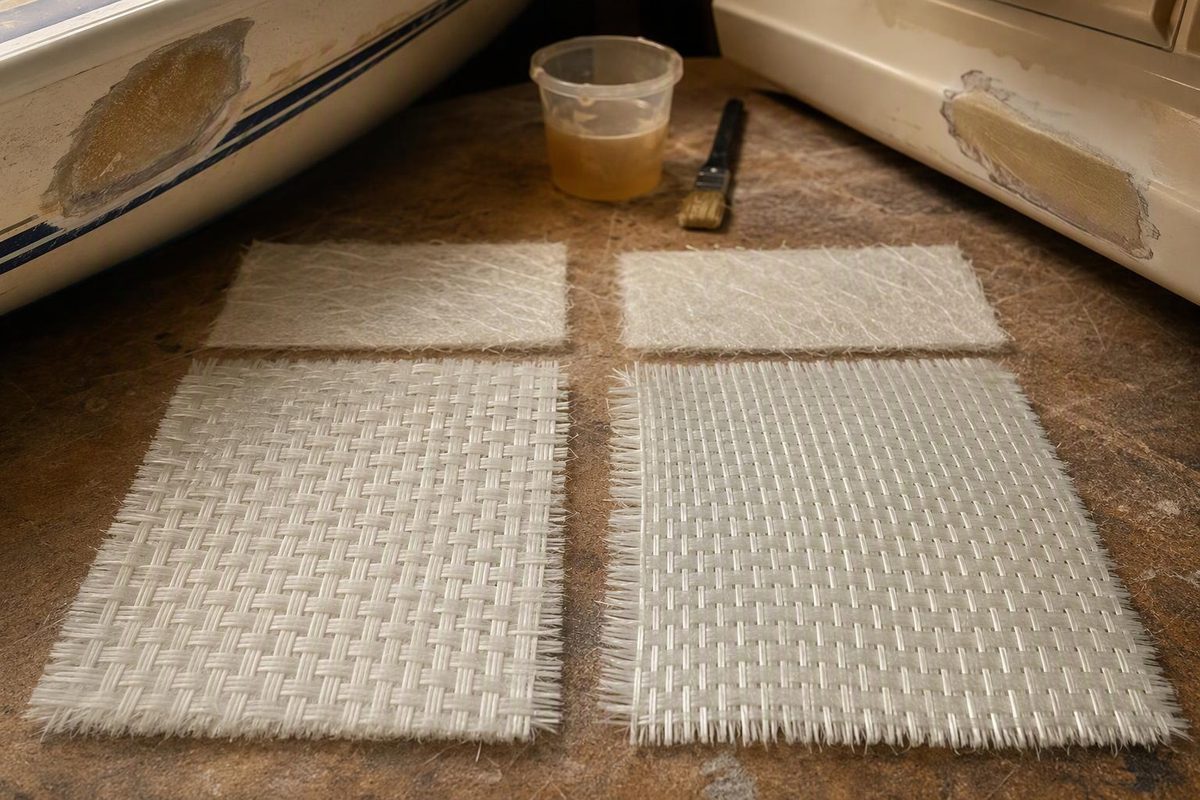
Biaxial fiberglass cloth is stitched reinforcement with continuous glass fibers running in two directions. For a repair, choose it by fiber orientation, mat backing and compatibility with your resin—not by the word “biaxial” alone.
A no-mat fabric may suit a laminate where extra backing thickness is unnecessary. Mat-backed 1708 builds thickness faster, but it is not automatically stronger or required for every boat repair.
What makes biaxial different from woven cloth?
In ordinary woven cloth, yarns pass over and under one another. In stitched biaxial fabric, two layers of yarns lie on top of one another and are held together by stitching. This avoids the bends, or crimp, created by weaving.
Common double-bias fabric has fibers at +45° and −45° to the roll edge. Other biaxial products use 0°/90° orientation, so “biaxial” does not always mean diagonal fibers. WEST SYSTEM describes its ±45° fabrics as conformable reinforcement for repairs, while U.S. Composites also lists a 0°/90° mat-backed product. WEST SYSTEM fabric guidance; U.S. Composites specifications.
That orientation remains important after cutting. Mark the roll direction on your dry pieces and follow the repair’s specified fiber directions. A structural laminate may require other orientations or fabric types; do not replace its entire reinforcement schedule with ±45° cloth just because it handles well.
Read the product number—and the actual specification
These are common constructions, not guarantees that every supplier uses identical weights:
| Fabric designation | Typical construction | What to check |
|---|---|---|
| 1700 / 17 oz no-mat biaxial | Approximately 17 oz/yd² continuous fibers, commonly ±45°, without chopped-strand backing | Actual weight, orientation and resin approval |
| 1708 | Approximately 17 oz/yd² ±45° reinforcement plus chopped-strand mat | Mat weight, total weight and binder compatibility |
| 1208 | Approximately 12 oz/yd² ±45° reinforcement plus mat | Whether the lighter fabric fits the contour and repair schedule |
| 1808 | Often approximately 18 oz/yd² 0°/90° reinforcement plus mat | Confirm orientation rather than assuming ±45° |
U.S. Composites lists these mat-backed constructions and a 17 oz no-mat fabric. Vectorply’s E-BX 1700 datasheet, revised June 16, 2015, lists no chopped mat and a reinforcement weight of 18.14 oz/yd², excluding polyester stitching. That illustrates why a product name is not a precise weight certificate; confirm the current specification before ordering. U.S. Composites specifications; Vectorply E-BX 1700 datasheet.
Watch the units. Continuous-fiber cloth is commonly specified in ounces per square yard, while mat may be specified in ounces per square foot. WEST SYSTEM’s 738 combines 17 oz/yd² biaxial with 0.75 oz/ft² mat. One square yard contains nine square feet, so the mat adds 6.75 oz/yd², giving approximately 23.8 oz/yd² total. Do not add those two weights without converting units. WEST SYSTEM product specifications.
Does 1708 work with epoxy?
Some 1708 does; verify the exact product. Conventional chopped-strand mat can contain a binder unsuitable for epoxy. Stitched mat-backed fabrics can avoid that problem.
WEST SYSTEM states that the mat on its 738 fabric is stitched and does not have the incompatible-binder issue. U.S. Composites expressly lists its stitched mat-backed fabrics as compatible with epoxy, polyester and vinyl ester. Those approvals apply to those products—not every roll sold as 1708. WEST SYSTEM fabric guidance; U.S. Composites compatibility information.
In WEST SYSTEM’s 738, the mat’s stated purpose is to add thickness per layer. The manufacturer notes that 738 is slightly weaker per unit thickness than its no-mat 737 because the chopped-strand portion lacks continuous fibers. That does not make mat-backed fabric unsuitable; it means thickness and continuous-fiber content are different comparisons. WEST SYSTEM’s explanation of 737 and 738.
For more on the binder distinction, see fiberglass with epoxy resin.
Plan the laminate before mixing resin
-
Establish what needs repair. A cosmetic surface defect does not by itself justify adding structural fabric. Stop before layup if the panel moves unexpectedly, the core is wet or deteriorated, or the load-bearing repair schedule is uncertain. Cloth selection does not resolve failed support or core damage. For a hull, start with boat hull construction and damage assessment. WEST SYSTEM treats damaged skins and damaged cores as separate repair tasks. Boat repair manual, Sections 4–5.
-
Check thickness, not just layer count. WEST SYSTEM reports average hand-layup thicknesses of 0.035 inch per layer for its 17 oz no-mat biaxial and 0.042 inch for its mat-backed fabric. These are product-specific planning figures, not universal cured thicknesses or complete structural schedules. Use the actual fabric data and the repair specification. Laminate thickness guidance.
-
Dry-fit every piece. Confirm direction, coverage and contact around curves before mixing. For corner tabbing—the glass joining a panel or structural member to a hull—follow the specified fillet and overlap details. Do not let fabric bridge above the corner. WEST SYSTEM’s sole-to-hull procedure uses a fillet beneath biaxial tape. Boat repair manual, Section 6.1.3.
-
Prepare, wet out and cure as one system. For epoxy bonding to cured laminate, surfaces should be clean, dry and abraded. Remove any amine blush from cured epoxy with water and an abrasive pad before sanding; partially cured epoxy may allow recoating without sanding under the resin manufacturer’s instructions. Saturate each fabric layer and remove trapped air and excess resin without creating dry spots. Follow your resin’s mix ratio, working-temperature limits, recoat window and return-to-service cure requirements. Surface preparation; Boat repair manual, Sections 4.3 and 16.
Use resin-appropriate gloves, eye protection, protective clothing, ventilation and sanding-dust controls. Check the resin and hardener safety data sheets for the required protection. Epoxy safety guidance.
Biaxial is reinforcement, not a finished surface. Where a smoother finish is needed, a repair specification may combine it with lighter woven cloth and fairing. WEST SYSTEM fabric guidance. For a tub, shower pan or door, first confirm the substrate and approved repair system rather than transferring a marine layup unchanged. Compare other reinforcement options in fiberglass cloth: weight, weave and format.