
Epoxy Glue: Choose and Use It for Fiberglass Bonds
Choose epoxy glue for fiberglass by surface, gap, movement and water exposure. Compare adhesive formats and follow a practical bonding sequence.
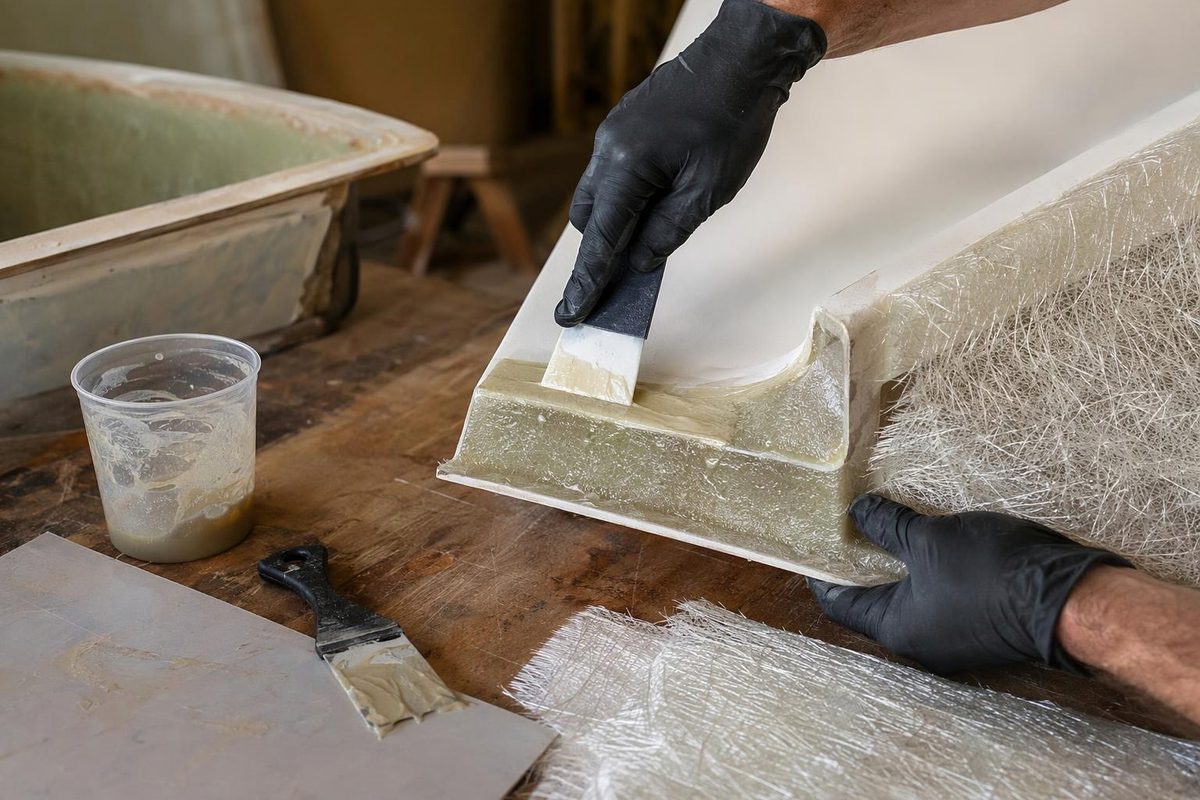
For bonding sound fiberglass parts, choose an epoxy adhesive that names both materials, suits the joint gap and gives you enough assembly time. A five-minute set can help with a small, simple repair; it can become a problem when several parts need positioning.
Epoxy glue is commonly a two-part adhesive: resin and hardener react after mixing. Products differ in consistency, toughness, water resistance and cure schedule. The word epoxy alone does not establish suitability for your repair.
First decide whether glue is the right repair
Bonding a loose trim piece to an intact fiberglass panel is an adhesive task. Restoring a cracked hull skin is not simply the same task with stronger glue.
In a fiberglass boat laminate, the fibers carry most structural loads. Repairing broken reinforcement requires restoring that load path, not merely filling the crack with adhesive. WEST SYSTEM’s fiberglass repair manual makes this distinction explicit.
Stop at damage assessment if the panel flexes unexpectedly, reinforcement is broken, a core is wet or soft, or a hull’s integrity is uncertain. A glue-only repair is not an adequate default. For repairs requiring reinforcement, start with fiberglass patch-kit planning.
Choose the adhesive format and properties
These manufacturer specifications illustrate different choices—not a ranking of bond strength.
| Adhesive example | When its format is useful | Published timing |
|---|---|---|
| Gorilla Epoxy, clear | Small, simple bonds where a clear finish matters; the manufacturer lists fiberglass among supported materials | Apply within 5 minutes; full cure in 24 hours |
| WEST SYSTEM Six10 | Gap-filling structural adhesive in a self-metering cartridge with static mixer; dispenses through a standard caulking gun | 42-minute working time; full cure in 1–4 days at 72°F |
| WEST SYSTEM G/flex 655 | Non-sag, toughened adhesive for joints exposed to expansion, contraction, shock or vibration | 75-minute working time; full cure in 24 hours at 72°F |
Before buying, check four things:
- Both surfaces. Fiberglass compatibility does not establish compatibility with the other part. Gorilla’s clear epoxy, for example, is not recommended for polyethylene or polypropylene. Identify an unknown plastic before committing to a bond.
- Gap and orientation. A thickened, non-sag adhesive helps keep material in a vertical joint. “Gap-filling” is not permission to bridge any distance: check the product’s permitted bond-line thickness and application method.
- Movement. A toughened adhesive is not a flexible sealant. WEST SYSTEM describes G/flex 655 as more flexible than standard epoxies yet much stiffer than adhesive sealants.
- Exposure. Distinguish occasional splashes, continuous immersion and application to a wet surface. Gorilla labels its clear epoxy water-resistant. Do not treat that as approval for an immersed repair; seek explicit instructions for your exposure conditions.
For a fiberglass-to-metal joint, use the separate guide to adhesive selection and metal preparation.
A practical bonding sequence
Work with ventilation, eye protection, protective clothing and gloves suited to the product’s safety data sheet. Avoid skin contact with uncured resin and hardener; never use solvents to clean epoxy from skin. When sanding epoxy, control dust and use appropriate respiratory protection. See WEST SYSTEM’s epoxy safety guidance.
-
Dry-fit before mixing. Confirm that the parts mate properly and can be held without movement. Arrange clamps, tape or supports now. Bond strength depends on adequate joint area as well as adhesive strength and preparation; a tiny contact area does not become a sound joint merely by using stronger glue. See bonding and clamping guidance.
-
Prepare sound surfaces. Remove wax, grease and other contamination before sanding. Remove loose or failing coatings. For cured polyester laminates, WEST SYSTEM specifies cleaning contamination and sanding with 80-grit paper to a dull finish. Remove dust and let the surface dry. On cured epoxy, wash off any amine blush with clean water and an abrasive pad before sanding. Use cleaners compatible with the substrate, following the adhesive maker’s surface-preparation instructions.
-
Meter and mix exactly as instructed. A dual syringe does not necessarily mix its contents: Gorilla’s syringe dispenses separate components for hand mixing, while Six10 uses a static mixer. Do not assume every epoxy uses equal parts, or add extra hardener to accelerate cure. Thorough mixing and the specified ratio are essential; see resin and hardener measurement and WEST SYSTEM’s mixing instructions. Mix only what you can apply promptly: larger batches build heat and cure faster.
-
Apply within the working window and secure the joint. Follow any product-specific wet-out or pre-coating requirement, particularly for porous surfaces. Do not confuse working time with pot life—the time available in a mixing container. G/flex 655 lists a 45-minute pot life alongside its 75-minute working time. Use enough adhesive to contact both surfaces and fill the intended gap. Hold the parts still, but do not squeeze the joint dry. WEST SYSTEM recommends just enough clamping pressure to produce a small amount of squeeze-out in its bonding procedure.
-
Wait for the required cure—not just the set. Initial set is not readiness for service. Gorilla’s five-minute epoxy still requires 24 hours before significant stress or weight. Follow the selected product’s temperature, clamp-removal and return-to-service instructions. If the adhesive remains soft or sticky beyond its stated schedule, do not load the repair or hide it under a finish.