
Glue for Fiberglass to Metal: Choose and Prepare the Bond
Choose an adhesive for fiberglass-to-metal joints, prepare steel or aluminum correctly, and avoid weak bonds from contamination or overclamping.
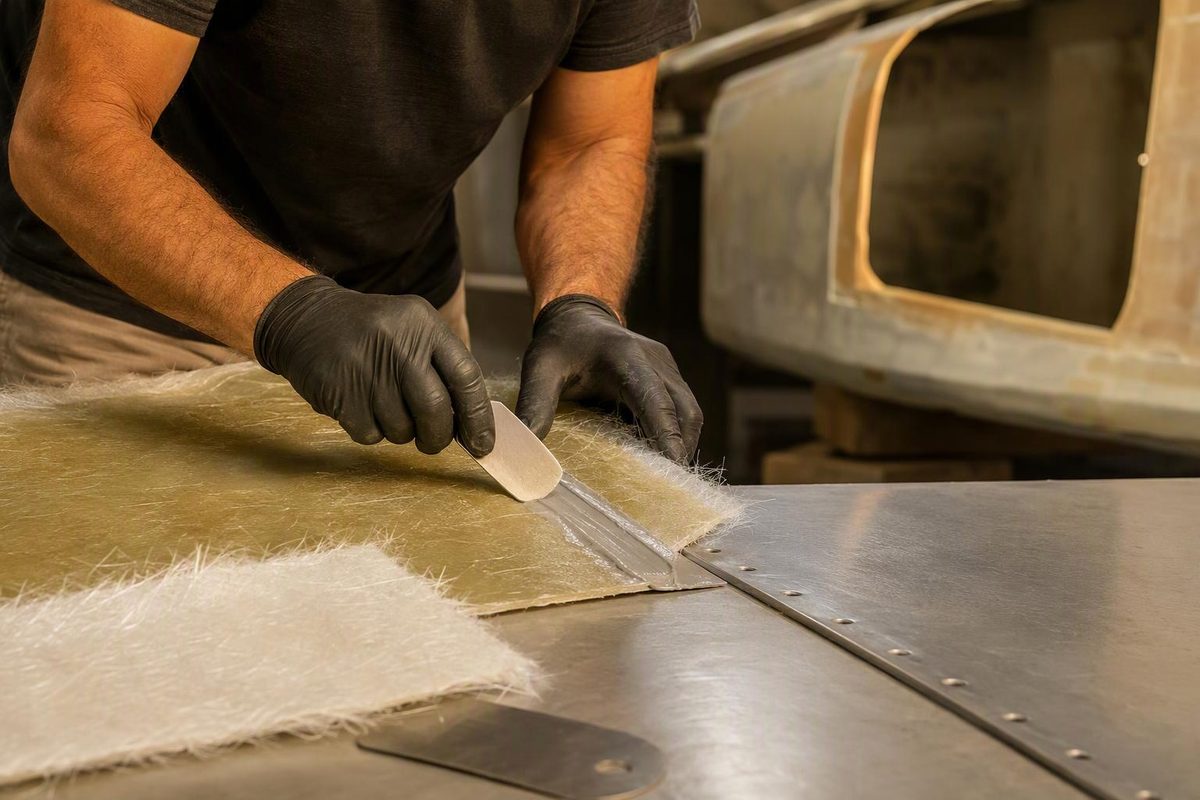
For a small fiberglass-to-metal joint that needs a strong, relatively stiff bond, start with a toughened two-part epoxy explicitly rated for both materials. A non-sag adhesive is convenient when the surfaces are uneven or vertical. WEST SYSTEM G/flex 655 is one documented example: its manufacturer specifies permanent waterproof bonding to fiberglass and metals, with toughness intended to accommodate expansion, contraction, shock and vibration. That makes it a candidate—not proof that a particular bracket or fitting is safe to glue in place. G/flex 655 specifications
This guide concerns bonding cured fiberglass to a metal part, not choosing resin for a new fiberglass layup.
Choose by what the joint must do
| Joint requirement | Adhesive to consider | Check before buying |
|---|---|---|
| Strong, relatively stiff attachment with some shock or vibration | Toughened two-part epoxy rated for fiberglass and the metal | Surface preparation, gap capacity, cure temperature and service exposure |
| Production panel, reinforcement or bracket bonding | Structural methacrylate adhesive, also called MMA | Exact substrate approval, metal pretreatment, dispensing equipment and assembly time |
| Flexible, watertight bedding or sealing around hardware | Marine adhesive sealant approved for both surfaces | Required holding strength, immersion approval and whether later removal is needed |
G/flex 655 is pre-thickened and non-sagging; G/flex 650 is a liquid that can be modified with approved fillers. Do not substitute an easy-sanding fairing putty just because it contains epoxy—see the distinction between fairing and structural adhesive fillers. G/flex 650 specifications
MMA is a genuine structural alternative, but it is not automatically easier for a one-off repair. For example, the manufacturer’s Plexus MA300 datasheet specifies only 3–6 minutes of working time, recommends PC120 Cleaner Conditioner on metal, and labels the product for industrial use. “Minimal preparation” still does not mean bonding over dirt or uncontrolled oxidation. MA300 technical datasheet
For flexible marine joints, 3M distinguishes permanent 5200 bonds from medium-strength 4200 FC joints that permit disassembly. Choose deliberately: a permanent adhesive sealant is not a convenient default for hardware that will need servicing. Nor does its ability to seal a fitting establish that it can replace the fitting’s fasteners. 3M marine adhesive-sealant guide
Do not assume ordinary polyester laminating resin is suitable glue for this joint. Look for explicit adhesive approval for the cured fiberglass, metal and intended exposure.
Check the surfaces and attachment first
Identify the metal and what actually covers it: bare steel, aluminum, galvanizing, paint, powder coating or another treatment. A bond to paint depends on the paint staying attached. Do not apply bare-metal instructions indiscriminately to a protective coating; obtain a preparation procedure for that surface.
On the fiberglass side, inspect for loose finish, cracking, soft laminate or delamination. Adhesive cannot make an unsound bonding surface sound. WEST SYSTEM requires solid surfaces and removal of flaking, chalking or blistered coatings before epoxy bonding. If the bonding surface is cured epoxy, wash off any amine blush with clean water and an abrasive pad, then dry before sanding; a solvent wipe is not a substitute. Surface-preparation guidance
Stop before a glue-only repair if failure could affect hull integrity, steering, lifting, propulsion or a person’s support. Those attachments need a specified joint design, including any backing or fasteners. Adhesive strength alone is insufficient: joint area and adhesion also determine load transfer. Bonding and joint-area guidance
Bonding sequence for a small G/flex 655 joint
These steps are specific to this adhesive. Use another product’s own instructions rather than transferring its grit, primer or cure schedule.
Wear suitable chemical-resistant gloves and eye protection, provide ventilation, and control sanding dust. Follow the adhesive and cleaner safety data; never clean epoxy from skin with solvent. WEST SYSTEM safety guidance
- Dry-fit and arrange the holding method. Confirm contact area and fit before mixing. Have clamps, supports and application tools ready.
- Clean before sanding. Remove grease, wax and mold release with a suitable cleaner. For solvent cleaning, use plain white paper towels and wipe off while wet with fresh towels. Let the solvent evaporate completely.
- Prepare the fiberglass. Remove soft or loose surface material and abrade smooth bonding surfaces. The G/flex instructions specify 80-grit for smooth, nonporous surfaces. Remove dust; avoid touching the prepared area with bare fingers.
- Prepare the metal using the product-specific method. For bare metal, G/flex 655 instructions call for sanding or grit-blasting to bright metal, cleaning with acetone or lacquer thinner using white paper towels, and allowing the surface to dry completely. Confirm the preparation procedure for coated, plated or otherwise unfamiliar metal before proceeding.
- Mix and apply. Mix equal volumes of G/flex 655 resin and hardener thoroughly. Apply a thin adhesive coat to the prepared metal and immediately scrub through it with sandpaper or a fine wire brush. The guide also gives this wet-epoxy abrasion method as an alternative for aluminum when its specified etch treatment is unavailable. Work adhesive onto both mating surfaces and use enough to fill the joint’s voids. At 72°F/22°C, the guide allows about 45 minutes to apply the mixture and up to 75 minutes to assemble and clamp after initial application.
- Hold without starving the joint. Apply only enough clamp pressure to produce a small squeeze-out. Do not squeeze the joint dry. Remove excess before it gels.
- Allow the specified cure. At 72°F/22°C, the guide gives 7–10 hours before clamp removal and moderate loading, and 24 hours before high loads. Cooler conditions slow curing; a hard surface is not permission to load early.
These preparation, mixing, clamping and cure steps come from the G/flex 655 handling instructions.
For an uncertain finish or metal treatment, make a trial bond on representative scrap before committing the part. A trial can reveal poor adhesion, but it does not validate a safety-critical attachment.