
Will Fiberglass Resin Bond to Plastic? Check Both Materials
Some epoxies bond to prepared plastics; polyester is not a safe default. Check ABS, PVC, polyethylene and other plastics before making a patch.
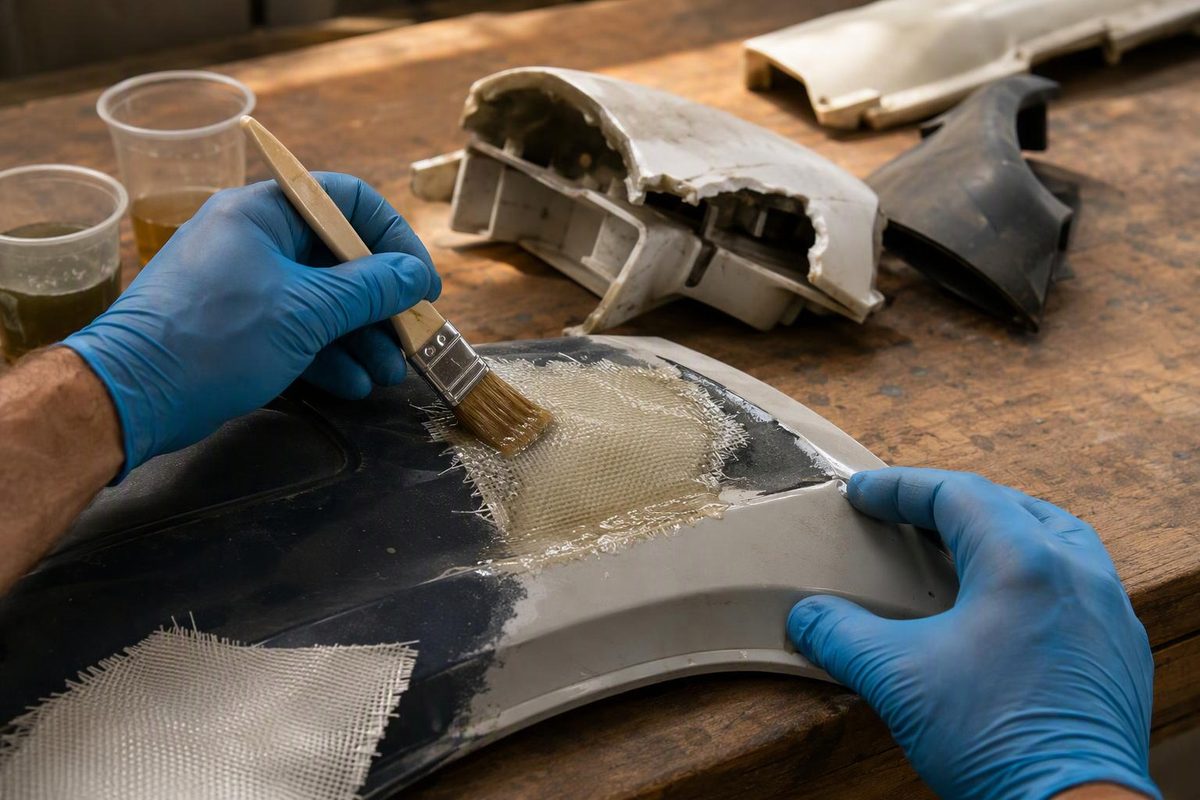
Yes, some fiberglass resins can bond to some plastics—but “fiberglass resin” is not a compatibility specification. Identify both the resin chemistry and the plastic before making a patch. A toughened epoxy with documented plastic-bonding instructions can be suitable; do not assume a polyester repair-kit resin will work.
For example, TotalBoat explicitly says its polyester resin is incompatible with ABS and will not stick. By contrast, WEST SYSTEM publishes adhesion data for its G/flex 655 epoxy adhesive on ABS, PVC, polyethylene and polycarbonate. Those results apply to that formulation and preparation—not every epoxy.
Glass cloth can reinforce the patch, but it cannot make an incompatible resin bond to the plastic underneath. G/flex 655 is an adhesive, not a blanket substitute for laminating resin, though its instructions permit use with lightweight fiberglass fabrics and tapes.
Identify the plastic before choosing resin
Look for a molded material marking such as ABS, PVC, PP, PE-HD or PC, then check the part manufacturer’s documentation. If the material is unknown, pause before sanding, solvent-wiping or heating it.
Use this table as a screening guide, not blanket approval for a repair:
| Plastic substrate | What the evidence supports | Practical decision |
|---|---|---|
| ABS | G/flex 655 has documented adhesion after specified preparation; TotalBoat polyester resin is expressly unsuitable. | Look for a plastic-compatible epoxy system rather than assuming polyester will work. |
| PVC | G/flex 655 has documented adhesion to prepared PVC. | Confirm the actual PVC grade and resin instructions; do not extend the result to every PVC product. |
| Polycarbonate / PC | G/flex 655 has documented adhesion after 80-grit sanding. | The instructions exclude polycarbonate from the alcohol-wipe step; do not use a generic solvent-prep routine. |
| Polyethylene / HDPE / LDPE | G/flex 655 instructions require flame treatment for good adhesion. | Sanding alone is not the prescribed preparation for this system. |
| Polypropylene / PP or acrylic / PMMA | G/flex’s developers report difficulty obtaining reliable bonds despite different preparation methods. | Seek a system specifically approved for the plastic, or a manufacturer-approved alternative repair. |
The epoxy entries come from WEST SYSTEM’s adhesion data, its plastic repair instructions, and the developers’ plastic-bonding tests. These are manufacturer results, not independent validation of your repair.
Hard-to-bond does not mean impossible to bond. For example, 3M describes a specialty acrylic adhesive that bonds many grades of PP and PE. That product is labeled for industrial/occupational use, not consumer use; it illustrates why the exact adhesive chemistry matters, rather than serving as a DIY shopping recommendation.
Prepare and test the actual combination
For a small, noncritical repair, use this sequence before committing to the full patch:
- Match the system to the job. Check suitability for the plastic, water exposure, operating temperature and expected movement. For help identifying resin chemistry, see choosing fiberglass resin by surface and cure.
- Follow the plastic-specific cleaning instructions. Do not automatically copy acetone prep from a fiberglass repair. G/flex 655’s instructions specify isopropyl alcohol for plastics except polycarbonate.
- Abrade only as directed. The cited G/flex 655 instructions specify 80-grit sanding. That is a product-specific instruction, not a universal grit recommendation.
- Treat the surface only when the approved procedure calls for it. Flame treatment changes the plastic surface; it is not an attempt to melt the resin into it. Do not improvise torch treatment on unknown plastic or near flammable solvent or fuel. If you cannot carry out the specified treatment safely, stop and choose another repair route.
- Make a representative trial. Use scrap of the same plastic if available, with the intended cleaning, preparation, resin and reinforcement. Mix accurately and allow the manufacturer’s specified cure before stressing it. Follow the product’s safety instructions, including gloves, eye protection and ventilation.
A trial that peels away cleanly from the plastic is a reason to reject the combination. A trial that holds is useful screening, not proof of structural strength or long-term waterproof durability.
Check what the patch must withstand
Adhesion is only one part of a repair. WEST SYSTEM explains that bending and off-axis loads can create peel stress and substantially reduce assembly strength. Bond area, edge geometry and panel stiffness also affect plastic repair performance.
For a nonstructural cover, a compatible system and successful trial may justify proceeding. For a leaking boat hull, load-bearing fitting, or shower pan that moves underfoot, do not treat a hard, attached patch as evidence that the underlying problem is solved. Get a repair procedure covering the material, damage and support conditions before returning it to service.