
Fiberglass Resin Gallon Coverage and Buying Guide
Estimate fiberglass resin gallon coverage by cloth weight and area, then compare mixed yield, hardener, compatibility, working limits and shelf life.
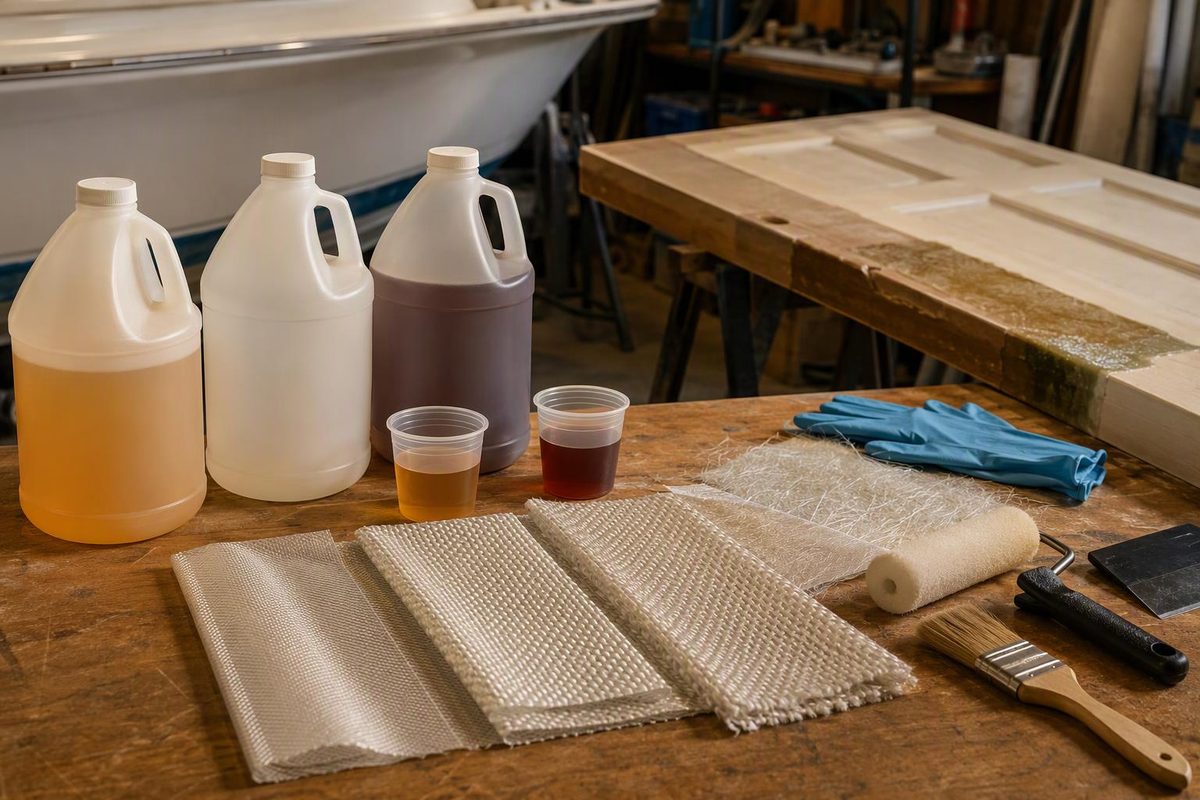
A mixed gallon of fiberglass resin covers about 80 square feet of 6-ounce cloth or 36 square feet of 23.8-ounce biaxial fabric with mat when the estimate includes wet-out, two fill coats and 15% waste. A gallon can cover more as a thin coating and less when saturating chopped-strand mat or sealing porous wood.
Enter the area and reinforcement for a single-layer mixed-epoxy estimate.
Single-Layer Mixed-Resin Estimator
For 80 sq ft of 6 oz cloth.
This estimate is for one fabric layer with two fill coats and 15% waste at approximately 72°F. Calculate multilayer laminates by reinforcement weight.
Published One-Gallon Coverage
| Reinforcement | Approx. area |
|---|---|
| 4 oz cloth | 91 sq ft |
| 6 oz cloth | 80 sq ft |
| 10 oz cloth | 62 sq ft |
| 17 oz biaxial | 46 sq ft |
| 23.8 oz biaxial with mat | 36 sq ft |
Source: WEST SYSTEM mixed-epoxy coverage guide; figures include wet-out, two fill coats and 15% waste.
A gallon is a package size, not necessarily the amount available after mixing. Before buying, identify the resin chemistry, check whether the stated volume includes hardener, and calculate the total weight of reinforcement to be saturated.
Check What “One Gallon” Includes
Polyester and epoxy packages are not directly comparable. One polyester example is sold as a gallon of base resin with a separate bottle of MEKP catalyst. That product permits 1–2.2% MEKP by weight, but both the acceptable percentage and catalyst strength are product-specific. Follow the label or technical data sheet rather than a generic drops-per-ounce rule.
The same unwaxed polyester laminating resin remains tacky at its exposed surface unless the final layer is isolated from air using the specified wax additive, PVA or compatible finishing resin (TotalBoat product data).
Epoxy resin and hardener are substantial separate components. A listing may describe:
- One gallon of resin, with hardener sold separately.
- A kit with a combined mixed yield of one gallon.
- A kit named for the resin-container size that produces more than one mixed gallon.
For example, WEST SYSTEM says its Group B 105 resin-and-hardener package produces 1.2 or 1.3 mixed gallons, depending on the hardener (WEST SYSTEM coverage guide). Compare the package’s mixed yield, not just its largest container.
Never assume epoxy ratios are interchangeable. WEST SYSTEM 105/205 uses a 5:1 resin-to-hardener ratio by volume, while System Three General Purpose uses 2:1. Their specified weight ratios also differ (WEST SYSTEM technical data, System Three product data). Match resin and hardener within the approved system. See how to match, measure and mix epoxy for measuring details.
Calculate Resin From Reinforcement Weight
Area alone cannot determine the resin requirement for a laminate. Use this sequence:
- Measure each patch or panel in square feet.
- Add the area of every ply. A 10-square-foot panel with three full layers has 30 square feet of total laminate area.
- Divide the total square feet by 9 to obtain square yards.
- Multiply the square yards by the fabric weight in ounces per square yard.
- Apply the resin-to-fiber ratio specified for the fabric, resin and process.
- Add resin for waste, overlaps, an absorbent substrate and any separate fill coats.
For woven cloth in a hand layup, a 1:1 resin-to-fiber ratio by weight is a useful initial estimate. TotalBoat’s calculator uses that general rule and recommends adding 10–15% for waste, overlaps and irregular shapes. It also notes that heavier or more open reinforcements consume more resin (TotalBoat resin calculator).
Convert the resulting resin weight to volume using the selected product’s density. Do not assume every epoxy or polyester system weighs the same per gallon.
Example With Two Plies of 6-Ounce Cloth
A 60-square-foot area covered with two plies of 6-ounce cloth has 120 square feet, or 13.33 square yards, of total cloth. The glass weighs about 80 ounces, or 5 pounds.
At a 1:1 starting ratio, allow 5 pounds of mixed resin for wet-out. Then add the applicable waste allowance and any resin needed to seal the substrate or fill the weave. Use the product’s stated density to convert that adjusted weight to gallons.
Chopped-Strand Mat Needs Its Own Estimate
U.S. Composites estimates that one linear yard of its 50-inch-wide, 1.5-ounce-per-square-foot mat requires about 36 ounces of resin. The company cautions that actual use varies with technique (U.S. Composites mat data).
Mat construction also affects compatibility. Conventional binder-held mat intended for polyester or vinyl ester may not suit epoxy, while the supplier identifies stitched mat as an epoxy-compatible alternative. Check the exact reinforcement specification before ordering. See using fiberglass with epoxy resin.
One Mixed Gallon Covers 36–91 Square Feet in Published Examples
WEST SYSTEM publishes the following approximate areas for one gallon of mixed epoxy. These figures include fabric wet-out, two fill coats and 15% waste at approximately 72°F. They are not wet-out-only figures.
| Reinforcement | Coverage Per Mixed Gallon |
|---|---|
| 4 oz cloth | 91 sq ft |
| 6 oz cloth | 80 sq ft |
| 10 oz cloth | 62 sq ft |
| 17 oz biaxial | 46 sq ft |
| 23.8 oz biaxial with mat | 36 sq ft |
The values are calculated from the manufacturer’s mixed-fluid-ounce requirement per square foot in the WEST SYSTEM coverage guide cited above. They show why a square-feet-per-gallon claim is incomplete without the fabric weight and coating schedule.
These figures are most useful for a single layer followed by the stated fill-coat schedule. For a multilayer laminate, calculate the reinforcement weight across all plies instead of multiplying a finished single-layer coverage figure without adjustment.
For thickness-only planning, the cited TotalBoat polyester product data lists theoretical coverage of 12.8 square feet per gallon at 1/8 inch, 25.7 square feet at 1/16 inch and 51.3 square feet at 1/32 inch, before waste. Those film figures do not predict a reinforced layup unless the glass content is also known.
Choose the Resin System Before the Quantity
A container labeled “fiberglass resin” is not automatically suitable for every repair. Confirm these project-specific points before selecting the package size.
Match the Substrate and Existing Laminate
A resin may exclude unknown composites, cured epoxy or other substrates. Follow its preparation and substrate instructions rather than assuming that all fiberglass surfaces accept the same chemistry. Compare the practical differences in polyester resin vs. epoxy resin.
For a repair over an existing laminate, identify the old resin where possible and remove contamination, oxidation and damaged material as required by the selected system.
Confirm Reinforcement Compatibility
Check whether the cloth, conventional mat or stitched fabric is approved for the resin. This is especially relevant when moving from polyester or vinyl ester to epoxy because some mat binders do not dissolve or wet out as intended in epoxy.
Plan the Final Surface
Unwaxed polyester laminating resin requires the manufacturer’s specified air-excluding final-cure method. For epoxy, follow the system instructions for recoating, blush removal and sanding. The resin needed for fill coats or a final surface layer belongs in the quantity estimate.
Divide the Gallon Into Manageable Batches
Cure accelerates with warmth and resin mass. According to TotalBoat’s instructions, a cup of catalyzed polyester can reach 200–300°F while curing (TotalBoat technical instructions). Do not catalyze the entire gallon unless the product instructions and job genuinely support a batch that large.
Working time depends on the specific resin, hardener or catalyst level, ambient temperature and batch shape. The draft source set does not provide one universal working-time figure, so use the selected product’s data sheet.
Check Shelf Life Before Buying Extra
The cited TotalBoat polyester product lists a shelf life of six months from manufacture. Other systems differ. WEST SYSTEM says properly stored 105 resin and hardeners can remain usable for many years, according to the technical data cited above.
That difference makes surplus buying system-specific. Check the manufacture date, storage requirements and product data before ordering more than the job requires.
Treat Safety Requirements as Product-Specific
Read the safety data sheet and use the controls and protective equipment specified for the chosen resin, hardener or catalyst. NIOSH notes that uncured resin components can be hazardous, glove material must suit the chemistry, eye protection is appropriate where splashing is possible, and odor does not reliably indicate whether exposure is safe (CDC/NIOSH guidance).
For a structural hull, deck or load-bearing panel, the required quantity follows the repair design—not the container size. Resolve the laminate schedule, damage depth, core condition and resin history before ordering material.