
Polyester Resin vs Epoxy Resin: Repair or Production?
For secondary repairs to cured polyester/fiberglass, the cited evidence favors the tested epoxy; polyester remains a lower-cost production option.
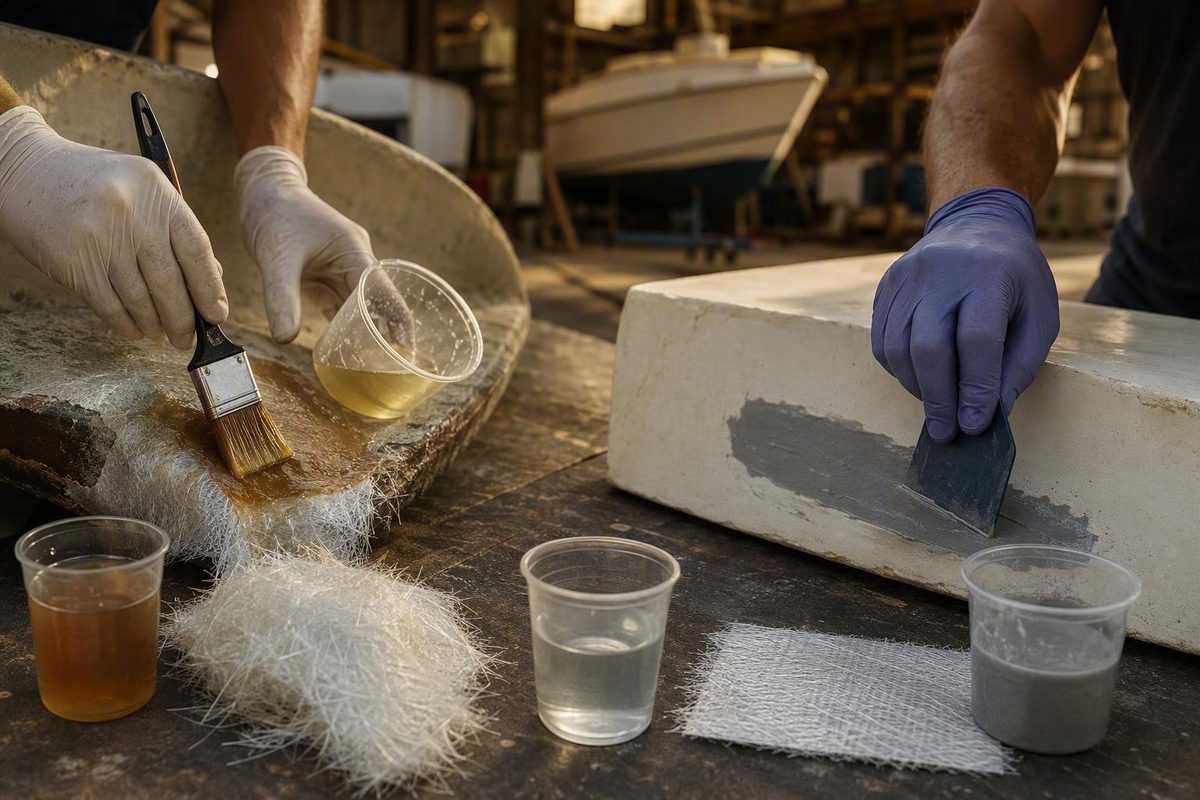
For a secondary repair to sound, properly prepared, cured polyester/fiberglass, the cited evidence favors the tested WEST SYSTEM epoxy over the DCPD polyester formulation evaluated. Polyester remains an established lower-cost material for compatible new-production laminates, but forming a new laminate is different from bonding a repair to one that has already cured. This is a qualified finding from one manufacturer-published comparison, not proof that every epoxy outperforms every polyester.
Quick verdict: epoxy for the cited repair case, polyester for economical production
Choose according to the bond and application:
- Repairing an existing cured polyester/fiberglass boat laminate: The tested WEST SYSTEM epoxy is the evidence-backed choice for the reported repair configuration. For another epoxy, confirm that its current documentation expressly permits secondary bonding to cured polyester.
- Making a compatible new fiberglass laminate: Polyester is an established production option. The source describes it as the lower-cost resin when combined with fiberglass reinforcement in production boatbuilding.
- Creating a thin adhesive bond: Use a product documented for thin-film secondary bonding. The general-purpose polyester discussed by the source was not presented as a reliable thin-film adhesive.
The key distinction is primary fabrication versus secondary repair. In new construction, resin and reinforcement form the laminate together. A later repair must adhere to an existing cured surface, making secondary-bonding performance central.
The manufacturer-affiliated comparison recommends WEST SYSTEM epoxy for this repair case. It also characterizes the evaluated general-purpose polyester as air-inhibited and generally requiring a thickness of approximately 15–25 mil for reliable cure rather than functioning reliably as a thin-film adhesive. Those statements apply to the products and context discussed, not every formulation in either resin family (Epoxyworks’ polyester-versus-epoxy technical article).
Polyester vs epoxy at a glance
| Decision point | Better-supported direction | Important limitation |
|---|---|---|
| Cured-laminate repair | Tested WEST SYSTEM epoxy | Requires a sound, properly prepared substrate |
| Economical production layup | Compatible polyester system | The source addresses material cost, not current installed cost |
| Thin-film bonding | Product designed for secondary bonding | Do not generalize the finding to every epoxy |
| Substrate range | Cited WEST SYSTEM epoxy reports broader compatibility | Verify the exact product and substrate |
| Evidence base | Tested epoxy performed better | One epoxy system and one polyester formulation |
The source attributes several repair advantages to WEST SYSTEM epoxy: stronger secondary adhesion, reliable thin-film cure, lower shrinkage, greater elongation, moisture resistance and compatibility with more substrates. These are manufacturer-specific claims rather than universal epoxy specifications.
Likewise, the reported air inhibition and 15–25 mil guidance concern the general-purpose polyester described in the comparison. They do not establish that every polyester formulation behaves identically.
Before purchasing either resin, read the current technical data sheet for the exact resin, hardener or catalyst. Verify substrate and reinforcement compatibility, permitted bond-line or laminate conditions, working characteristics, cure requirements and finishing instructions. A broad chemistry label is not a substitute for product-specific documentation.
Why an existing laminate changes the decision
A new laminate and a repair patch may use similar fiberglass reinforcement, but their interfaces differ. Once that laminate has cured, a later patch depends on secondary adhesion to the existing surface.
A product documented to cure and adhere under those conditions is therefore a more defensible choice than one intended primarily for thicker laminating applications.
The cited guidance says WEST SYSTEM epoxy adheres to properly prepared cured polyester, as well as properly prepared wood, metals, cured vinylester, cured epoxy laminates and graphite fibers.
For that reason, the fact that a boat was originally built with polyester does not settle the repair decision. Polyester can remain appropriate within a compatible production or repair process, but secondary bonding to an existing surface presents a different problem from forming the original laminate.
What the reported strength test does—and does not—show
The principal comparison comes from a manufacturer-published article written by GBI Technical Advisor Tom Pawlak in 2004. The test used a cured DCPD polyester/fiberglass laminate, fresh 80-grit preparation, stitched 2315 triaxial fiberglass with mat, and a 12:1 repair bevel. The undamaged control averaged 26,198 psi in tensile strength. The DCPD polyester repair averaged 18,460 psi, or 70.5% of control, while the WEST SYSTEM epoxy repair averaged 21,404 psi, or 81.7% of control. The epoxy result was therefore 11.2 percentage points higher in retained control strength (reported test method and results).
This is directional, product-specific evidence for the tested configuration. It does not establish that every epoxy repair will retain the same proportion of original laminate strength or that every polyester repair will produce the reported result.
The article does not provide the sample count, specimen-to-specimen variability, statistical significance, complete conditioning details or independent replication. It also does not compare multiple current formulations from competing manufacturers. The supportable conclusion is narrow: the tested WEST SYSTEM epoxy performed better than the tested DCPD polyester in that particular secondary-repair configuration.
The setup also shows that resin was only one variable. Both repairs used specified reinforcement, fresh abrasion and defined bevel geometry. Different materials, preparation or geometry could produce different results.
A practical resin-selection matrix
| Task | Better-supported starting point | Checks before purchase |
|---|---|---|
| Secondary patch on sound cured polyester/fiberglass | Tested WEST SYSTEM epoxy, or another system expressly documented for the application | Confirm substrate preparation, reinforcement and service conditions |
| Compatible new fiberglass laminate | Polyester laminating resin as an established option | Check process, reinforcement, cure schedule and finish |
| Thin adhesive bond | Product designed for secondary bonding | Verify substrates and permitted bond-line conditions |
| Casting, artwork, flooring, countertops or specialized coating | Application-specific comparison | This boat-repair test does not establish a winner |
| Structural or safety-critical repair | Stop and verify the complete repair system | Confirm geometry, laminate schedule, access and need for professional assessment |
“Epoxy” alone is too broad a shopping specification. For a cured polyester/fiberglass repair, select a system whose current documents expressly cover the substrate and intended application.
Polyester is not excluded from all repairs or fabrication. It remains an established option where the selected product, laminate, process and finishing system are compatible. The available evidence simply does not show that its production advantages transfer automatically to a thin secondary bond on an existing cured surface.
Nor does this comparison establish that either resin is suitable for every hull, below-waterline area or load-bearing repair. If damage involves a core, stringer, bulkhead or another structural component—or if the cause or extent of damage is uncertain—the resin should be selected only as part of a complete repair assessment.
Preparation and product instructions still determine the result
The reported test used fresh abrasion, a defined bevel and specified reinforcement in addition to the selected resin. Its 80-grit preparation and 12:1 bevel describe that test specimen; they are not universal repair instructions or guarantees of strength.
Before mixing resin, confirm:
- Substrate condition: Identify and remove material that cannot support the repair.
- Resin compatibility: Check the exact resin and hardener or catalyst against the cured substrate.
- Surface preparation: Follow current instructions for exposed laminate, gelcoat, coatings and possible contamination.
- Reinforcement and geometry: Use the required glass type, orientation, overlap, taper and laminate thickness.
- Mix measurement: Follow the specified resin-to-hardener ratio or catalyst range and mixing procedure.
- Cure conditions: Maintain the product’s stated requirements for temperature, time, thickness and recoating.
- Finishing compatibility: Verify the proposed filler, primer, gelcoat or paint system before beginning.
- Handling requirements: Obtain and follow the current safety data sheet for every resin, hardener, catalyst, solvent and finishing product involved.
Current product documents should govern the work because the principal comparison dates from 2004 and formulations can differ. Chosen by task rather than reputation, the tested WEST SYSTEM epoxy has the stronger evidence for the reported secondary repair to properly prepared cured polyester/fiberglass, while polyester retains a practical role in compatible new-production laminates. The final result still depends on the exact product, substrate condition, preparation, reinforcement, geometry and adherence to current instructions.