
Fiber Glass Resin: Choose by Chemistry, Surface and Cure
Choose fiberglass resin by substrate, reinforcement, finish and cure. Check epoxy, polyester, vinyl ester and wax before starting a repair.
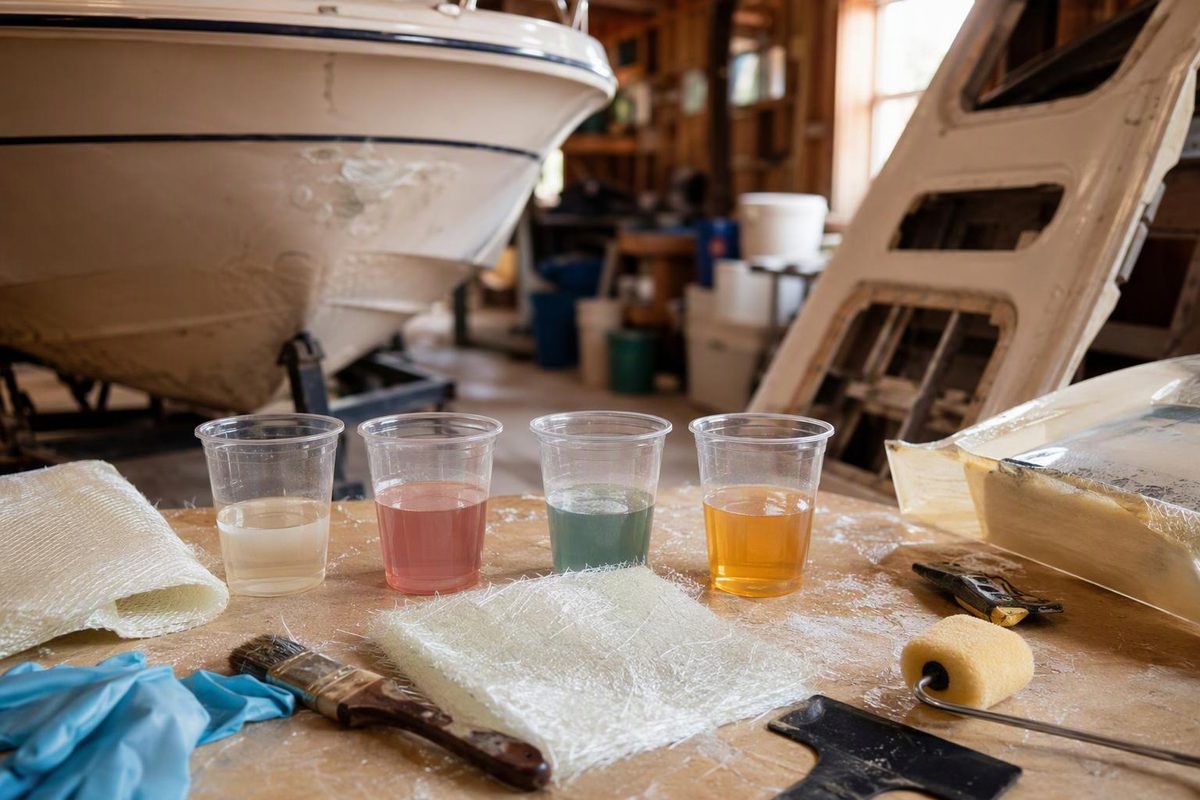
“Fiber glass resin,” more commonly written fiberglass resin, is not one chemistry. Polyester, epoxy and vinyl ester resins can all be used with glass reinforcement, but their mixing instructions and compatible surfaces differ. Buy by the technical data sheet—not just the words fiberglass resin on the can.
For a repair, answer four questions first: What surface will the resin bond to? Are fibers damaged? Which reinforcement will you use? What finish goes over it?
1. Decide whether you need resin and reinforcement
A chip confined to gelcoat may need a cosmetic repair rather than a fiberglass layup. Cracks extending into load-carrying fabric require a structural repair before refinishing; damaged or separated core material needs its own repair procedure. WEST SYSTEM’s boat-repair manual distinguishes these repairs by damage depth, not visible patch size. See its damage-assessment guidance.
Resin alone does not replace broken reinforcement. Most structural loads in a fiberglass laminate are carried by the fibers; resin supports them so they can carry and spread those loads. Pouring extra resin into a damaged area is not equivalent to rebuilding the glass layers. WEST SYSTEM explains laminate construction.
Stop and establish a structural repair plan if a hull repair involves stringers, a transom, wet core or uncertain load paths. If you cannot assess those elements, get qualified help before patching. Likewise, treat a shower-pan crack that moves underfoot as a support-and-damage diagnosis, not simply a resin purchase. Our fiberglass repair guide helps separate surface work from a laminate repair.
2. Match the resin to the bonding surface
Repairing cured fiberglass creates a secondary bond: new material must adhere to an already hardened surface. That is different from building a new part whose layers cure together.
| Resin type | When to consider it | Main compatibility check |
|---|---|---|
| Epoxy laminating/repair resin | Bonding reinforcement to sound, prepared cured fiberglass. WEST SYSTEM provides procedures for epoxy over cured polyester laminate. | Use a resin/hardener system intended for the job; confirm the finish and reinforcement are compatible. |
| Polyester resin | Compatible polyester layups and repairs covered by the product’s instructions, particularly within a polyester/gelcoat system. | Do not assume it bonds to epoxy or an unidentified composite. |
| Vinyl ester laminating resin | A specified fabrication or repair system calling for impact or corrosion-resistance properties. | Confirm the exact substrate, cure requirements and finish rather than treating it as interchangeable with polyester. |
These are application choices, not a universal strength ranking. WEST SYSTEM’s manual addresses epoxy secondary bonding; TotalBoat’s polyester instructions list acceptable and unacceptable substrates; Fiberglass Warehouse’s vinyl ester data sheet specifies that product’s intended applications and properties.
The polyester restrictions are worth reading carefully. TotalBoat permits its product over prepared cured polyester and previously gelcoated surfaces, but excludes unknown composites, cured or uncured epoxy, and vinyl ester. Those are that product’s restrictions, not proof that every polyester formulation behaves identically.
For a tub, shower pan or door, identify the actual exposed surface. Do not infer resin compatibility from a “fiberglass” product description if the repair will bond to a coating or plastic skin.
3. Check the reinforcement and the wax
Mat compatibility: Fiberglass Warehouse’s conventional chopped-strand mat uses a binder that needs styrene to dissolve; the supplier specifies polyester or vinyl ester and excludes epoxy. For epoxy, choose reinforcement explicitly approved for that resin—whether cloth, stitched fabric or an epoxy-compatible mat. See the supplier’s binder guidance and our chopped-strand mat selection guide.
Wax status: Unwaxed polyester laminating resin can harden while retaining a tacky air-exposed surface. That tack is useful between build layers. Finishing resin contains wax that rises to the surface and blocks air, allowing a tack-free cure. Follow the product’s final-layer method; do not diagnose all surface tack as a mixing failure. Before bonding to cured wax-containing material, remove wax and prepare the surface as instructed. TotalBoat explains laminating versus finishing resin.
4. Plan preparation, mixing and finishing before opening the cans
- Prepare sound material. Remove contamination before sanding. WEST SYSTEM requires clean, dry, sanded bonding surfaces and gives specific preparation for cured polyester laminate. Strong resin cannot compensate for a weak coating beneath it. Surface-preparation instructions.
- Use the correct curing component. Epoxy needs its approved hardener at the specified ratio; changing that ratio to speed cure is not acceptable. The polyester and vinyl ester products cited above use MEKP, with product-specific dosage limits—not epoxy hardener. Epoxy mixing guidance and polyester instructions.
- Control batch heat. Mix only what you can apply within the working time. Both epoxy and polyester generate heat during cure, and concentrated material left in a cup can become dangerously hot. Follow the product’s batch and thickness limits. WEST SYSTEM and TotalBoat describe this hazard.
- Choose the finish now. Epoxy exposed to sunlight needs UV protection. Gelcoat over epoxy is possible in some repair systems, but compatibility and preparation must be established for the actual products. Do not add an epoxy “barrier layer” beneath polyester merely on assumption. WEST SYSTEM’s finish guidance.
Before applying a non-epoxy finish over WEST SYSTEM epoxy, its instructions call for full cure, washing and sanding. If amine blush has formed, remove it with clean water and an abrasive pad—not solvent—before sanding. Follow your resin and coating manufacturers’ preparation instructions. See cured-epoxy preparation.
Before mixing, read the safety data sheets for both components and arrange ventilation, eye protection, suitable chemical-resistant gloves and dust protection for preparation work. A dust mask is not a substitute for vapor protection. Avoid skin contact with uncured epoxy and never clean epoxy off skin with solvent. Keep polyester resin away from ignition sources. WEST SYSTEM’s safety guidance and TotalBoat’s handling instructions cover these precautions.
Your shopping list should name the resin chemistry, matching hardener or catalyst, compatible reinforcement, final-layer method and finish. If one of those is still unknown, resolve it before committing to the repair.