
Chopped Strand Mat: Choose the Binder, Weight and Resin
Choose chopped strand mat by resin compatibility, binder and weight. Learn the oz/ft² trap, resin estimates and practical wet-out checks.
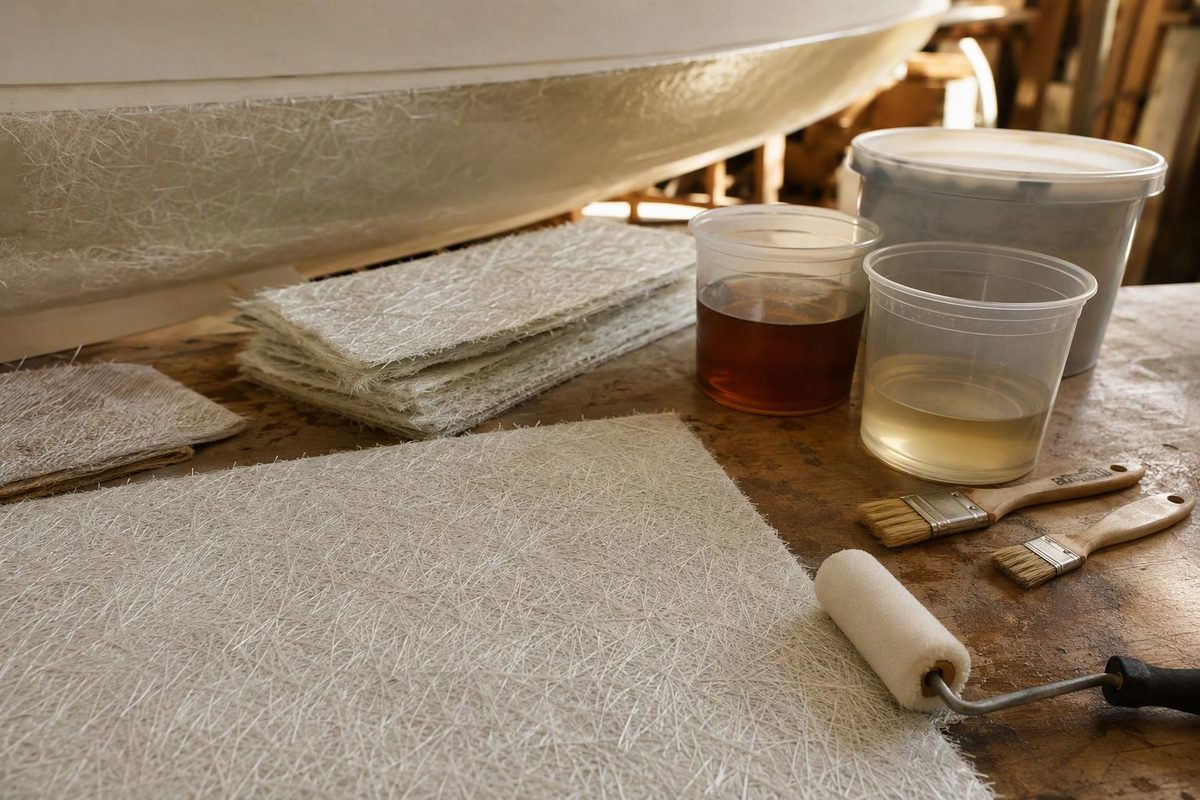
Chopped strand mat (CSM) is fiberglass reinforcement made from short, randomly oriented strands—not woven threads. It is useful for building laminate thickness and following contours with a compatible resin. Before buying it, check three things: the exact product’s resin compatibility, its weight per unit area, and whether mat belongs in the repair’s reinforcement schedule.
The strands are typically 1–2 inches long and held together by a binder. In conventional mat, styrene in polyester or vinyl ester resin dissolves that binder, allowing the mat to soften and drape. Epoxy does not dissolve the same binder. That distinction affects handling, but it does not mean every chopped strand mat is incompatible with epoxy. Epoxyworks explains the construction and binder behavior.
Match the exact mat to the resin
Use the product datasheet, not just a listing that says “fiberglass mat.”
- With polyester or vinyl ester: choose mat explicitly listed for that resin. Conventional emulsion-bound CSM commonly fits this use; Easy Composites’ 450 gsm mat, for example, is specified for both resins but not epoxy. Product specifications
- With epoxy: choose an explicitly epoxy-compatible mat, or suitable cloth or stitched reinforcement. Binder-free stitched mat is one option; Epoxyworks reports that it wets out readily and becomes flexible with epoxy. Stitched-mat guidance
- With an unidentified binder: pause before laminating. Ask the supplier for the product code and compatibility document.
“Powder-bound” alone is not an epoxy approval. 3B’s PM 3013 powder-bound mat is specified for polyester, vinyl ester and epoxy. In contrast, Fibre Glast’s #250/#1250 mat also uses a powdered polyester binder, but its datasheet restricts compatibility to polyester and vinyl ester. 3B datasheet · Fibre Glast datasheet
There is also a distinction between “can be wetted with epoxy” and “suitable for your job.” WEST SYSTEM’s technical article reports successful use and moisture testing of selected generic mats with its epoxy, while noting reduced flexibility and clarity. That does not establish suitability for every supplier’s mat or every structural repair. Follow the specification for the material you actually have. Read the testing and its limits, or see our guide to fiberglass with epoxy resin.
Read the weight units carefully
In the US, standalone mat is usually specified in ounces per square foot, while woven cloth and oriented fabrics are usually specified in ounces per square yard. Those units differ by a factor of nine. Epoxyworks’ weight explanation
| Mat weight | Equivalent oz/yd² | Approximate metric weight |
|---|---|---|
| 0.75 oz/ft² | 6.75 | 229 g/m² |
| 1 oz/ft² | 9 | 305 g/m² |
| 1.5 oz/ft² | 13.5 | 458 g/m² |
These are unit conversions, not strength ratings. A “1.5 oz mat” is not a lighter equivalent of “6 oz cloth.” Confirm the denominator before comparing products.
Also check roll width and whether the price buys a linear yard, linear meter or precut pack. Calculate usable area from width × length, then allow for your actual patch shapes, overlaps and offcuts.
Choose weight within a defined laminate schedule
CSM can be used alone or with cloth or woven roving, including for thickness buildup and between fabric layers. Fibre Glast’s mat datasheet
For a repair, thickness is only one requirement. The replacement laminate should account for the original reinforcement, ply orientation and thickness—not merely cover the hole with enough mat to look substantial. Manufacturer-specific repair instructions take priority. Composite repair principles
If the damage involves separated layers, a damaged core or unexplained movement, establish the repair scope before choosing a mat weight. For the broader reinforcement decision, use the cloth-versus-mat guide. The wet-out sequence below is not a structural repair design.
Estimate resin, then check wet-out
Mat can need substantially more resin than a cloth-based estimate suggests. For its 300 gsm powder-bound CSM, Easy Composites gives a typical hand-layup allowance of 2–2.5 times the dry glass weight in resin. That means one square meter containing 300 g of glass would need roughly 600–750 g of resin, before application losses. Treat this as a product-specific planning estimate, not a universal ratio. Resin allowance
For a noncritical layup using a compatible material system:
- Prepare and dry-fit first. Follow the repair system’s surface preparation, then size and arrange the reinforcement before mixing resin.
- Mix exactly as specified. Use the approved catalyst or hardener, ratio, batch size and temperature range.
- Wet the bonding surface and each layer. Work resin through the mat and consolidate with a suitable roller or squeegee to remove trapped air. Lamination guidance
- Stop for bridging or incomplete saturation. Do not bury a lifted corner or dry-looking bundle beneath the next layer. With epoxy, mat may remain less clear than cloth, so transparency alone is not a reliable acceptance check. Wet-out limitations
- Follow the specified cure and finishing schedule. Use the resin manufacturer’s instructions to determine when the laminate is ready for service—not surface hardness alone.
Control dust during cutting and sanding, protect eyes and skin, and follow both the mat and resin safety documents for ventilation and respiratory protection. The mat SDS addresses glass handling; it does not replace the resin’s precautions.