
Core Mat: What It Does and How to Choose It
Choose core mat by grade, thickness, resin and wet-out needs. Compare Coremat Xi and XM, estimate resin, and know when a repair needs a specified core.
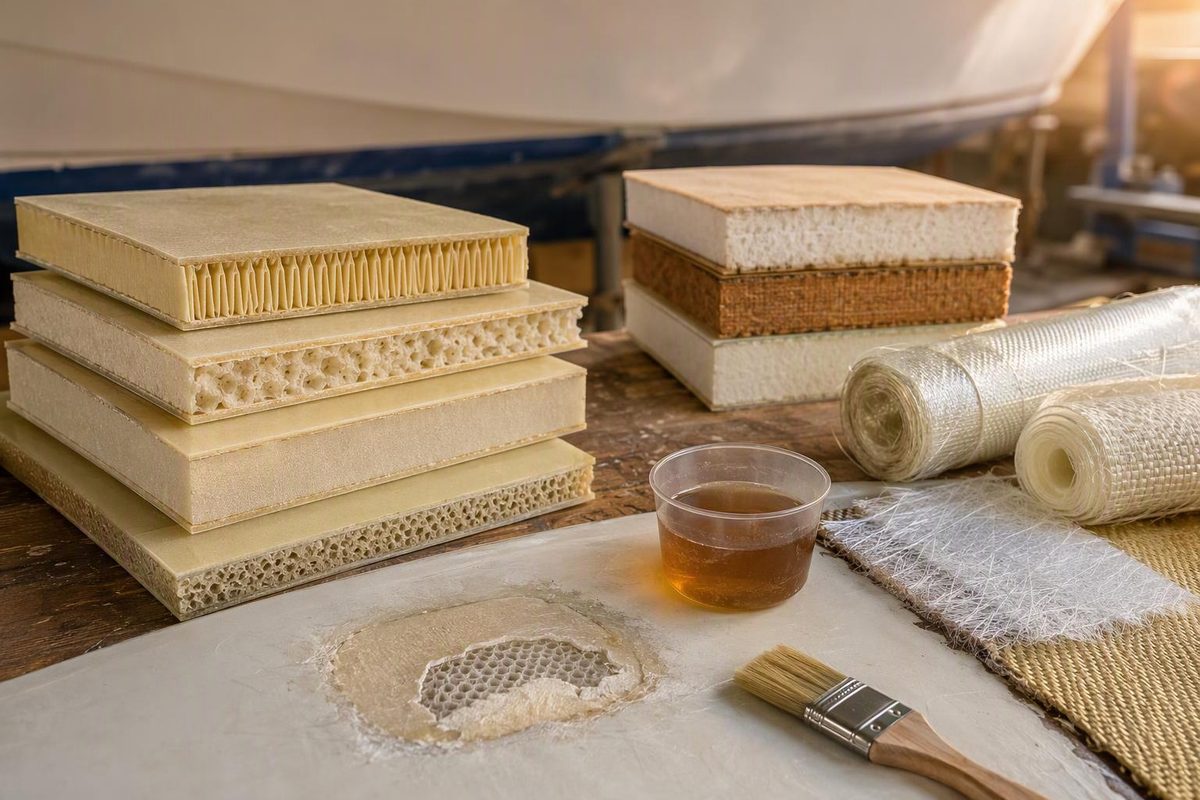
Core mat is a bulking layer that you impregnate with resin during layup to add thickness and stiffness to a fiberglass laminate. It does not replace the fiberglass reinforcement. For a repair, the first question is whether you need a thin laminate bulker at all—or must restore damaged glass skins and an existing structural core.
Lantor’s Coremat® is a specific product family made from polyester fleece containing microspheres. It is designed for open-mold processes such as hand layup and spray-up. The microspheres provide low-weight volume; the material can also help block reinforcement patterns from showing through the finish, known as print-through. Products sold simply as “core mat” should be checked against their own datasheets rather than assumed equivalent. Lantor’s product guide explains the branded grades.
Core mat, fiberglass mat and other cores are not interchangeable
- Core mat: Adds bulk within a specified laminate and can serve as a print-through barrier.
- Chopped-strand mat or fiberglass fabric: Provides glass reinforcement. Choose its construction and resin compatibility separately; see fiberglass cloth vs. mat.
- Balsa, foam or plywood core: Forms the core of a particular sandwich structure. Replacing it requires a repair plan that preserves the panel’s construction—not merely something that fills the gap.
In a cored boat panel, the glass skins carry tensile and compressive loads from bending, while the core supports and separates them. WEST SYSTEM’s repair manual recommends matching replacement core to the original material where possible, including its thickness and density. A 3 mm bulker is not a like-for-like replacement for a much thicker deck core. See the construction discussion and Section 5.2 of the repair manual.
If a deck is soft, a hull skin is separated from its core, or a transom has damaged plywood, stop before choosing material by price or roll thickness. Restore the damaged assembly to a suitable specification; seek qualified assessment when its load-bearing integrity is uncertain.
Coremat Xi vs. XM: check the binder, not just thickness
| Grade | Distinguishing feature | What to check before buying |
|---|---|---|
| Xi | Styrene-dissolvable binder and blue resin indicator; listed thickness range 1.4–5 mm | Whether your resin provides the wet flexibility needed for the shape |
| XM | Non-dissolvable binder and hexagonal cells; remains intact when impregnated; listed range 2–4 mm | Grade-specific resin uptake and fit around contours |
| XM10 | Separate 10 mm product developed for plywood-replacement applications | Application-specific suitability, especially loads and fasteners |
These distinctions come from Lantor’s product page. XM10’s intended use does not establish that it is a drop-in replacement for every boat transom or plywood panel.
Can you use core mat with epoxy?
Lantor’s Xi datasheet and XM datasheet list compatibility with polyester, vinyl ester, phenolic and epoxy resins. However, Xi’s binder dissolves in styrene-containing resin. That distinction matters when you need it to soften into a tight corner.
Do not translate “epoxy compatible” into “handles exactly as it does with polyester.” Confirm the grade with the supplier and make a small trial using your actual resin and intended contour. Check any accompanying glass mat independently; its binder may have different requirements. The guide to fiberglass with epoxy resin covers that separate compatibility issue.
Budget for resin uptake—not just the dry mat
Core mat needs resin impregnation. Its light dry weight is not its finished weight, and its resin requirement is additional to the glass skins.
The manufacturer’s published tables give these typical uptake values. Use them for planning, then check actual uptake with your chosen material and resin:
| Nominal thickness | Coremat Xi | Coremat XM |
|---|---|---|
| 2 mm | 1.2 kg/m² | 1.0 kg/m² |
| 3 mm | 1.8 kg/m² | 1.5 kg/m² |
| 4 mm | 2.4 kg/m² | 2.0 kg/m² |
Sources: Xi datasheet, version 1.1/July 2016 and XM datasheet, version 1.3/February 2020. Verify the sheet for the material supplied before ordering.
For example, budget about 0.9 kg of resin for 0.5 m² of 3 mm Xi, for the core mat alone:
0.5 m² × 1.8 kg/m² = 0.9 kg
Add the requirements for reinforcement, other laminate layers and working losses. Do not use this number as a mixing ratio, and do not convert kilograms to liters without the resin’s density.
Four checks before committing to a layup
- Define the job. A specified bulking or print-blocking layer is different from a cosmetic filler, a glass patch or replacement of damaged structural core.
- Confirm the whole material system. Record the core-mat grade, resin, reinforcement, layer order and required thickness. Resin compatibility with the mat alone does not establish suitability for bonding to the existing repair surface. For vacuum processing, obtain explicit approval rather than extrapolating from hand-layup instructions.
- Trial the fit and impregnation. Check that the material follows the shape without bridging. For Xi, the blue indicator helps identify dry spots, but Lantor explicitly says it does not guarantee sufficient resin content. Check resin uptake as well, and keep unused Xi out of direct sunlight in its original bag. Xi handling notice.
- Follow the resin’s cure requirements. Use its specified mixing ratio, working temperature, recoat window and cure time before loading or finishing. Core mat does not change those instructions; review resin and hardener matching before mixing.