
Chopped Fiberglass: Loose Strands, Fillers and Repair Limits
Learn when loose chopped fiberglass belongs in resin putty, how it differs from mat and milled fibers, and when a repair needs fabric reinforcement.
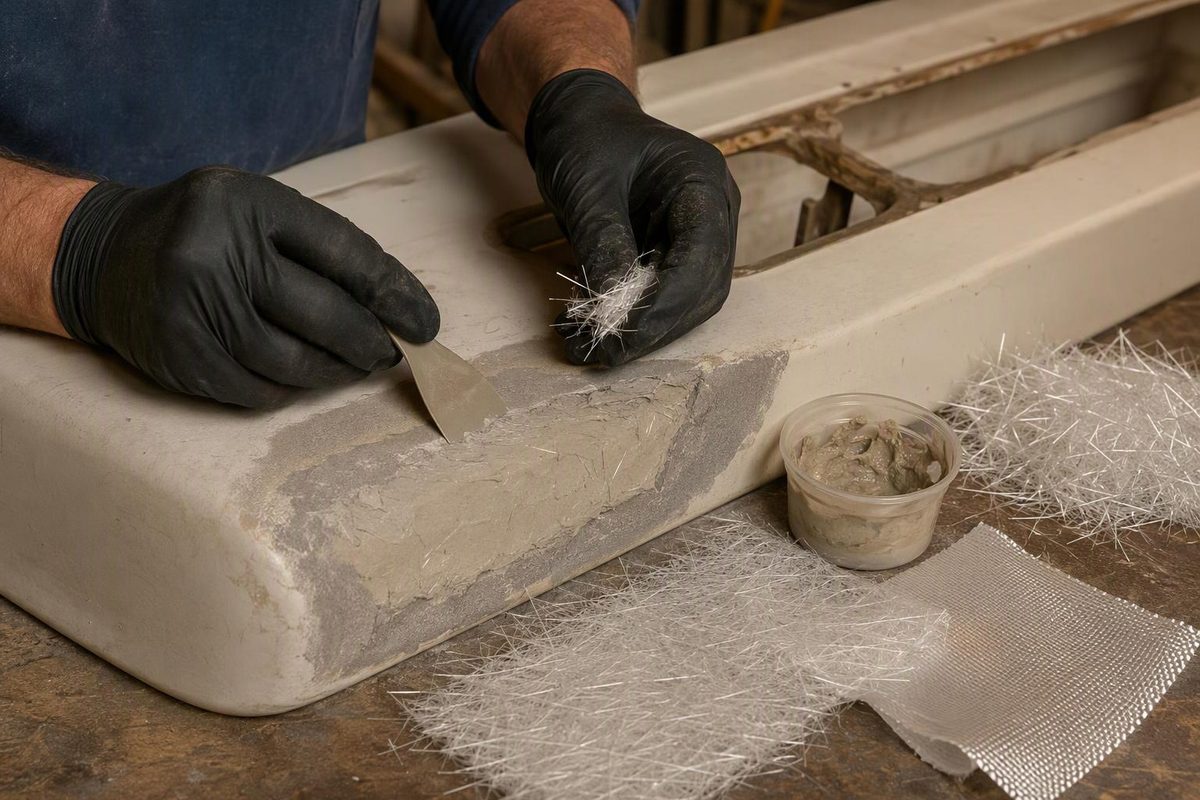
Loose chopped fiberglass is an additive for making fiber-reinforced resin mixtures—not an automatic substitute for a fiberglass patch. It can reinforce fillets (rounded inside-corner joints), castings and difficult-to-laminate corners. Whether it belongs in a repair depends on what is damaged: the finish, a local void, or the load-carrying laminate.
Before buying, check whether “chopped fiberglass” means loose strands or chopped-strand mat. They are different materials with different application methods.
Identify the form first
| Material | What it is | What to check |
|---|---|---|
| Loose chopped strands | Short glass strands mixed into resin | Fiber length, approved resin systems and filler-loading instructions |
| Milled glass fibers | Finely ground, short glass filaments used in filled resin mixtures | Intended bonding or filling use, handling and sanding characteristics |
| Chopped-strand mat | Sheet reinforcement laid up with resin | Mat weight, binder compatibility and the specified laminate schedule |
For example, Fibre Glast’s 1/4-inch chopped glass fibers are sold for reinforcing resin castings and fillets, particularly at edges and corners. The supplier explicitly lists compatibility with epoxy, polyester and vinyl ester. That approval applies to this product; check the specification of any alternative before mixing it. Source: Fibre Glast
Milled fibers are a separate choice. TotalBoat describes its product as finely ground filaments suited to fine fillets and gaps, and does not recommend it for fairing or easy sanding. A strong filling mixture is not necessarily a convenient finishing putty. Source: TotalBoat
If you need reinforcement supplied as a sheet, use the chopped-strand mat selection guide rather than treating loose fibers as the same purchase.
Decide whether the damage needs filler or a laminate
A local void or specified fillet: A fiber-filled resin mixture may fit. WEST SYSTEM’s 402 blend, for example, contains chopped glass and other fillers and is intended for small semi-structural repairs, void filling and small-scale impact damage. Its instructions are not a blanket approval for every chopped-fiber mixture. Source: WEST SYSTEM 402
A shallow finish defect: Do not choose chopped fibers simply because they sound stronger. WEST SYSTEM’s repair manual treats shallow gelcoat cracks or scratches that do not reach the laminate separately from laminate repairs. Choose a compatible finish-repair system for that depth of damage, and investigate any flexing that caused it. Source: WEST SYSTEM repair manual, section 2
Broken reinforcement, a through-hole or a load-bearing repair: Do not fill the opening with chopped-fiber putty and assume strength is restored. In a boat laminate, the fibers carry most structural loads; rebuilding skin continuity is a central repair objective. Fabric type and repair geometry therefore matter, not just the hardness of the cured filler. Source: WEST SYSTEM repair manual, section 1.1
Stop and establish a repair plan if a hull’s integrity is uncertain, or if a deck or shower pan continues to move at the crack. Filler selection comes after diagnosing damaged laminate, core or support—not before. For boats, start with hull stress-crack triage.
Mix a small, product-specific batch
Control airborne fibers while dispensing and dust while sanding. Use eye protection, protective clothing, resin-compatible gloves and any respiratory protection specified by the product safety data sheets. NIOSH identifies potential eye, skin and lung harm from fibrous-glass exposure and recommends controlling exposure, not relying on protective equipment alone. Source: NIOSH
For an epoxy system whose instructions permit the selected fibers:
- Prepare sound bonding material. Remove contamination before sanding, remove loose or deteriorated material, and leave the surface clean, dry and properly abraded.
- Measure and mix resin and its approved hardener first. Follow the stated ratio and mixing procedure. Do not alter the hardener ratio to compensate for fibers or change cure speed.
- Wet out bonding surfaces where required. Follow the system’s application instructions. WEST SYSTEM’s two-step bonding method applies unfilled resin/hardener to the prepared surfaces before thickened epoxy, promoting penetration and preventing resin-starved joints.
- Add the approved filler gradually. Follow its loading instructions and mix evenly. There is no universal chopped-fiberglass recipe: loose strands, milled fibers and blended fillers have different formulations.
- Check handling before applying. The mixture must fill the intended gap without sagging or draining out. Use a compatible thickener only where the system permits it; both Fibre Glast and TotalBoat describe combining glass fibers with silica for handling control.
- Respect thickness and cure limits. A thick mass of epoxy retains reaction heat. Do not treat a reinforced putty as an unrestricted deep-pour material, and follow the resin’s cure requirements before sanding, coating, loading or water exposure.
The preparation, mixing, wet-out and heat-control principles above follow WEST SYSTEM’s repair manual, sections 16.3–16.4; handling guidance also appears in the Fibre Glast and TotalBoat product instructions. TotalBoat recommends a small trial batch because fillers can affect resin pot life. For polyester or vinyl ester, use that resin’s catalyst procedure rather than borrowing an epoxy recipe.
For the final surface, choose a compatible fairing or finishing system separately. The 2-part epoxy filler guide explains the distinction between easy-sanding fairing putty and structural adhesive fillers.