
Gelcoat Repair Kit: Choose and Use the Right Type
Choose a gelcoat repair kit for chips and scratches, check resin and color compatibility, and know when fiberglass needs structural repair first.
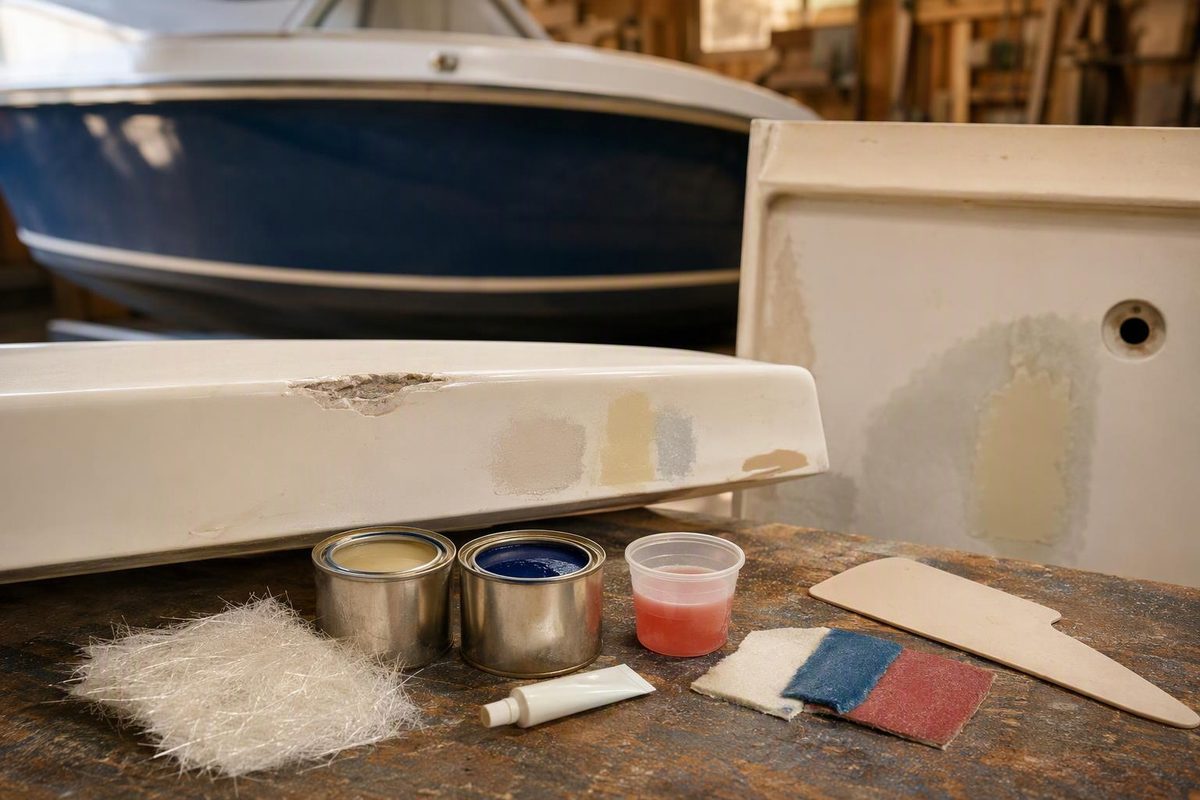
A gelcoat repair kit restores the colored outer surface of a fiberglass part. It can fill a shallow chip, gouge or opened cosmetic crack, but it cannot replace cut, fractured or delaminated fiberglass reinforcement.
On a typical fiberglass boat, gelcoat provides a smooth cosmetic finish and moisture barrier, while fibers in the laminate carry most structural loads. Restoring the continuity of those resin-and-fiber skins is therefore critical when damage extends below the finish (WEST SYSTEM).
Stop before buying a kit if the damage is structural
A small paste kit is a reasonable match when all of these are true:
- Damage appears confined to the gelcoat.
- The surrounding surface is firm and does not flex unusually.
- No glass fibers, core material or open hole are visible.
- The crack is not growing, leaking or reopening after a previous repair.
- There is no soft or apparently delaminated area around it.
Exposed or broken fibers, an impact fracture, a puncture, a wet core or a moving panel needs laminate repair before refinishing. A gelcoat-only patch may conceal that damage without restoring strength. The WEST SYSTEM repair manual similarly separates shallow gelcoat damage from cracks entering the laminate, woven reinforcement or core (WEST SYSTEM).
For a boat crack that moves, grows or sits below the waterline, use the triage checks in Boat Hull Stress Cracks Need Triage Before Repair. If reinforcement is required, compare a gelcoat kit with a fiberglass boat repair kit, which should include or support resin-and-cloth work.
Match the kit to five requirements
| Check | What to look for |
|---|---|
| Repair material | Thickened gelcoat or patch paste for chips and gouges—not merely polish, paint or epoxy filler |
| Substrate | Explicit approval for the existing gelcoat, laminate resin, primer and any filler beneath the finish |
| Color | Factory-matched paste for a known make, model, year and color code, or a tintable base with compatible pigments |
| Air cure | Waxed gelcoat, release film, PVA or another manufacturer-specified way to exclude air during final cure |
| Completeness | Catalyst, measuring method, mixing cup, applicator and cure instructions; abrasives and compound may still be separate |
Check the manufacture date or stated shelf life before ordering old stock. Polyester gelcoat can polymerize in its container without catalyst. TotalBoat specifies a shelf life of six months from manufacture and storage below 75°F for its gelcoat; its support guidance says to reject material that has thickened or become clumpy (TotalBoat technical data; Jamestown Distributors). Shelf life is product-specific, so use the kit’s date and data sheet rather than treating six months as universal.
Do not assume gelcoat will cure over epoxy
Compatibility differs by system. TotalBoat lists ordinary cured epoxy and epoxy fairing compounds as unacceptable direct substrates for its gelcoat, apart from specified primer processes. Marine Coat One likewise tells users not to apply its polyester repair paste over epoxy (TotalBoat technical data; Marine Coat One instructions).
Wessex Resins reports successful bonding of gelcoat to prepared WEST SYSTEM epoxy in tests involving three WEST SYSTEM hardeners. That limited result does not establish compatibility for every gelcoat, epoxy or hardener combination (Wessex Resins). If epoxy lies beneath the intended patch, use a finish system that explicitly approves that substrate and preparation, or obtain written guidance from the manufacturers.
A controlled repair sequence
Product directions override generic catalyst ratios, grit numbers and cure times.
- Identify and open the defect. Remove loose gelcoat. Open a narrow crack enough to remove weak edges and provide bonding area; stop if this exposes fractured glass, moisture or a void.
- Dewax and clean before sanding. Sanding can drive contamination into the surface. Use only the cleaner and rag type specified by the kit. TotalBoat, for example, calls for cleaning and dewaxing, 80-grit mechanical tooth, and an acetone wipe with lint-free cotton for its system (TotalBoat technical data).
- Test the color. Weathering can shift the original finish away from its factory shade. For tintable material, add compatible pigment before catalyst, record each addition, and judge a fully cured, sanded and polished sample. TotalBoat recommends cured test samples; Marine Coat One warns that weather exposure can prevent an exact match (TotalBoat technical data; Marine Coat One).
- Measure gelcoat and catalyst exactly. Do not borrow a drop count from another brand. Catalyst concentration, batch size and temperature affect the required amount and working time. Prepare the tools first and mix only what can be placed within the specified pot life.
- Fill slightly proud. Press paste into the prepared recess without trapping air. Keep it off the surrounding finish so the final sanding area remains small.
- Exclude air as directed. Polyester gelcoat exposed to air may retain a tacky surface. A waxed final coat forms its own barrier; unwaxed products may require PVA or plastic release film. TotalBoat describes unwaxed gelcoat as suitable between layers and waxed gelcoat as suitable for an exposed final repair layer (TotalBoat).
- Let it cure fully. Temperature, catalyst rate and mixed mass affect cure. Do not sand merely because a generic time has elapsed; wait for the product’s specified sanding condition.
- Level, refine and polish. Start with the abrasive prescribed by the kit, use a firm small block where practical, and progress through the specified finer grits before compound and protective wax. Avoid sanding through adjacent gelcoat.
Control liquid chemicals, vapors and sanding dust
Read the safety data sheets for the gelcoat, catalyst and cleaner before opening them. Follow their requirements for chemical-resistant gloves, eye protection, ventilation and any respiratory protection. Keep liquid chemicals and curing mixtures away from flames, sparks and other ignition sources. During grinding and sanding, contain dust and use the protective equipment specified for that task.
Catalyzed gelcoat cures exothermically. TotalBoat warns that a mass left in a mixing cup or tray can reach 300–400°F. Mix only a small usable batch, keep the container on a safe surface, and follow product and local disposal directions rather than pouring residue into a drain (TotalBoat technical data).