
Choose a Fiberglass Pool Step Repair Kit by Damage Type
Check whether the system seals, reinforces, resurfaces or restores support, plus its finish and cure needs. Movement is a stop-and-diagnose signal.
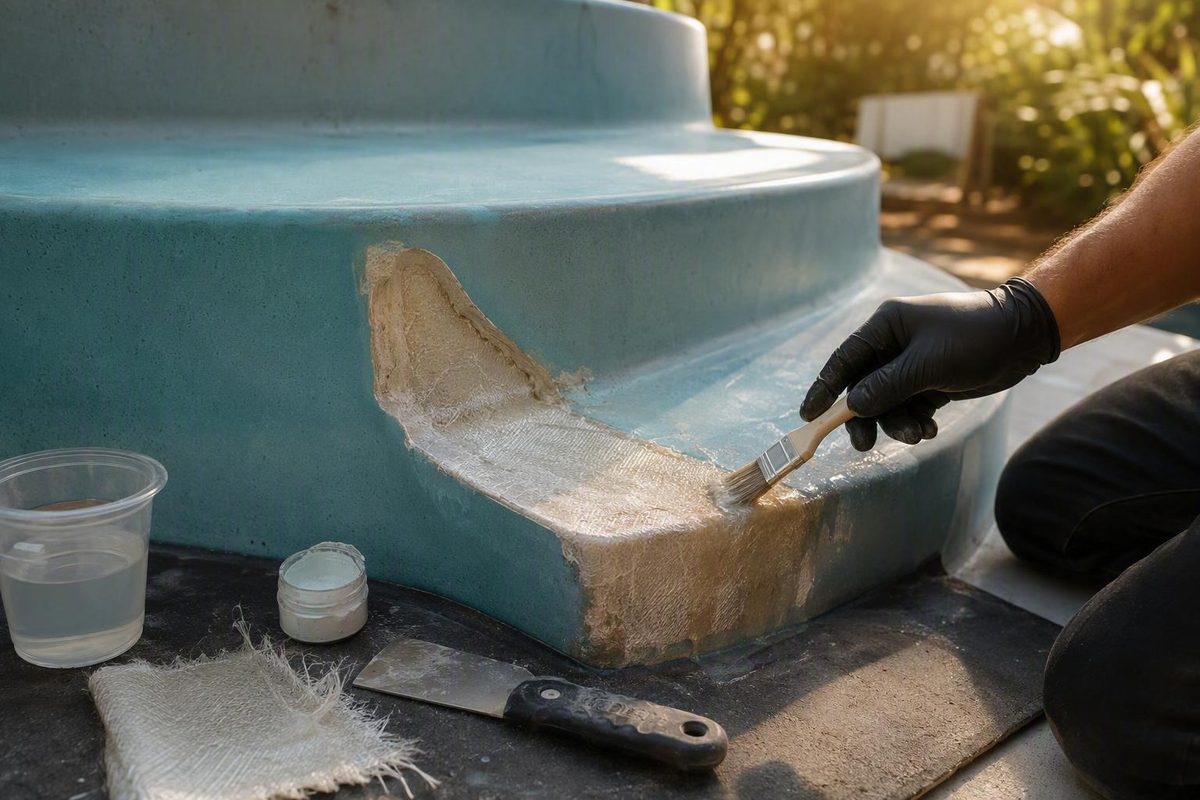
A search for a fiberglass pool step repair kit returns everything from small underwater epoxy cartridges to resurfacing coatings, customized tread-repair packages, loose fiberglass materials, and foam intended to fill voids beneath a step. These products do different jobs.
No product in the available evidence is proven best for every pool-step problem. The right choice depends on four questions:
- What is the step actually made from?
- Is the failure cosmetic, watertightness-related, structural, or support-related?
- Does the proposed system include compatible reinforcement and finishing materials?
- Can the repair be prepared and cured under the required temperature, dryness, and immersion conditions?
Answer those questions before comparing package prices or seller claims.
Start With the Failure, Not the Product Label
Begin by placing the damage in one of five categories:
- Shallow crazing, fading, roughness, or finish wear. The surface may need patching or resurfacing, but visible finish damage alone does not establish the condition of the underlying laminate.
- A rigid, localized crack. A compatible filler or reinforced patch may be appropriate, depending on the substrate and the extent of the damage.
- An active leak. Sealing the water path matters, but stopping water does not necessarily restore laminate strength or correct the reason the crack formed.
- A broken or load-bearing tread. This is not merely a filling job. It may require fiberglass reinforcement, contour reconstruction, and a damage-specific repair plan.
- A step known or suspected to flex under foot. Movement is a stop-and-diagnose signal. Lost backfill, erosion, soil compaction, or separation from the original support may leave the tread poorly supported.
Pool Step Specialists attributes unsupported treads to possible support separation, soil compaction, or erosion and says the resulting flexing can contribute to leakage and further loss of support. These are specialist-vendor observations, not independent structural test results. See the vendor’s damage classifications and kit descriptions.
Kit listings often conflate three different outcomes:
- Stopping water: sealing a crack, joint, gasket, or penetration.
- Restoring laminate strength: bonding appropriate fiberglass reinforcement across damaged material.
- Renewing appearance and footing: restoring color, contour, finish, and surface texture.
A small epoxy filler may be relevant to a rigid crack or leak. That does not automatically make it a structural repair for a fractured tread. Likewise, a coating can make worn steps look uniform without reinforcing broken laminate or restoring missing support beneath them.
Use the visible problem to narrow the product category:
- Widespread fading, roughness, shallow defects, or lost texture: investigate a resurfacing system.
- One localized, nonmoving defect: investigate a compatible filler or fiberglass patch system.
- A leaking crack: identify both the water path and why the crack formed.
- A fractured tread: look for a reinforced, damage-specific repair plan rather than putty alone.
- Observed movement or deformation: investigate support and laminate integrity before surface repair.
Do not stand on, press, bounce, or otherwise load a visibly cracked, deformed, or uncertain tread to test it. Document movement that has already been observed and inspect visually without loading the damaged area. If movement or structural damage is suspected, obtain a qualified assessment.
A compact decision tree is:
Identify the material → document observed movement without loading the damaged tread → classify the damage → investigate leakage or lost support → choose sealing, laminate reinforcement, resurfacing, support restoration, or qualified assessment.
Confirm That the Step Is Fiberglass or FRP
Visually similar pool steps may be made from fiberglass-reinforced plastic, thermoplastic, acrylic, or a combination of molded steps, gaskets, and a vinyl liner. Repair materials are not necessarily interchangeable among these substrates.
Do not rely on color, gloss, age, or appearance alone. Check:
- Manufacturer labels or molded markings
- Model and serial information
- Original installation records
- Pool manuals and warranty documents
- Installer or previous-owner invoices
- Records identifying the assembly as FRP, thermoplastic, acrylic, or part of a vinyl-liner system
A third-party pool-service exchange illustrates the risk of assumption: the response initially discussed fiberglass resin repair, but the owner subsequently identified the steps as Rovel thermoplastic. The exchange is an individual expert recommendation, not manufacturer-specific technical documentation. Read the material-identification exchange.
Before contacting a seller or repair specialist, photograph:
- The complete stair assembly
- Every damaged area
- Each crack with a ruler or other scale beside it
- The waterline relative to the damage
- Any visible sagging, bulging, or deformation
- The step-to-liner or step-to-wall connection
- Any accessible underside, brace, backfill, or support
- Manufacturer names, labels, model numbers, and molded markings
Pool Step Specialists shows examples labeled as both FRP and thermoplastic repairs and invites owners to submit photographs for kit selection. That can be useful presales triage, but it is not equivalent to an on-site structural inspection. Photographs may not reveal hidden support loss, moisture, previous repair layers, or the full extent of laminate separation.
Read the manufacturer’s substrate list carefully. Step Renew, for example, is marketed for both fiberglass and thermoplastic pool steps used with vinyl-liner pools. Other systems may be restricted to a particular plastic, resin family, surface condition, or finishing method.
Do not improvise with scratch, flame, solvent, or drilling tests to identify the material. The supplied evidence does not validate those methods as reliable pool-step identification procedures. Documentation and manufacturer confirmation are better starting points.
Compare the Four Types of Products Sold Around This Search
Products appearing around this search fall into four practical groups:
- Step-specific resurfacing and patching systems
- Customized damage-specific repair kits
- Small sealant or adhesive cartridges
- Component catalogs and under-step support products
The table compares documented scope rather than ratings or promotional claims.
| Product or system | Intended job | Explicit fiberglass-step relevance | Underwater or dry use | Reinforcement included | Finish or coating included | Non-slip provision | Documented support | Captured price | Major evidence gap |
|---|---|---|---|---|---|---|---|---|---|
| Step Renew | Preparation, patching, and complete resurfacing | Yes; marketed for fiberglass and thermoplastic steps in vinyl-liner pools | Prepared-surface coating project; confirm drying and refill requirements | No fiberglass reinforcement documented | Epoxy coating and patch compound | Anti-slip silica included | Manufacturer product documentation | No price supplied in the captured page | No stated crack-size or structural-damage limit |
| Pool Step Specialists kits | Tread repair, complete refurbishment, frost or jet damage, or crazing | Yes; FRP and thermoplastic examples shown | Confirm requirements for the selected kit | Damage-specific contents not fully itemized | Refurbishment kit uses a proprietary finishing compound | Not fully documented | Manual, three months of video access, phone, and email support | Tread $249; refurbishment $369; frost/jet $249; crazing $189, plus shipping and about $25 in local materials. Capture date not supplied. Vendor listing | No independent load, immersion, or longevity comparison; full contents and cure schedules not shown |
| Sponsored AQUABOND marketplace listing | General crack-and-leak sealing | Listing claims fiberglass compatibility; no demonstrated structural tread repair | Marketed for underwater use | None shown | White epoxy putty or sealant finish | None documented | Marketplace listing only | No visible price | Sponsored listing; no step-specific structural instructions, coverage, or cure data |
| AquaBond cartridge and tread systems | Dry or underwater crack, gasket, tread, and leak work | Detailed guidance centers on acrylic steps, vinyl liners, gaskets, and vinyl treads | Separate dry and underwater products | Some tread products include repair compound, but no fiberglass laminate layup is documented | Product-dependent | Vinyl non-skid replacement tread in one system | Manufacturer instructions and technical support | Dry DMK-3000 kit $114.92; VSRK-60 tread kit $372.75. Capture date not supplied. Manufacturer guide | Fiberglass laminate compatibility and load-bearing repair capacity are not established |
| AquaGuard component catalog | Assemble a repair from separate materials and tools | General fiberglass-pool relevance; no dedicated complete step system identified | Varies by component | Mat and biaxial reinforcement sold separately | Resin, gel coat, patch, and finish products sold separately | Non-skid products sold separately | Product-level information varies | Component prices vary; no complete-project total | No step-specific compatibility matrix or documented all-in-one kit |
| Secure Set foam | Fill a void beneath or around fiberglass steps | Yes, but for support rather than surface laminate repair | Injected through access holes | No fiberglass reinforcement or closure kit | None | None | Videos, foam instructions, temperature guide, and void calculator | No price captured | No universal method established for void measurement, hole placement, expansion control, or verifying restored capacity |
Step Renew is comparatively comprehensive for resurfacing. Its documented package includes one gallon of epoxy coating, one pint of epoxy solvent, one quart of patching compound, one-half gallon of cleaner and etch, anti-slip silica, brushes, roller supplies, a mixer blade, two sheets of 60-grit sandpaper, and a stir stick. White, blue, and gray are the listed colors, although the manufacturer says screen colors are approximations. Review the Step Renew package description.
The visible Amazon item should be classified narrowly. It is a sponsored AQUABOND DMK-5000 listing for a white 50 mL crack-and-leak epoxy marketed as fiberglass-compatible and suitable for underwater sealing. The listing does not demonstrate restoration of a load-bearing fiberglass tread, and its marketplace rating does not establish structural suitability. See the captured marketplace listing.
AquaGuard is better understood as a component catalog. It lists polyester resin, fiberglass reinforcement, gel coat, non-skid material, abrasives, patch products, dispensing equipment, and tools, but the captured category page does not identify one complete fiberglass pool-step system. Browse the AquaGuard repair-material category.
No winner can be named from this evidence. There is no comparative structural-load, adhesion, immersion, chemical-exposure, or long-term durability testing across the listed systems. The best commercial fit is the system whose documented scope matches the diagnosed problem—not the product with the broadest title.
A Flexing Step Needs Support Before a Surface Patch
A visible crack can be a symptom of a support problem. If the tread moves, a rigid patch may be forced to bridge a moving area. Surface repair alone does not correct the underlying movement.
Use a two-stage framework:
- Investigate and restore support.
- Repair and refinish the fiberglass surface.
The cited vendors identify eroded soil or sand, compacted backfill, and separation from an original support as possible causes of poor tread support.
Pause surface-only repair if any of the following is already observed or suspected:
- The tread moves, sags, or changes shape during normal use
- The crack opens during ordinary loading
- A broad unsupported or separated area is suspected
- Water loss appears associated with the damage
- A previous patch has cracked around its perimeter
- Deformation extends beyond the visible crack
- The support area cannot be inspected
- The construction of the step assembly is uncertain
Secure Set is an example of a support product rather than a fiberglass surface-repair kit. The manufacturer describes it as a two-component, high-density, closed-cell polyurethane foam. Its overview calls for drilling several 3/8-inch access holes, injecting foam, and closing the holes with a separate fiberglass repair kit. Secure Set states that it neither sells that closure kit nor provides the fiberglass-repair instructions. Review the support-void process and its stated limits.
That process should not be treated as universal. The available evidence does not establish a validated method for:
- Measuring every void’s shape and volume
- Locating hidden braces or supports
- Selecting safe access-hole locations for every design
- Controlling foam movement and expansion in every assembly
- Confirming that the material reached the intended area
- Determining when injection might distort a weakened tread
- Verifying a particular load capacity after injection
Any injection plan also needs a compatible method for closing every access hole. Unsupported filler should not automatically be treated as equivalent to restoring the original reinforced laminate.
Active movement, suspected separation, extensive leakage, inaccessible support, or uncertain construction shifts the project from product selection to assessment of a load-bearing assembly.
Choose Polyester or Epoxy as Part of a Complete System
“Polyester or epoxy?” cannot be answered from resin properties alone. Select the resin as part of a system that includes:
- The existing step laminate
- The chosen fiberglass cloth or mat
- The filler or fairing material
- The intended gel coat, top coat, or step coating
- Dryness and immersion requirements
- Application temperature
- Preparation, recoat, cure, and refill instructions
A commercial supplier characterizes epoxy as offering stronger bonding, better moisture resistance, and lower shrinkage than polyester. The same comparison describes polyester as less expensive and commonly compatible with conventional chopped-strand mat and polyester gel coat. These are general supplier comparisons, not proof that either resin is suitable for a particular pool step. See the polyester-versus-epoxy comparison.
When polyester may make sense
Polyester may form a coherent system when the existing part is known to be polyester-based and the selected reinforcement and finish are documented as compatible. It is commonly considered when:
- The original laminate is known to be polyester
- Conventional chopped-strand mat is specified
- Several laminate layers are planned
- The final finish is a compatible polyester gel coat or pool top coat
- The selected products support the anticipated exposure conditions
Conventional chopped-strand mat commonly uses a styrene-soluble binder. The cited supplier says polyester resin supplies the styrene needed to break down that binder. Specialty mats compatible with epoxy exist, so “fiberglass mat” should not be assumed to work equally with every resin.
When epoxy may make sense
Epoxy may be attractive for adhesion, moisture resistance, and lower shrinkage. The cited supplier also says epoxy can adhere to an existing polyester base. The final coating sequence still requires product-specific confirmation.
The supplier warns against applying polyester gel coat over an epoxy repair. Because the evidence does not test every epoxy, preparation method, tie coat, or barrier system, treat that warning as a compatibility concern requiring written product guidance—not as an exception-free rule covering every formulation.
If the epoxy manufacturer does not document compatibility with the intended finish, choose a complete tested system or obtain written confirmation from the relevant manufacturers.
A coherent polyester example
A commercial pool-repair demonstration uses:
- Polyester laminating resin
- Two differently sized fiberglass-mat patches
- Fiberglass surface veil
- A compatible polyester pool top coat
The veil provides a finer finishing layer and reduces visible reinforcement print-through. See the demonstrated polyester pool-crack system.
That demonstration concerns a generic crack in a polyester-and-fiberglass pool. It does not validate a repair for a load-bearing stair tread, diagnose support loss, or establish structural capacity.
Never copy a catalyst percentage or mix ratio from an unrelated product. Follow the selected system’s instructions for:
- Resin-to-hardener ratio or catalyst range
- Batch size
- Pot life and working time
- Application-temperature range
- Time between laminate layers
- Sanding and recoating windows
- Full cure
- Time before immersion
What a Complete Kit Should Include
A complete purchase is not necessarily a single box. It is the full set of compatible materials needed to prepare, repair, finish, and return the step to service under the chosen manufacturer’s instructions.
Diagnosis and preparation
Confirm that the project includes:
- Manufacturer, model, and substrate information
- Camera, ruler, and marker for documenting the damage
- Cleaner or surface-preparation product specified by the system
- Specified solvent, if required
- Abrasives in the prescribed grits
- Dust-removal supplies
- Masking tape and protective sheeting
- Suitable mixing containers
- Accurate measuring tools
- Drying or moisture-control provisions where required
Do not substitute household cleaners or solvents without compatibility guidance from the selected product manufacturer.
Reinforcement or filling
A structural fiberglass patch may require:
- Compatible laminating resin or structural adhesive
- Fiberglass cloth, mat, or biaxial reinforcement approved for that resin
- Surface veil if specified by the finishing system
- Enough reinforcement for every planned layer and overlap
- Crack-filling or contour-fairing material
- Additional resin for wet-out and expected waste
- Closure materials for any authorized access holes
Do not treat them as interchangeable unless the product documentation explicitly describes the filler as suitable for the intended reinforced application.
Finishing
A complete walking-surface repair may also need:
- Compatible gel coat, pool top coat, or step coating
- Primer or tie coat if specified
- Color-matching provisions
- Fairing material for restoring the contour
- A compatible non-slip additive or textured tread
- Materials for blending edges and removing sharp transitions
Watertightness does not automatically restore surface texture. If the original texture is removed during preparation or coating, the selected system should provide a documented way to reinstate it.
Application tools
Depending on the system, the project may require:
- Brushes, rollers, and trays
- Laminating rollers or squeegees
- Spreaders and contouring tools
- Shears for cutting reinforcement
- A drill-mounted mixer
- A scale, graduated cups, or metering equipment
- A dispensing gun
- Replacement static mixers
- Sanding blocks or appropriate sanding equipment
Confirm whether these are included.
Safety equipment
The evidence supports ventilation for styrene-containing polyester resin and identifies masks, goggles, and protective clothing among the precautions discussed by the commercial resin sources. Product-specific requirements can differ, however.
Before buying or opening any chemical product:
- Obtain its current label and safety data sheet
- Confirm the required ventilation and protective equipment
- Check its handling, storage, spill, and disposal instructions
- Follow any applicable local disposal requirements
- Do not assume that general fiberglass guidance replaces product-specific safety documentation
Step Renew illustrates a comparatively comprehensive resurfacing package because it combines preparation products, patch compound, coating, anti-slip silica, abrasives, applicators, and a mixer blade. It should not be assumed to include structural fiberglass reinforcement or to cover an unsupported broken tread.
A component catalog offers more flexibility but places greater responsibility on the buyer to select compatible resin, reinforcement, finish, non-skid material, abrasives, and tools.
Pre-purchase verification
Before ordering, obtain clear answers to these questions:
- Which substrates is the product approved for?
- What crack width, depth, or damage size can it address?
- Is it intended for cosmetic filling, leak sealing, or structural reinforcement?
- What coverage does it provide at the required thickness?
- Is it suitable for continuous or repeated immersion?
- Can it be applied below the waterline?
- Must the surface be completely dry?
- What application-temperature range applies?
- What are the working time, recoat window, full cure, and immersion schedule?
- Which fiberglass reinforcement is compatible?
- Which gel coat, top coat, or step coating can be applied over it?
- How will color, contour, and non-slip texture be restored?
- Are the dispensing gun, static mixers, abrasives, and applicators included?
- Are replacement cartridges and finish materials available?
- What technical support and warranty are provided?
- Could DIY work affect an existing warranty?
For broader context, Fiberglass Guide lists an article on fiberglass patch-kit contents and polyester-versus-epoxy selection. It is general fiberglass content, not evidence of pool-step-specific structural suitability.
Plan the Repair Workflow and Cure Window
A typical dry fiberglass repair follows a broad sequence, but the actual preparation profile, laminate schedule, material quantity, and cure period must come from the selected products and damage plan.
A high-level workflow is:
- Document the complete condition.
- Identify the step material and existing finish.
- Determine why the damage formed.
- Obtain assessment or restore support when necessary.
- Lower the water if required by the repair system.
- Dry the substrate to the product’s stated condition.
- Prepare the specified bonding area.
- Apply the compatible filler, adhesive, resin, and reinforcement.
- Fair the repair and apply the compatible finish.
- Restore the specified surface texture.
- Allow the complete system to cure.
- Inspect before refilling and returning the step to service.
In the cited polyester demonstration, the area is sanded before catalyzed laminating resin is applied. Two differently sized fiberglass-mat patches are laminated over the crack, followed by surface veil. After polymerization and finishing preparation, a catalyzed pool top coat is applied.
The surface veil creates a finer outer layer that can produce a smoother finish with less print-through. These details explain the logic of that example; they are not a universal laminate schedule for a load-bearing tread.
Dry fiberglass laminating should also be distinguished from underwater sealing. Some adhesives and sealants are marketed for underwater mixing, application, and cure. That capability may be relevant to certain gasket leaks or rigid cracks when the documented substrate and exposure conditions match.
Underwater capability does not, by itself, establish that a product can replace fractured glass reinforcement, reconstruct a broken tread, or correct movement beneath the step.
Cure guidance cannot be generalized. In one third-party pool-service exchange, the responding expert recommended waiting 24 hours before refilling after the described resin repair, but the exact manufacturer system was not identified. See the individual 24-hour recommendation.
By contrast, Feroca’s demonstrated polyester pool top-coat system recommends leaving the pool empty for at least seven days after top-coat application. That instruction applies to the featured system and should not be transferred to unrelated coatings, epoxies, or cartridge sealants. Review the seven-day recommendation for that system.
Before refilling, check for:
- Soft, gummy, or visibly incomplete cure
- Surface contamination
- Unbonded reinforcement or dry fibers
- Voids and pinholes
- Sharp transitions
- Cracking, lifting, or other finish defects
- Missing specified surface texture
- Debris or uncured residue
Visual inspection can identify obvious defects. It does not prove that a repaired tread has recovered a particular load capacity. When structural adequacy remains uncertain, obtain qualified assessment before returning the step to service.
Budget, Safety, and the Point Where DIY Should Stop
Advertised price is only one part of the project budget. Compare products by complete scope rather than package price alone.
| Cost item | Questions to ask |
|---|---|
| Base kit | Does it seal, reinforce, resurface, or provide only one component? |
| Shipping | Are shipping charges or regional restrictions stated? |
| Local supplies | Which preparation products, masking materials, containers, or tools are omitted? |
| Extra resin or cartridges | Is coverage sufficient at the required thickness? |
| Reinforcement | Are cloth, mat, biaxial fabric, veil, or tread materials included? |
| Abrasives | Are all preparation and finishing grits supplied? |
| Finish | Is the gel coat, top coat, primer, or step coating included and compatible? |
| Non-slip treatment | Does the system specify how to restore the walking surface? |
| Applicators | Are brushes, rollers, trays, spreaders, and laminating tools included? |
| Dispensing equipment | Does the cartridge require a special gun or replacement mixers? |
| Safety provisions | What ventilation, protective equipment, and handling controls do the label and SDS require? |
| Support restoration | Are support material, access tools, and inspection costs separate? |
| Hole closure | What compatible laminate and finish materials will close access holes? |
| Professional assessment | Is inspection needed before product selection? |
| Rework allowance | Is extra material available if a batch is lost or finishing must be repeated? |
The captured Pool Step Specialists prices—$249 for tread repair, $369 for refurbishment, $249 for frost or jet work, and $189 for crazing repair—excluded shipping and approximately $25 in locally purchased materials. The capture date was not provided, so verify current prices and terms before ordering.
A small cartridge or individual catalog component cannot be compared directly with a complete resurfacing package or customized reinforced tread kit. The scopes are different.
Chemical and dust safety
The cited resin supplier says polyester resin contains styrene and should be used with ventilation. It also recommends a mask, goggles, and protective clothing. The same source says epoxy components must be measured at the specified ratio and mixed thoroughly to avoid improper cure. These are general commercial-supplier precautions; the selected product’s current label and safety data sheet should control the work. Review the supplier’s handling and mixing guidance.
For polyester, use the exact catalyst instructions supplied with the chosen resin. Do not transfer catalyst percentages from another product. For epoxy, measure both components at the stated ratio and mix according to the manufacturer’s directions. A small test batch is appropriate only when the product instructions permit it.
The supplied evidence does not provide complete protective-equipment, fire, spill, storage, or waste instructions for every possible resin, catalyst, adhesive, coating, cleaner, or solvent. Obtain the current safety documentation for every product and follow applicable local requirements.
Stop-work triggers
Pause the project and seek manufacturer guidance or assessment from a qualified pool-step or composite-repair professional if:
- The tread moves, sags, or deforms
- A crack is known to open during ordinary use
- Damage is extensive or spreading
- Laminate separation is suspected
- Leakage is substantial
- The substrate cannot be identified
- The original support cannot be inspected or accessed
- Previous repairs have repeatedly failed
- The step-to-liner connection is involved
- The intended work may affect a warranty
- Resin, reinforcement, and finish compatibility cannot be confirmed
- The seller cannot define whether its product is a sealant, cosmetic patch, or structural system
Seller descriptions such as “permanent,” “nearly invisible,” “one coat,” “easy,” or “near-original strength” should be treated as marketing unless supported by relevant testing for the same substrate, preparation, immersion conditions, damage, and loading. The available evidence does not provide such a comparison.
Frequently Asked Questions
Can a small underwater epoxy repair a cracked fiberglass pool step?
It may seal a small, rigid crack if the manufacturer documents compatibility with the step substrate or finish and permits underwater application.
Do not assume that a small cartridge restores severed fiberglass reinforcement or the strength of a load-bearing tread. Observed movement, deformation, or broader laminate damage calls for diagnosis rather than sealing alone.
Can I patch a fiberglass step that flexes when someone stands on it?
Not as a surface-only repair. Previously observed flexing may indicate movement in the tread, laminate, or under-step support. A new surface patch can remain exposed to the same movement that contributed to the original failure.
Stop using the damaged tread and have the support and step construction assessed. If an appropriate support-restoration method is established, any resulting access holes and surface damage still require a compatible fiberglass-and-finish system.
Does a fiberglass pool-step repair require draining the pool?
It depends on the product and repair type. Some specialized sealants and adhesives are marketed for underwater crack or gasket work.
Underwater application is not equivalent to structural reinforcement. A broken tread, contaminated laminate, extensive crack, or finish-restoration project may still require a controlled dry work area.
Is polyester or epoxy better for a fiberglass pool-step repair?
Neither is universally better. The cited supplier characterizes epoxy as having stronger bonding, lower shrinkage, and better moisture resistance, while polyester commonly integrates with conventional chopped-strand mat and compatible polyester finishes.
Choose according to the existing laminate, reinforcement, exposure conditions, and final coating. Confirm the complete sequence with the relevant product manufacturers.
How long must a repaired pool step cure before refilling?
Use the full-cure and immersion schedule for the complete selected system. The available examples range from an individual expert’s 24-hour recommendation for an unspecified resin-repair system to at least seven days for a particular polyester top-coat system.
Those periods are not interchangeable. Do not refill solely because the surface feels hard; confirm that every resin, filler, adhesive, and finish layer has reached its documented cure for immersion.
Final Buying Sequence
Verify the step material, classify the damage, investigate observed movement or lost support, choose a compatible reinforcement-and-finish system, inventory everything omitted from the package, and confirm cure and immersion requirements before ordering.
A rigid cosmetic defect may be a reasonable DIY project when the substrate and product scope are clear. Movement, suspected laminate separation, major leakage, or uncertain structural support should shift the decision from product shopping to qualified assessment.