
Fiberglass Pool Gelcoat Problems: Diagnose Before Repair
Identify stains, white haze, chips, cracks and blisters on a fiberglass pool, then choose approved cleaning, a finish repair or professional inspection.
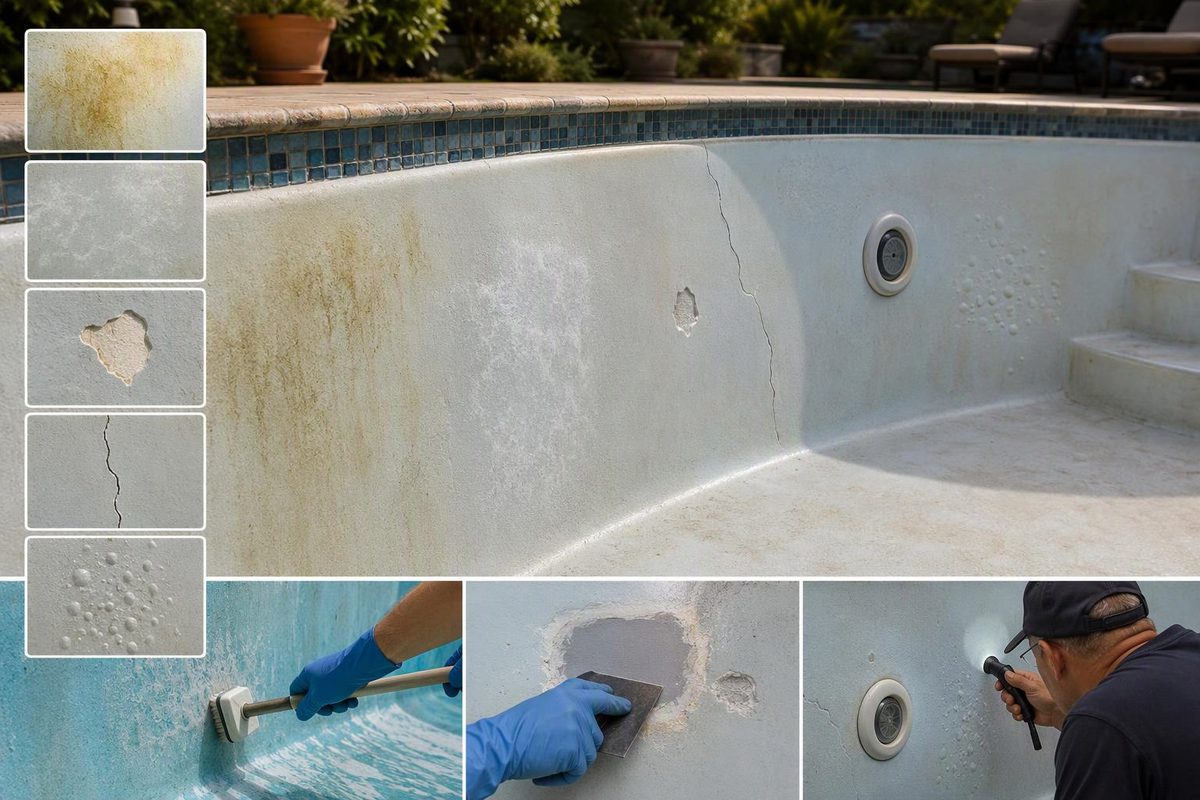
Fiberglass pool gelcoat problems need treatment matched to their depth: clean deposits, patch confirmed finish-only damage, and get professional assessment for moving cracks, blisters or exposed broken fiberglass. Do not drain the pool to investigate. A cosmetic gelcoat patch cannot repair cracked laminate or correct shell movement.
Select the symptom and any warning signs to see the safest next step.
Choose The Next Step
Start With Approved Gentle Cleaning
Use a soft nylon brush or microfiber cloth and a cleaner approved for your pool. Test the water and identify the stain before choosing a stain remover. Get persistent stains assessed.
Keep the normal operating water level. Do not use metal tools, wire brushes, steel wool or abrasive pads.
Source: the manufacturer and composite-repair guidance cited in this article. Symptom triage is not confirmation of repair depth.
Gelcoat supplies the pool’s color and smooth surface and protects the underlying composite. Thursday Pools’ maintenance guide describes that protective role and recommends gentle cleaning, debris removal, water testing and assessment of persistent stains.
Keep The Pool Filled During Assessment
Keep the normal operating water level while arranging an assessment. Removing water exposes an inground fiberglass shell to pressure from surrounding groundwater; the shell can shift, bulge or crack. A dry repair may require controlled water removal, but that must be planned with the installer or manufacturer—not used as the first DIY inspection step.
Thursday Pools warns about structural stress at very low water levels. Tallman Pools’ care instructions require written authorization before draining its pools. That authorization requirement is specific to Tallman; follow your own shell manufacturer’s instructions.
Before cleaning, sanding or opening a potentially warrantable defect, photograph it close up and in the context of the wall, floor or step. Record when it appeared, recent chemical additions, impact, water loss and previous repairs. Save water-test results and maintenance records, identify the shell manufacturer and finish color, and contact the dealer before altering the surface.
Stop using a damaged step or affected area if it moves, has sharp edges or exposes broken fibers. A growing crack, wall bulge or unexplained water loss calls for professional assessment rather than a finish-only patch.
Stains Need Identification Before Treatment
A waterline ring can contain sunscreen, body oils and other residue. Leaves and metals such as iron or copper can also cause staining. Color alone is not enough to choose a treatment.
Start with a soft nylon brush or microfiber cloth and a cleaner approved for your fiberglass pool. Remove debris, test the water and identify the likely stain before applying a stain-removal product. Persistent staining deserves a pool professional’s assessment.
Do not scrape with metal tools or use wire brushes, steel wool or abrasive pads. Aggressive cleaning can turn a removable deposit into permanent finish damage.
White Haze Is Not Automatically Calcium Scale
Rough mineral buildup, persistent haze and actual color loss can look similar from the pool deck. Check pH, sanitizer, calcium hardness and recent chemical use against the shell manufacturer’s instructions. Try only approved, non-abrasive cleaning first.
If the surface stays pale, powdery or rough, have it identified before acid treatment, sanding or polishing. Orenda distinguishes chalking from ordinary calcium carbonate scale, but its April 2025 update reports preliminary findings from an unnamed manufacturer and acknowledges uncertainty about the mechanism. Those reports do not establish a universal cause or remedy for white fiberglass surfaces.
Correcting water chemistry helps limit further exposure; it does not necessarily restore damaged color or finish. Tallman’s care guidance also warns against sanding, polishing or buffing without direction from a fiberglass pool professional.
Chips Can Be Cosmetic Only When The Substrate Is Sound
A localized scratch, chip or gouge confined to sound gelcoat may suit a cosmetic repair. A gouge reaching fractured fiberglass needs a different repair scope.
Ask the manufacturer for the appropriate repair material and color system. Before accepting a patch, establish that the surrounding finish is sound and the substrate is stable. Scott Bader’s gelcoat repair guidance calls for removing damaged material and checking whether cracking continues into the laminate.
Our gelcoat repair kit guide explains the difference between cosmetic filling and repairs requiring reinforcement. A kit does not establish which type of damage you have.
Hairline Cracks Need A Movement Check
A thin crack is not automatically structural, but width alone cannot establish that it is cosmetic. Note whether it is isolated, spreading, recurring after repair or associated with movement at a step, fitting or wall.
Gelcoat can crack from its own brittleness or from flexing underneath. Epoxyworks’ composite repair guidance explains why repairing the finish without correcting underlying movement can lead to repeated cracking. Its boat repair procedure is not a pool-specific repair specification.
Do not coat over an unexplained crack network. Have the laminate and support conditions assessed first. For step damage, use the decision checks in our fiberglass pool step repair kit guide.
Blisters Require Inspection Beneath The Finish
Raised domes beneath the finish are different from stains or scale. River Pools describes osmotic blistering as water accumulating beneath gelcoat and separating it from the layer behind it.
Appearance alone does not establish a blister’s depth or the condition of the laminate. The WEST SYSTEM fiberglass boat manual, section 10.1, includes assessment beneath the gelcoat when evaluating blister damage. That supports looking beyond the visible finish—not applying a boat-hull treatment directly to a pool.
Photograph the distribution and arrange an inspection. Do not puncture bubbles or sand the whole surface as an exploratory DIY step. Isolated finish damage and widespread separation need different repair plans.
A Repair Plan Must Specify Depth, Compatibility And Immersion Cure
Before buying resin or accepting a resurfacing quote, get the repair scope in writing.
| Plan Item | What It Must Establish |
|---|---|
| Repair depth | Finish only, filler or replacement laminate |
| Cause correction | How movement, moisture or chemical exposure will be addressed |
| Compatibility | Suitability for the substrate, old patches and treated-water immersion |
| Preparation | Removal of unsound material, contamination control and required surface profile |
| Cure | Temperature, catalyst or hardener requirements and refill timing |
Gelcoat products are not interchangeable. Fibre Glast’s application guide ties selection to resin compatibility and service environment, and identifies preparation, catalyst level, thickness and temperature as important variables. Scott Bader’s instructions specify layer buildup and a wax-containing final layer for its system. The repair plan should address final-layer air exclusion where the selected material requires it.
Do not assume polyester gelcoat can go directly over any epoxy patch. TotalBoat’s gelcoat instructions exclude direct application over epoxy resins and fairing materials, while allowing its specified TotalProtect barrier-coat system with detailed preparation. That is a rule for this product combination, not a universal resin rule.
A sanding time is not necessarily a refill time. Scott Bader’s 24-hour guidance concerns sanding and finishing, not pool refilling. Obtain the immersion-cure requirement for the exact repair system; the cited guidance does not establish a universal refill interval.
After repair, use your shell manufacturer’s current chemistry instructions, soft cleaning tools and approved products. Tallman’s care guidance warns against letting concentrated chemicals rest on the finish.