
Fiberglass Jon Boat: Buying, Comparing and Inspection Guide
A fiberglass jon boat can be a quiet, steady platform for fishing, hunting, gigging, or utility work. The name alone, however, tells you little about how a…
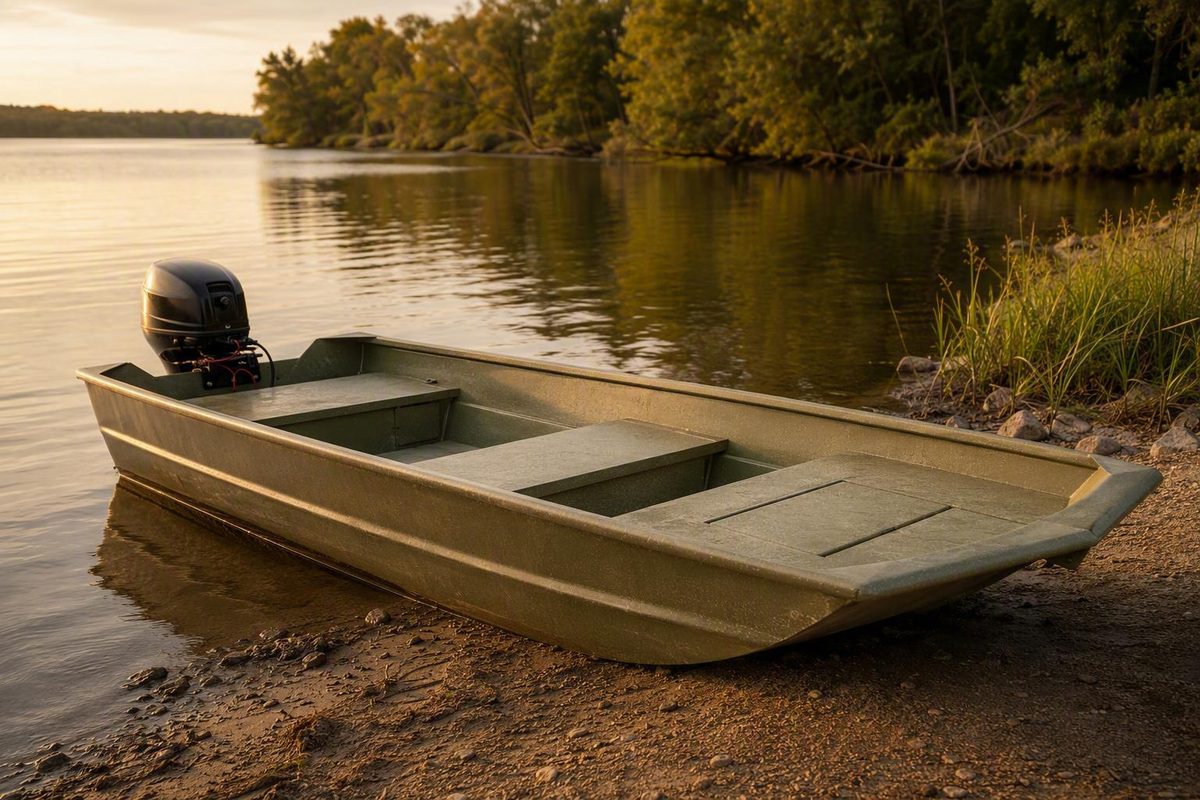
A fiberglass jon boat can be a quiet, steady platform for fishing, hunting, gigging, or utility work. The name alone, however, tells you little about how a particular boat will perform.
Sellers and owners use the label for molded flat-bottom boats, shallow-running skiffs, tri-hulls, regional river boats, and even yacht tenders. Some have the open layout and shallow-water priorities associated with an aluminum jon boat without sharing its hull form.
That distinction affects draft, stability, spray, ride, load capacity, required power, and vulnerability to grounding. The practical question is therefore not “Which material is best?” It is:
Which specific hull, in its actual loaded configuration, fits your water, obstacles, towing setup, storage, budget, and intended activity?
This guide provides a category overview, a material-comparison framework, and a used-hull screening checklist. It is not a current model directory: the available evidence does not establish comprehensive production status, availability, manufacturer specifications, warranties, delivered prices, or model-specific performance.
What “fiberglass jon boat” actually means
A useful working definition is a small fiberglass utility or fishing boat with jon-like priorities, usually including open floor space, relatively shallow-water operation, simple rigging, and a flat or nearly flat running surface.
That is a practical definition, not an established industry standard.
The supplied market evidence uses the term inconsistently. One retailer groups two Stalker models with a product named the Buoy 114 Yacht Tender and another named the Angler Bay Tri Hull 1569. Owner discussions also compare conventional aluminum jons with Carolina Skiff-style boats and specialized Ozark river hulls. “Fiberglass jon boat” is therefore better understood as a loose shopping or regional category than a precise hull classification.
Several neighboring boat types can look similar while behaving differently:
- Conventional jon boat: Usually has a flat or nearly flat bottom, an open interior, and a utility-oriented shape intended primarily for protected or shallow water.
- Fiberglass skiff: A broad category that can include flat-bottom and modified-V designs. A skiff may have jon-like utility without being a conventional jon.
- Tri-hull: Uses multiple longitudinal hull sections. Its stability, draft, spray, and ride must be assessed from the actual design rather than inferred from a jon label.
- Bass boat: Commonly incorporates casting decks, enclosed storage, a console, and a performance-oriented power package. An older fiberglass bass boat is not automatically a fiberglass jon boat.
- Yacht tender or dinghy: Intended partly to carry people or supplies between a larger vessel and shore. Its layout, transom, capacity, and operating limits may differ from those of a fishing jon.
- Regional river boat: A purpose-built design influenced by local fishing and river-running practices. Owners may call it a fiberglass jon even when its details differ substantially from a mass-market aluminum jon.
Why classification matters
Bottom form, beam, freeboard, length, weight, and load placement influence how a boat floats and moves. A broad, flat hull may feel steady at rest but respond abruptly to closely spaced chop.
Those characteristics cannot be determined from the word “fiberglass.”
Construction must also be identified. A plywood hull covered with light fiberglass cloth is different: the plywood may remain the main structure while the glass primarily protects against moisture and abrasion. The supplied specialist discussion supports that distinction but does not establish a universally safe plywood thickness, laminate schedule, transom design, or horsepower rating (Boat Design Net’s plywood-and-fiberglass discussion).
A practical classification test
Before relying on a seller’s category name, identify:
- The actual bottom form: flat, modified-V, tri-hull, tunnel, or another shape.
- Overall length, bottom width, beam, freeboard, and transom height.
- Bare hull weight and complete operating weight.
- The capacity plate or documented person, load, and horsepower limits.
- Primary construction: solid laminate, cored laminate, molded liner, wood-supported structure, or glass-covered plywood.
- Steering layout and usable open floor area.
- The builder’s documented intended use.
- Published loaded draft, if available, including the load and test conditions.
- Trailer-support requirements for that particular hull.
Treat seller-provided figures as unverified unless they match the capacity plate, builder documentation, an archived specification sheet, or another authoritative record. If those facts cannot be established, the fiberglass jon-boat label is not enough to support a purchase.
The short answer: who should consider fiberglass?
A fiberglass jon-style boat deserves consideration when the operating area is mostly protected and the buyer values quietness, reduced wind response, a settled platform, and a molded layout that already suits the job.
An aluminum jon is often the more practical starting point when the boat must be towed or moved frequently, launched informally, beached regularly, or operated where contact with rocks, gravel, stumps, docks, and other hard obstacles is difficult to avoid.
These are tendencies rather than guarantees. The supplied evidence consists largely of owner discussions and manufacturer, dealer, or retailer guidance—not controlled testing of otherwise identical boats.
| Priority or condition | Fiberglass may fit when… | Aluminum may fit when… |
|---|---|---|
| Protected lakes and calm tailwaters | Quiet presentation and a settled fishing platform matter | Low package weight and easy launching matter more |
| Rocky or stump-filled shallows | Contact can usually be avoided | Repeated impact or abrasion exposure is expected |
| Frequent towing | The vehicle, hitch, and trailer suit the complete package | A generally lighter package is preferred |
| Occupants moving aboard | The specific broad, heavier hull provides the desired feel | A sufficiently wide aluminum hull is already steady enough |
| Chop | Hull shape, dimensions, load, and freeboard suit the conditions | The aluminum hull has appropriate geometry and dimensions |
| Utility customization | The molded layout already works | Brackets, decks, or accessories will be changed frequently |
| Used-boat risk | Structure and repair history can be verified | The buyer wants to limit exposure to hidden fiberglass core or laminate repairs |
| Saltwater | Builder documentation and hardware support the intended environment | Alloy, electrical installation, anodes, and maintenance suit saltwater use |
Commercial comparison guidance generally describes fiberglass boats as heavier and quieter and aluminum boats as lighter and more tolerant of routine impacts or abrasion. The same guidance also acknowledges that size, construction, and hull form can overwhelm simple material comparisons (Boat Outfitters’ aluminum and fiberglass overview).
Fiberglass is not automatically an open-water safety upgrade. A heavier boat may feel more settled, but a basic flat bottom can still pound, throw spray, or become unsuitable as waves build. A broad, well-designed aluminum hull may also be steadier than a narrow fiberglass boat.
Begin with six questions:
- Where will the boat operate most often?
- What will it strike, rub against, or be beached on?
- Can the complete towing package be accommodated by the vehicle, hitch, and trailer documentation?
- Will the boat fit its storage area?
- What is included in the purchase, and what will the complete package cost?
- Can the particular hull’s structural condition be established?
Fiberglass versus aluminum: the trade-offs that matter
A fair comparison holds length, bottom width, hull form, capacity, power, equipment, and operating load as close as possible. Otherwise, a heavy fiberglass skiff may be compared unfairly with a basic aluminum jon—or a sophisticated aluminum fishing boat with a simple fiberglass flat-bottom.
| Criterion | Fiberglass jon-style boat | Aluminum jon boat |
|---|---|---|
| Bare weight | Generally heavier, depending on construction and size | Generally lighter in comparable utility designs |
| Towing and handling ashore | May require more trailer and tow capacity | Often easier to tow, launch, and store |
| Power requirement | Added weight may increase power demand | Often performs acceptably with less power |
| Wind response | Added mass may reduce quick wind-driven movement | A light hull may drift or pivot more readily |
| Occupant movement | Broad, heavy examples often feel settled | Depends heavily on width, hull form, and load |
| Noise | Often transmits less wave slap and dropped-object noise | Bare metal panels may sound louder |
| Ride in chop | Weight may damp movement, but hull geometry remains decisive | Flat bottoms may pound; shaped aluminum hulls can behave differently |
| Impact damage | May chip, crack, delaminate, or expose laminate | May dent, crease, split, or develop rivet or weld problems |
| Abrasion | Gelcoat and laminate can wear through | Finish and metal can gouge, wear, or deform |
| Corrosion | Laminate does not corrode, but hardware still requires care | Saltwater corrosion and electrical isolation require attention |
| Cosmetic care | Gelcoat may need cleaning, polishing, or localized repair | Paint and finishes can scratch; bare metal shows wear |
| Modification | Cutting and drilling require sealing and structural awareness | Accessory fabrication is often easier, subject to proper methods |
| Structural repair | Laminate can be rebuilt, but core and transom work may be extensive | Welding or riveting may be possible, depending on alloy, fatigue, and access |
Weight, towing, and power
A heavier hull may feel beneficial on the water while being burdensome everywhere else. It can increase trailer demands, storage difficulty, launch constraints, and engine requirements.
Do not compare only advertised bare hull weights. Account for the motor, trailer, batteries, fuel, controls, electronics, safety equipment, anchors, accessories, crew, and gear. Use the tow vehicle, hitch, and trailer labels and manuals—not a seller’s informal assurance—to determine whether the complete package is compatible.
A modified aluminum jon may no longer be especially light after decking, batteries, livewells, fuel, electronics, and a larger motor are added. Whenever possible, obtain a documented package weight or weigh the complete rig.
Noise, wind response, and steadiness
In the supplied owner discussions, fiberglass skiffs are repeatedly described as quieter, less reactive to wind, and less affected by occupants moving around. Aluminum boats are commonly described as lighter and easier to move, but more susceptible to wind and wave noise. These are anecdotal observations, not guarantees, and the boats being compared differ in hull form, dimensions, equipment, and load (Charleston Fishing’s owner comparison of aluminum jons and fiberglass skiffs).
Mass can damp quick movement, but beam, bottom width, underwater shape, seating position, and load distribution also matter. A broad aluminum hull may therefore feel steadier than a narrow fiberglass one, while a finished aluminum interior may be quieter than a bare utility hull.
Ride and spray
Greater weight may improve perceived ride by reducing abrupt reactions to small waves. Molded fiberglass also allows complex hull shapes, but aluminum can be formed into modified-V and specialized designs.
Both aluminum and fiberglass flat-bottom boats can pound or spray in chop.
If rough water is part of the intended use, compare the complete hull design, capacity documentation, drainage arrangement, visibility, load, and operating limits. Do not generalize from a calm-water demonstration.
Damage modes
The two materials usually show different forms of damage:
- Fiberglass may develop gelcoat chips, stress cracks, fractured laminate, delamination, or damage around poorly sealed penetrations.
- Aluminum may dent, crease, gouge, split, corrode, loosen rivets, or develop fatigue or weld-related defects.
Saltwater and oyster beds
Fiberglass laminate resists corrosion, but the boat’s metal hardware, wiring, fasteners, motor, and trailer still require care. Aluminum suitability depends on the alloy, installation, electrical isolation, anode arrangement, finish, and maintenance.
Do not assume a fiberglass model is intended or warranted for saltwater merely because a retailer places it in a saltwater category. Confirm that use through builder documentation and warranty terms.
The supplied owner reports conflict on oyster-bed exposure. Avoid contact regardless of material, and examine the hull and propulsion system after a grounding.
Match the hull to the water and activity
Start with the harshest condition the boat will encounter regularly—not the calmest day on which you hope to use it.
| Water or activity | Priorities | Practical direction |
|---|---|---|
| Rocky river | Impact exposure, easy launching, manageable towing, protected running gear | Aluminum often has the practical advantage |
| Gravel-bottom tailwater | Abrasion exposure, controllability, shallow-water setup | Aluminum for frequent contact; fiberglass if contact can usually be avoided |
| Stump-filled lake | Low-speed impact exposure, maneuverability, propulsion protection | Aluminum is commonly favored |
| Oyster flat | Contact avoidance and post-grounding inspection | No categorical material winner |
| Marsh | Wind behavior, open layout, cleanup, corrosion care | Either; match the design and maintenance to the environment |
| Protected lake | Quietness, steadiness, fishing control | Fiberglass may appeal if package weight is manageable |
| Gigging or crabbing | Open floor, low clutter, lighting load, cleanup | Layout matters more than the category name |
| Duck hunting | Gear capacity, stability, concealment, debris cleanup | Often aluminum, though a suitable fiberglass utility hull can work |
| Family fishing | Capacity, seating, freeboard, boarding, storage | Compare complete layouts and documented limits |
| More exposed water | Hull shape, dimensions, freeboard, capacity, conditions | Do not choose a basic flat bottom by material alone |
Rocky rivers, gravel bars, and frequent beaching
These uses reward manageable towing weight, easy launching, impact tolerance, and serviceable running gear. The supplied owner and commercial guidance generally favors aluminum where repeated hard contact is expected, although it does not provide controlled model-matched testing.
The hull is only part of the risk. A propeller, skeg, water intake, jet unit, transducer, or other fitting may be the lowest and most vulnerable part of the boat. Choose and operate the package according to the builder and propulsion manufacturer’s instructions.
Protected lakes and tailwaters
A fiberglass skiff or regional river hull may deserve consideration where quiet presentation, reduced wind response, and steadiness while casting are high priorities. The boat still needs sufficient capacity, freeboard, control, and propulsion for its intended load and local conditions.
Historical Ozark forum participants discussed Supreme, Shawnee, Playcraft, and Carolina Skiff designs for shallow river use. That discussion demonstrates regional interest but does not establish current production, current specifications, availability, or a defensible brand ranking (Ozark Anglers’ historical fiberglass river-boat discussion).
Marshes and oyster flats
In marshes, wind, vegetation, mud, tidal access, corrosion exposure, and cleanup may matter as much as impact resistance. A heavier fiberglass boat may respond differently to wind, while a lighter aluminum hull may be easier to launch or maneuver at low power.
Around oyster beds, do not choose from anecdotes alone. Plan to minimize contact and examine the bottom, chines, keel, transom, and propulsion system after a strike or grounding.
Gigging, crabbing, hunting, and gear-heavy fishing
For gear-intensive activities, evaluate the layout before the material:
- Look for unobstructed floor space and suitable walking surfaces.
- Inventory batteries, fuel, coolers, decoys, lights, catch, and other equipment when considering capacity.
- Compare load placement with the builder’s instructions rather than concentrating every heavy item at the stern.
- Ensure added structures do not block intended drainage paths.
- Consider how easily mud, fish residue, or salt can be removed.
- Verify that lights, rails, generators, and elevated platforms are compatible with the hull’s documented capacity and structure.
- Assess visibility from the operating position after accessories are installed.
A tiller can preserve open floor space. A console may provide a more comfortable steering position and a location for controls and electronics, but it consumes space and adds components.
Rougher or exposed water
A basic flat-bottom fiberglass boat does not become an open-water boat merely because it is heavy. Flat bottoms can meet wave faces abruptly, throw spray, and become uncomfortable as conditions deteriorate.
For more exposed water, prioritize documented capacity, hull length, bottom form, bow shape, freeboard, drainage, visibility, load, and realistic weather limits. The supplied evidence does not establish measured draft, safe minimum operating depth, or open-water suitability for any current fiberglass jon-style model. Those determinations require model-specific documentation and an understanding of the actual load and conditions.
Hull form, tiller layout, and shallow-water propulsion
Shallow-water performance is a system outcome. Material is only one variable.
The boat’s running configuration also depends on trim, speed, load placement, engine installation, and propulsion type.
Specifications to verify
Seek authoritative, model-specific records for:
- Overall length
- Bottom width
- Overall beam
- Bare hull weight
- Rigged package weight
- Maximum persons and total capacity
- Maximum rated horsepower
- Loaded draft and the conditions under which it was measured
- Transom dimensions and engine-mounting requirements
- Flotation and applicable compliance information
- Permitted steering arrangements
- Warranty coverage and exclusions
- Environmental limitations, if any
For an older hull, look for the capacity plate, owner’s manual, archived builder literature, or written builder confirmation. A seller can identify where a figure came from, but a seller’s unsupported statement should not replace those records.
Tiller versus console
A tiller generally preserves open interior space and reduces the number of steering components. It can suit fishing, gigging, hunting gear, decoys, and bulky equipment. Because the operator sits aft, the complete load arrangement still needs to be evaluated with the motor, battery, fuel, and gear aboard.
A console takes floor area and adds controls, cables, wiring, and weight. Its effect on trim depends on its position and the rest of the load.
Compare both layouts as complete operating configurations. An empty hull that looks spacious can become crowded or stern-heavy once fully rigged.
Jet outboards
A historical buyer discussed using a factory 25-horsepower jet on a regional fiberglass river boat. That forum reference records the buyer’s plan; it does not establish that 25 horsepower is suitable for that boat or any present model (Ozark Anglers’ historical river-boat discussion).
Jet suitability depends on the specific hull, loaded displacement, engine output at the jet, engine weight, intake position, water flow, transom dimensions, operating conditions, and ability to perform under the intended load. Compatibility should be confirmed through hull and engine documentation or by a qualified rigger.
Do not infer horsepower requirements from an isolated owner speed report. Propeller or jet configuration, mounting, load, altitude, current, hull condition, and instrumentation can all affect a reported result.
Pre-purchase measurement list
Measure the complete ownership system before paying a deposit:
- Boat length, including stern projections
- Trailer length from coupler to supported motor
- Maximum package width
- Height on the trailer with accessories installed
- Garage opening and usable interior dimensions
- Space required to maneuver the trailer
- Launch-ramp access, depth, slope, and overhead clearance
- Complete towing weight or the information needed to establish it
- Trailer rating and available payload
- Tow-vehicle and hitch ratings
- Propulsion clearance during launch and retrieval
Verify compatibility against the relevant vehicle, hitch, trailer, boat, and engine documentation. A hull that fits the water but not the storage space, ramp, trailer, or tow vehicle is not a workable package.
What is actually listed for sale—and what the listings do not prove
The supplied market evidence is too limited to support a current model directory or comprehensive market survey.
One undated retailer snapshot displays four products in a fiberglass jon-boat category:
| Listed product | Displayed sale price |
|---|---|
| Buoy 114 Yacht Tender | $6,749 |
| Stalker Jon 140 | $6,299 |
| Stalker 1464 | $7,279 |
| Angler Bay Tri Hull 1569 | $8,299 |
The same page states that shipping and tax are excluded from its cart totals. It does not establish the sale year, present availability, model-year specifications, construction, warranty, or whether a motor, trailer, seats, steering, and rigging are included (Direct Boats’ fiberglass jon category page).
The product names also illustrate the category problem: one is called a yacht tender and another a tri-hull. The four listings should not be represented collectively as conventional jon boats without model-specific evidence.
The retailer markets the group for fresh and salt water. Treat that as seller language, not confirmation of builder-approved use or warranty coverage.
This page does not establish:
- A complete list of active manufacturers
- Current production status
- Present inventory
- Current delivered prices
- Model-specific capacity or draft
- Propulsion or trailer inclusion
- Current warranty terms
- Whether legacy regional brands remain active
Total-package cost worksheet
Ask competing sellers to quote the same complete configuration in writing.
| Cost category | Seller’s written amount |
|---|---|
| Hull | |
| Motor | |
| Propeller or jet unit | |
| Tiller or console equipment | |
| Steering and controls | |
| Fuel system | |
| Battery and switching | |
| Trailer | |
| Bunks, winch, and tie-downs | |
| Rigging and installation | |
| Seats and bases | |
| Drainage equipment | |
| Navigation lights | |
| Required safety equipment | |
| Electronics and transducers | |
| Trolling motor and battery system | |
| Freight or destination charges | |
| Dealer preparation | |
| Sales tax | |
| Title and registration | |
| Initial service | |
| Storage | |
| Insurance | |
| Tow-vehicle or hitch changes | |
| Complete delivered total |
Do not compare a bare fiberglass hull price with a turn-key aluminum package. Conversely, do not assume that an expensive listing includes propulsion or a trailer unless the written quote says so. Compare included equipment, condition, warranty, package weight, and required post-purchase work rather than the headline price alone.
Used fiberglass jon boat inspection checklist
An older fiberglass jon-style boat may be a useful platform, or it may conceal a transom, deck, core, stringer, foam, or laminate project that exceeds its value. The following steps are preliminary screening measures, not a substitute for a qualified inspection.
1. Verify identity and records
Ask to review:
- Hull identification number and corresponding paperwork
- Builder, model, and model year
- Capacity plate
- Rated horsepower
- Title or registration records applicable in the relevant jurisdiction
- Trailer identification and paperwork
- Engine serial number and available service records
- Repair invoices and photographs
- Explanations for altered, missing, or inconsistent labels
Requirements differ by jurisdiction. Confirm documentation questions with the agency responsible for boat registration or titling rather than relying solely on the seller.
2. Inspect the exterior in strong, angled light
The hull should be clean and dry. Look for:
- Keel and chine abrasion
- Exposed reinforcement
- Open or concentrated cracks
- Blisters
- Depressions, bulges, or distorted surfaces
- Mismatched paint or gelcoat
- Poorly faired patches
- Outlines suggesting previous repairs
- Damage around corners, drains, strakes, and the transom
- Undocumented repairs below the waterline
A small surface chip may be limited to gelcoat if the laminate beneath it is intact. More concerning signs include exposed reinforcement, distortion, movement, cracking along a structural line, or cracking through an earlier repair. Visual examination alone cannot establish the condition of concealed laminate, core, or wood.
3. Treat tap testing as a screen, not a verdict
Comparing the sound of adjacent or corresponding areas may help identify zones that deserve further investigation. General BoatUS guidance describes solid laminate as sounding sharper and suspected delamination as sounding duller when lightly tapped. It also emphasizes removing compromised laminate when repairing impact damage (BoatUS fiberglass hull-repair guidance).
Sound varies with thickness, curvature, backing structure, foam, core, and previous repairs. Tap testing cannot prove that a hull or core is dry, intact, or structurally sound.
4. Give the transom special attention
Visually examine the motor-mount area, splashwell, drain, tie-down eyes, braces, and upper corners for:
- Cracks near mounting bolts
- Compressed or crushed areas
- Staining around penetrations
- Failed sealant
- Bulges or apparent separation
- Added plates or unexplained reinforcement
- Distortion around the engine mount
- Cracks reported to change under ordinary motor load
Do not improvise a force test or apply loads beyond normal operation. If the owner demonstrates ordinary motor movement, observe from a safe position without placing yourself beneath or behind unsupported equipment.
A historical restoration discussion describes a fiberglass jon with an approximately 12-inch transom crack and visible bowing under motor load. That example does not diagnose another boat, but it illustrates why movement combined with cracking should be treated as a possible structural failure rather than a cosmetic patch (iBoats’ fiberglass-boat restoration discussion).
5. Examine the deck and interior
Look for:
- Localized softness or unusual deflection
- Cracks around seat bases and consoles
- Standing-water marks or persistent odor
- Unsealed accessory holes
- Water appearing around penetrations
- Deteriorated or wet-looking flotation where accessible
- Damaged bonding around accessible structural members
- Blocked drainage paths
- Added decking that conceals original construction
- Unsupported batteries or fuel tanks
- Cut or altered structural components
Do not walk on surfaces not intended to bear weight. If a floor or deck was replaced, ask what was found underneath and whether photographs or invoices document the work.
6. Investigate previous modifications and repairs
A smooth finish does not prove that a repair restored the original structure. Ask:
- What damage led to the repair?
- Was compromised material removed?
- Which materials were used?
- Was the repair above or below the waterline?
- Was a damaged core replaced or merely covered?
- How were penetrations sealed?
- Are photographs, invoices, or professional records available?
Pay particular attention to added engines, jack plates, elevated platforms, consoles, and storage structures. Their compatibility cannot be established from appearance alone.
7. Examine the trailer and hull support
Look for damaged bunks or rollers, obvious pressure points, misalignment, inadequate transom support, hull distortion, or contact between hardware and laminate. Compare the arrangement with any available builder or trailer documentation.
Also inspect the trailer’s identification, rating label, coupler, chains, tires, bearings, lights, and brakes. Questions about trailer capacity or roadworthiness should be resolved through the trailer manufacturer, applicable vehicle documentation, or a qualified service provider.
Stop-buy or professional-inspection triggers
Pause the purchase when you find:
- Transom flex, bowing, or distortion
- A crack reported or observed to change under normal motor load
- Broad areas with suspiciously different tap sounds
- Soft flooring or accessible structural members
- Open structural cracks
- Exposed or wet-looking core
- Persistent water emerging from enclosed areas
- Keel wear extending into laminate
- Uncertain repairs below the waterline
- Large undocumented repairs
- An unverified horsepower rating
- Visible hull deformation associated with trailer support
A low asking price does not resolve structural uncertainty.
Maintenance, repairability, and the repair-or-replace decision
Fiberglass work ranges from surface care to structural reconstruction. Separating those categories helps prevent both underreaction to structural damage and overreaction to harmless cosmetic weathering.
Cosmetic upkeep
Routine work may include:
- Washing away dirt, salt, fish residue, and organic staining
- Keeping intended drainage paths clear
- Limiting standing water and prolonged weather exposure
- Polishing or waxing suitable gelcoat
- Correcting minor surface oxidation
- Repairing nonstructural surface chips with compatible materials
- Inspecting hardware penetrations
- Maintaining fittings, wiring, propulsion equipment, and the trailer
Cosmetic work does not restore a weakened transom, replace a damaged core, reconnect failed structure, or rebond extensive delamination.
Structural repair at a high level
A structural fiberglass repair generally requires:
- Identifying the original construction and damage extent.
- Removing compromised laminate rather than covering it.
- Examining the surrounding area for additional damage.
- Cleaning and dewaxing before grinding.
- Preparing a sufficiently broad bonding area.
- Selecting resin, reinforcement, and coatings compatible with the existing structure.
- Rebuilding the laminate in controlled stages.
- Restoring any affected core, transom, or structural connection.
- Following product-specific cure requirements.
- Fairing and refinishing the completed repair.
- Determining whether the restored structure is appropriate for its intended load.
BoatUS gives general hull-repair guidance calling for a 12-to-1 bevel when preparing a secondary bond. It also warns that applying more than four plies at once can generate excessive heat. The same guidance permits polyester or vinylester for certain above-waterline repairs, recommends epoxy for underwater repairs, and cautions against epoxy where gelcoat will be applied. These are general repair principles—not a fiberglass jon-boat laminate schedule—and material and coating compatibility must be confirmed for the actual repair system (BoatUS fiberglass repair guidance).
Do not adopt a universal cloth schedule, plywood thickness, transom doubler, or horsepower recommendation from a forum or generic article. Original construction, damage geometry, engine loads, and builder requirements govern structural work.
Safety boundaries
Grinding and laminating can involve dust, fibers, vapors, heat, and reactive chemicals. BoatUS specifically advises eye protection, a suitable dust mask, and long sleeves during grinding. Beyond that general guidance, follow the safety data and instructions supplied by the resin, catalyst, solvent, reinforcement, and coating manufacturers.
Do not assume that materials or coatings are compatible. If the existing laminate, coating, or contamination cannot be identified, qualified assessment is preferable to experimentation on a structural area.
When limited DIY work may be reasonable
Limited cosmetic work or a small, accessible repair may be within an experienced owner’s abilities when:
- The damage boundaries are clear.
- No transom, core, stringer, engine mount, or critical attachment is involved.
- The service environment is understood.
- Compatible repair and finishing materials can be identified.
- Product instructions and working conditions can be followed.
- Failure would not conceal a structural or propulsion hazard.
A generic patch kit should not be treated as an engineered answer for unknown structural damage.
When professional assessment is prudent
Obtain qualified help for:
- A moving or bowed transom
- Suspected wet or deteriorated core
- Widespread delamination
- Extensive below-waterline damage
- Failed structural bonds
- Damage around an engine mount or lifting point
- Uncertain previous structural repairs
- Major hull distortion
- Damage that may affect capacity or rated horsepower
- Any repair whose safe load capability cannot be established
Repair or replace?
Compare the complete project rather than the price of resin and cloth.
Hull value: What would the boat be worth in documented sound condition?
Damage location: A small surface defect differs materially from damage to the transom, keel, core, or structural supports.
Hidden-damage risk: Will opening the area likely reveal broader deterioration or water intrusion?
Intended power and load: Engine installation and operating load affect the demands placed on the structure.
Tools and working environment: Include protective equipment, grinding and dust control, shelter, supports, measuring tools, temperature control, and disposal.
Labor: Count diagnosis, disassembly, drying, preparation, layup, curing, fairing, coating, rerigging, and troubleshooting.
Finish expectations: A utility finish may cost less than a restored gelcoat appearance, but neither should conceal unresolved damage.
Trailer and engine condition: A cheap hull may still be an uneconomic package if the trailer, motor, controls, and wiring also require substantial work.
Sentimental value: It may justify spending more than market value, but it does not establish structural safety.
Replacement and exit cost: Compare the repair with a documented sound replacement and account for disposal if the project becomes impractical.
A forum estimate of $200–$300 for restoration materials in 2011 is not usable for current budgeting. It may also omit tools, labor, protective equipment, refinishing, and hidden structural work.
The central rule is simple: repairability is not the same as an economical or verified-safe repair.
Frequently asked questions
Do companies still make fiberglass jon boats?
The supplied retailer page displays two Stalker models, a yacht tender, and a tri-hull in a fiberglass jon-boat category. That establishes only that the listings appeared on the page; it does not prove present availability, current production, category fit, or model-year specifications.
The available evidence is insufficient to produce a verified list of active manufacturers. Before buying, request current builder documentation, production status, warranty terms, included equipment, and a written delivered-price quote.
Is a fiberglass jon-style boat better than aluminum for shallow water?
Not categorically.
Fiberglass may suit protected shallow water where quietness, reduced wind response, and a settled platform matter. Aluminum is often more practical where shallow operation involves repeated contact with rocks, gravel, stumps, or beaches.
Actual shallow-water performance depends on hull geometry, loaded displacement, trim, propulsion, and the depth of the lowest vulnerable component. Compare verified specifications and complete loaded configurations rather than material alone.
Can a fiberglass jon boat use a jet outboard?
Potentially, but compatibility must be established for the particular hull and installation.
Hull design, loaded weight, engine weight and output, intake position, transom requirements, and operating conditions all matter. Use builder and engine documentation or a qualified rigger rather than a historical owner report.
How can I tell whether a used fiberglass transom is damaged?
Look for cracking around the motor mount or splashwell, compressed areas around bolts, staining, bulges, separation, unexplained reinforcement, and visible movement or distortion during ordinary operation.
A transom that bows, flexes, or opens a crack under normal motor load should be treated as potentially structural. Visual examination and tap testing can identify warning signs, but neither can prove that concealed core material is dry and sound.
Can a cracked fiberglass jon boat be repaired at home?
Some small, clearly bounded cosmetic or laminate repairs may be appropriate for an experienced owner using compatible materials and product-specific safety instructions.
A moving transom, wet core, failed structural support, widespread delamination, major below-waterline damage, or uncertain previous repair is not a generic patch-kit project. Those conditions require qualified diagnosis, and replacement may be more sensible if the repair scope or restored capacity cannot be established.
Final decision
There is no evidence-grounded universal winner between a fiberglass jon-style boat and an aluminum jon boat.
Fiberglass deserves consideration when quiet operation, reduced wind response, a settled fishing platform, and a suitable molded layout align with the intended use. Aluminum often remains the practical choice for lighter towing, frequent beaching, and obstacle-heavy shallows.
Make the final decision from the actual hull form, verified specifications, complete package weight and cost, intended propulsion, operating environment, and structural condition. Walk away—or obtain qualified help—when a used hull shows transom movement, soft structure, widespread delamination, uncertain underwater repairs, or damage whose safe repair cannot be established.