
How Much Does It Cost to Scrap a Fiberglass Boat?
Compare free vessel turn-in programs, per-foot removal rates, weight tiers, towing costs, landfill rules, and abandoned-boat penalties by state.
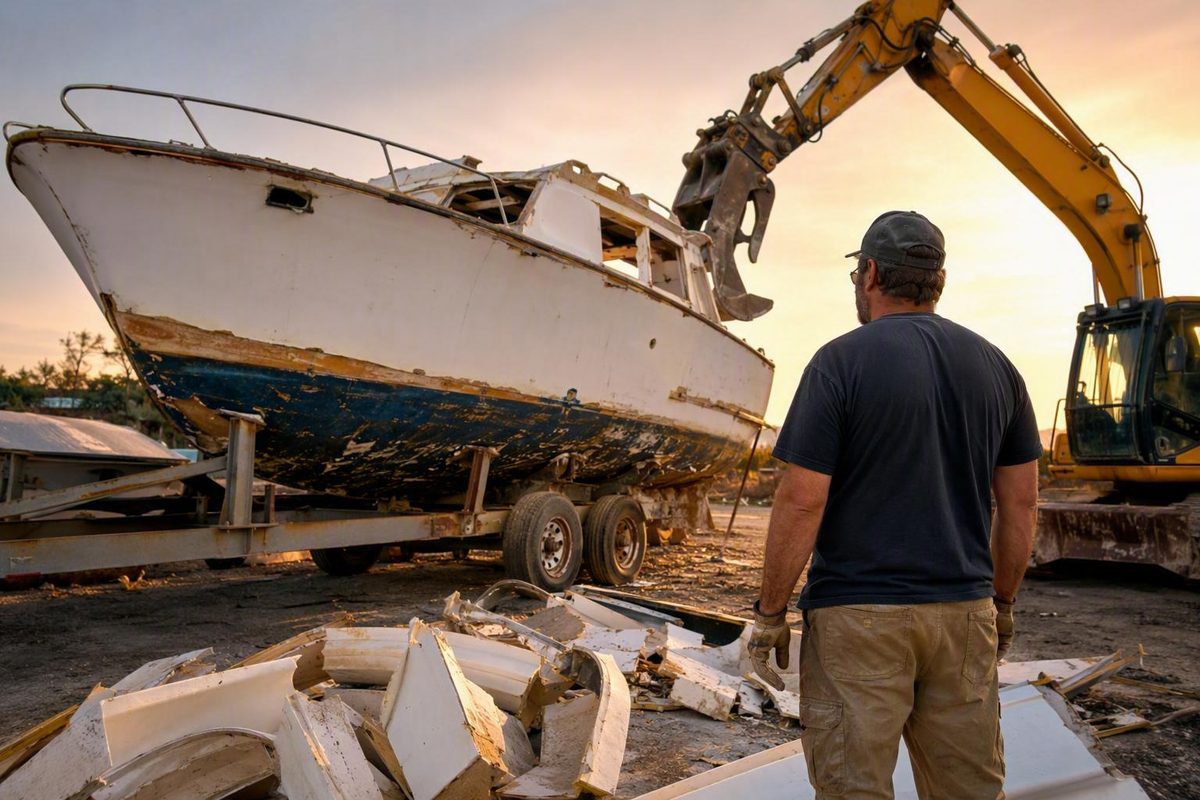
Scrapping a fiberglass boat typically costs $50–$100 per foot when an accessible boat can be delivered on a usable trailer, or about $200–$500 per foot for broader professional hauling and disposal. That puts a 20-foot boat at roughly $1,000–$2,000 in favorable conditions or $4,000–$10,000 under the broader professional benchmark. An eligible public turn-in program can reduce the owner’s cost to zero, while a waterborne, grounded, sunk, contaminated, or trailerless boat requires additional towing, haul-out, recovery, or custom handling.
Enter the boat’s location, length, trailer status, and known weight to compare the published disposal routes.
The calculator applies only the published benchmarks shown below. A dash means the evidence does not provide enough information for a defensible estimate.
Rates cover different scopes. Confirm towing, haul-out, dismantling, hazardous materials, transport, and final disposal in writing.
| Ranked Route | Estimated Owner Cost | When It Fits | Missing From Estimate |
|---|---|---|---|
| 1 Trailer-delivered benchmark | $1,000–$2,000 | Accessible dry-land boat with usable trailer | Local extras and acceptance rules |
| 2 Professional hauling and scrapping | $4,000–$10,000 | Planning range where broader service is needed | Exact scope varies by quote |
| — Public turn-in program | — | Depends on state, eligibility, funding, and vessel condition | No nationwide entitlement |
| — DIY landfill disposal | — local quote | Facility accepts prepared fiberglass and owner can transport it | Current tipping rate and actual weight |
The professional $200–$500-per-foot benchmark may represent a different scope from the favorable $50–$100-per-foot route. Do not add or compare figures without checking what each quote includes.
| Jurisdiction | Turn-In Route | Known Eligibility Or Cost | Derelict Consequence In Evidence |
|---|---|---|---|
| Florida | FWC Vessel Turn-In Program | 100% of removal, destruction, and disposal for an eligible at-risk vessel; warning or citation, inability to comply, and available funding required | Port Orange reported government removals averaging about $24,000 per boat; this is not an automatic owner bill |
| South Carolina | Free Vessel Turn-In Program announced | Confirm current application, funding, ownership, location, and condition rules | Up to $10,000 in fines plus removal costs under the 2025 abandoned-vessel law |
| Washington | DNR Vessel Turn-In Program | Current owner price, detailed eligibility, and application status are — in the available evidence | — |
| Other U.S. coastal jurisdictions | Use NOAA's state and territory contacts | Varies; the directory is not a promise of payment | Varies by jurisdiction |
Sources: Practical Sailor disposal benchmarks; Boat Removers regional rates and towing estimate; Divine Marine Seattle weight tiers and add-ons; Florida FWC; Washington DNR; NOAA ADV InfoHub; cited South Carolina and Port Orange reporting. Commercial prices can vary, and a current written quote controls.
There is no reliable current nationwide average. Unlike an aluminum or steel hull, an old fiberglass hull normally has little or no recoverable material value. The owner pays for preparation, loading, transport, dismantling, and final disposal. A facility price for an already prepared hull is not comparable with a turnkey quote that includes marine towing and haul-out.
Published Disposal Prices Span Several Different Services
The available benchmarks fall into four practical tiers:
| Disposal Situation | Published Benchmark | What It May Cover | Main Limitation |
|---|---|---|---|
| Trailer-delivered boat | $50–$100/ft | Favorable, accessible job | Not a national rate |
| Professional removal | $200–$500/ft | Hauling and scrapping | Scope varies |
| Seattle weight tiers | $1,500–$3,200 | Up to four tons | Trailer and other conditions |
| Complex recovery | Custom quote | Difficult or waterborne boat | No dependable formula |
Practical Sailor says a small boat delivered on a trailer may cost as little as $50 per foot and estimates broader professional hauling and scrapping at $200–$500 per foot. These are planning benchmarks, not guaranteed bids. Its disposal guide explains the circumstances behind the figures.
A Southern California removal company advertises $70 per foot for qualifying dry-land bowriders under 20 feet, $75–$90 per foot for boats from 20 to 27 feet, and $100 or more per foot for boats at least 28 feet long. The categories overlap at exactly 20 feet, so a 20-foot owner must confirm which tier applies. Cabin configuration, access, width, condition, towing, and hazardous waste can change the price. The provider publishes its qualifications with the rate schedule.
A Seattle-area provider instead charges by weight: $1,500 up to 1.5 tons, $2,000 up to two tons, $2,800 up to three tons, and $3,200 up to four tons. Its standard conditions include a towable trailer, biohazard removal, ownership documentation, a release of interest, and signed waivers. Larger or trailerless vessels require a custom quote, and the company says prices can vary. The provider lists its weight tiers and conditions.
Length-Based Examples Show the Likely Range
These calculations apply published rates to common boat lengths. They are arithmetic examples, not nationwide averages or bids.
| Boat | Favorable Example | Professional Benchmark | Regional Example |
|---|---|---|---|
| 16 ft | $800–$1,600 | $3,200–$8,000 | $1,120 at $70/ft |
| 20 ft | $1,000–$2,000 | $4,000–$10,000 | $1,400 at $70/ft |
| 25 ft | $1,250–$2,500 | $5,000–$12,500 | $1,875–$2,250 |
| 30 ft | $1,500–$3,000 | $6,000–$15,000 | $3,000 before extras |
The 30-foot regional figure uses the Southern California provider’s starting rate of $100 or more per foot. At that size, the provider requires an individual quote.
Length alone can be misleading. Two 25-foot boats can differ substantially in displacement, cabin volume, machinery, keel construction, and internal structure. The Seattle provider associates its tiers with boats typically measuring 21 feet and under at 1.5 tons, 23 feet and under at two tons, 26 feet and under at three tons, and 32 feet and under at four tons. Actual weight and the provider’s conditions control, not the typical length.
Do not estimate landfill weight solely from hull length. The available evidence supplies no defensible length-to-weight formula or current nationwide landfill rate. Use the builder’s specifications, a scale ticket, or a written facility estimate.
The Disposal Route Determines Which Charges Apply
A Trailer-Ready Boat Usually Costs Least
An accessible dry-land boat on a roadworthy trailer avoids marine recovery and may be delivered directly to a contractor or accepting facility. The favorable $50–$100-per-foot benchmark is most relevant to this situation.
A trailer merely being present is not enough. Tires, bearings, frame condition, brakes, registration requirements, and load capacity can determine whether a contractor will tow it. The Seattle provider requires a towable trailer for its published weight tiers; trailerless boats receive custom quotes.
An Afloat Boat Needs Towing and Haul-Out
A boat in a slip may need marine towing before it can be hauled onto land. The Southern California provider estimates marine towing at approximately $350–$2,000 or more, depending on location and distance. This is a regional provider estimate, not a national surcharge.
Haul-out and boatyard charges may be separate. A quote should state whether the contractor pays the marina or yard or whether the owner receives that invoice directly. Adding the towing estimate to a per-foot range can also double-count work if the broader quote already includes towing, so the written scope controls.
A Grounded or Sunk Boat Requires Custom Recovery
A grounded, partly submerged, sunk, unstable, oversized, or inaccessible vessel does not fit a dependable per-foot formula. Recovery may involve specialized equipment, shoreline access, pumping, debris control, temporary stabilization, marine towing, and onsite cutting before ordinary disposal begins.
There is no defensible universal multiplier for this work. Allowing a deteriorating boat to sink usually adds steps rather than avoiding the disposal bill.
DIY Disposal Still Has Facility Costs
Self-dismantling can remove contractor labor from the bill, but only if a receiving facility accepts fiberglass hull material in the prepared form. The owner must account for tools, protective equipment, dust control, sectioning, loading, transportation, prohibited materials, and tipping or demolition fees.
A 2021 inquiry to Portland-area facilities found one quote of a $150 demolition fee plus $123.95 for the first 2,000 pounds. Another facility charged an initial-weight fee and required sections no longer than 12 feet for its compactor. These historical examples show how facilities structure charges; they are not current Portland rates or national benchmarks. Professional BoatBuilder reported the facility responses.
Before cutting, obtain written answers about maximum section size, appointment requirements, pricing method, documentation, and prohibited materials. Cutting fiberglass creates dust and sharp debris, so suitable protective equipment, containment, cleanup, and disposal controls are part of the job.
Fuel, Oil, Batteries, and Access Can Raise the Bill
Fuel, engine or outdrive oil, batteries, bilge contents, tanks, biohazards, and unknown liquids may require separate handling. The Seattle provider lists $150 for engine or outdrive oil recycling, $10 per gallon for gasoline, and $60 per battery, while warning that prices may vary. Those figures illustrate possible add-ons rather than universal charges.
An intact hull may also be too large for the truck, container, or receiving facility. Onsite demolition adds cutting, machinery removal, debris control, cleanup, loading, and labor. An unusually wide boat may require permits or special transportation arrangements.
The loading site affects the quote even when the boat is already ashore. A hull in an open driveway is different from one collapsed into soil, blocked behind a building, surrounded by trees, or too fragile to lift intact.
Public Turn-In Programs Can Eliminate Owner Cost
Florida’s Vessel Turn-In Program can pay 100% of removal, destruction, and disposal costs for an eligible at-risk vessel. The applicant must have received at least one written at-risk warning or citation and be unable to bring the vessel into compliance. Participation is first come, first served and depends on available funding. Florida FWC publishes the official eligibility information.
That is not free disposal for every Florida owner. The program is intended to remove qualifying at-risk vessels before they become derelict. An owner should not move, strip, transfer, or dismantle the boat until the program provides instructions.
South Carolina also announced a free Vessel Turn-In Program as enforcement increased under its 2025 abandoned-vessel law. In August 2026, the state brought its first charges under that law; exposure can include fines of up to $10,000 plus removal costs. Reporting on the enforcement action describes the program and potential liability.
Washington’s Department of Natural Resources lists a Vessel Turn-In Program, but the available evidence here does not establish its current owner cost, detailed eligibility rules, or application status. Confirm those points directly with the agency.
For other coastal jurisdictions, NOAA’s Abandoned and Derelict Vessels InfoHub organizes state and territory contacts, legislation, funding information, and publications. It is a directory and research tool, not a promise that NOAA will pay an individual owner’s bill.
Program funding and eligibility can change. Apply before dismantling because inspection, ownership, location, and vessel-condition requirements may determine whether the boat qualifies.
Abandonment Can Cost More Than Lawful Disposal
Leaving the vessel for a government agency to remove does not make the liability disappear. South Carolina’s law allows up to $10,000 in fines plus removal costs, potentially putting an owner above the published price of arranging disposal voluntarily.
Port Orange, Florida, considered new derelict-boat rules in August 2026 while reporting that removals averaged about $24,000 per boat. That figure describes the city’s removal expense, not a universal disposal quote or an automatic owner invoice. It shows the scale of a government-led recovery after a vessel becomes derelict. Local reporting details the proposal and average removal cost.
Do not burn, sink, or abandon a fiberglass hull. Do not place cut sections in household trash unless the waste service explicitly approves the material and preparation method.
Salvage Value Can Reduce the Net Cost
The fiberglass laminate generally has little positive scrap value, but the engine, serviceable trailer, electronics, winches, mast, rigging, stainless rails, aluminum brackets, tanks, pumps, steering equipment, propeller, and removable ballast may have resale value.
Net out-of-pocket cost equals professional or facility charges minus verified part-sale proceeds or a written contractor salvage credit.
A listed asking price is not verified proceeds. Removal labor, storage, selling fees, and the chance that no buyer appears must be included. Stripping parts before requesting a quote can also backfire because some contractors account for expected salvage recovery in their bids.
Ask for one price with the engine, trailer, and equipment intact and another after selected components are removed. The comparison shows whether self-selling parts actually lowers the final cost.
A Complete Quote Must Cover the Whole Job
Give each bidder the same hull length, maximum beam, estimated weight, boat type, photographs, location, structural condition, trailer condition, access limitations, and inventory of remaining equipment. State whether the boat is afloat, grounded, sunk, blocked on land, or already on a trailer.
Disclose estimated quantities of fuel, oil, batteries, bilge contents, sludge, biohazards, and unknown liquids. Do not call the boat empty unless the tanks, machinery, lines, and bilge have been checked.
The written total should identify recovery, towing, haul-out, loading, demolition, mileage, trailer transfer, special transport, hazardous-material charges, facility fees, taxes, cleanup, and disposal documentation. It should also state what can trigger a change order, such as undisclosed fuel, inaccurate weight, an unusable trailer, or structural failure during loading.
Compare totals rather than headline rates. A $70-per-foot price beginning after delivery of a prepared boat may cost more overall than a $200-per-foot turnkey service once towing, haul-out, labor, transport, and facility charges are added.