
Composite Materials Examples: Fiberglass and 5 Other Types
See six composite materials examples, what each combines, and why fiberglass repairs must address the finish, reinforcement and any core separately.
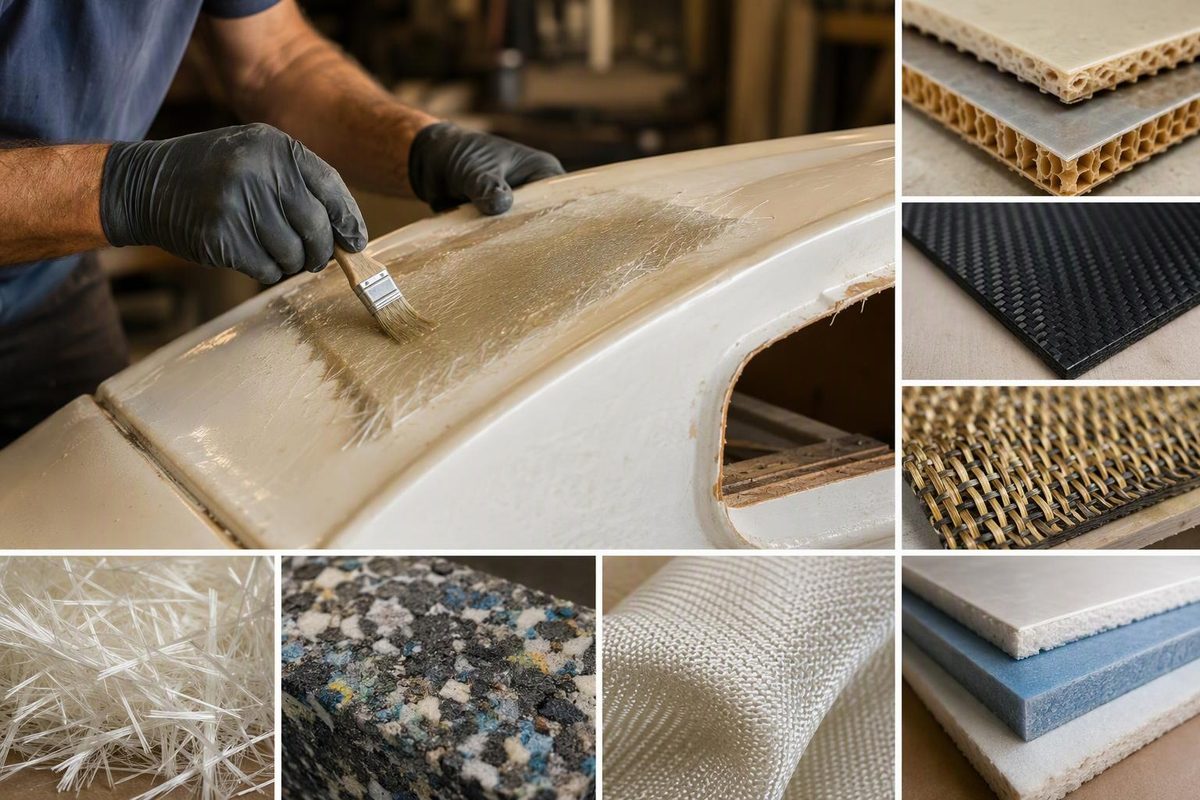
Common composite materials examples include fiberglass laminates, carbon-fiber composites, aramid-fiber composites, sandwich panels, plywood and concrete. They do not all use the same ingredients or work in the same way.
For a fiberglass repair, the useful question is not simply “Is this a composite?” It is which component is damaged: the surface finish, the reinforced laminate, or an underlying core?
What makes a material a composite?
A composite combines at least two constituent materials to obtain useful properties from their combination. In fiber-reinforced polymer composites, the reinforcement is glass, carbon or another fiber, while the matrix is the polymer that holds it together. Changing those ingredients changes the finished material’s properties; “composite” does not mean one universal specification. Composites UK explains this distinction.
In a fiberglass boat laminate, the fibers carry most structural loads. The resin supports those fibers and helps distribute loads through the structure. That is why replacing damaged reinforcement is different from filling a surface blemish. WEST SYSTEM’s boat-repair manual describes these separate roles.
Six examples and what each combines
| Composite example | What it combines | Where it is useful—and the distinction to remember |
|---|---|---|
| Fiberglass laminate, or glass-fiber-reinforced polymer (GFRP) | Glass fibers embedded in cured resin; common resin families include polyester, vinyl ester and epoxy | Boat hulls are a familiar example. The glass reinforcement and resin form the laminate; neither dry cloth nor a container of resin is the finished laminate. Boat construction reference |
| Carbon-fiber-reinforced polymer (CFRP) | Carbon fibers in a polymer matrix, often epoxy | Used where stiffness and strength relative to weight matter. Carbon is a different reinforcement, not simply a darker version of fiberglass. Materials reference |
| Aramid-fiber composite | Aramid fibers, such as Kevlar or Twaron, embedded in a polymer matrix | Aramid fibers are noted for impact resistance. The fiber name alone does not identify the resin or the complete composite construction. Fiber and matrix reference, aramid properties |
| Fiberglass sandwich panel | Two reinforced resin skins bonded to a lightweight core, such as balsa or foam | Used in cored boat construction to gain panel stiffness without a proportional weight increase. This is a construction arrangement, not a separate fiber type. Core construction reference |
| Plywood | Thin wood veneers bonded with adhesive, with alternating grain directions | An engineered wood composite used in building, marine and RV applications. Its cross-laminated construction provides strength in both panel directions and improves dimensional stability. APA plywood guidance |
| Concrete | Aggregate held in a hardened cement-based matrix, made by mixing hydraulic cement, aggregate and water | A non-polymer composite. Concrete is already a composite even without steel reinforcing bars. American Concrete Institute definition |
These examples show two different ways of describing composites: by ingredients, such as glass plus resin, and by construction, such as skins bonded around a core. A fiberglass sandwich panel belongs to both descriptions.
Why the distinction matters before a fiberglass repair
A typical gelcoat-finished fiberglass boat can contain three systems:
- Gelcoat: the outer cosmetic and moisture-barrier finish.
- Laminate: the load-carrying glass-and-resin layers.
- Core, where fitted: material between inner and outer skins that helps make the panel stiff.
WEST SYSTEM’s construction guidance distinguishes solid laminates from cored laminates and identifies gelcoat as a surface finish—not a substitute for the reinforcing layers beneath it. See the construction diagrams and explanation.
Before choosing a repair kit, establish which of those systems needs repair. A finish-only defect calls for a different scope than broken fibers, separated layers or damaged core. A smooth-looking patch is not proof that a load-bearing laminate has been restored.
For a boat, start with the fiberglass hull construction and damage guide. If structural integrity is uncertain, stop before treating the damage as cosmetic and seek a qualified assessment.
Once the substrate and damage depth are known, choose the resin by chemistry, surface and cure requirements and the reinforcement by cloth or mat construction. The label “composite repair” alone is not enough to select either.