
Woven Mat: Identify Woven Roving, Cloth and Combimat
Identify whether “woven mat” means woven roving, fiberglass cloth or combimat, then check weight, resin compatibility, shape and finish before buying.
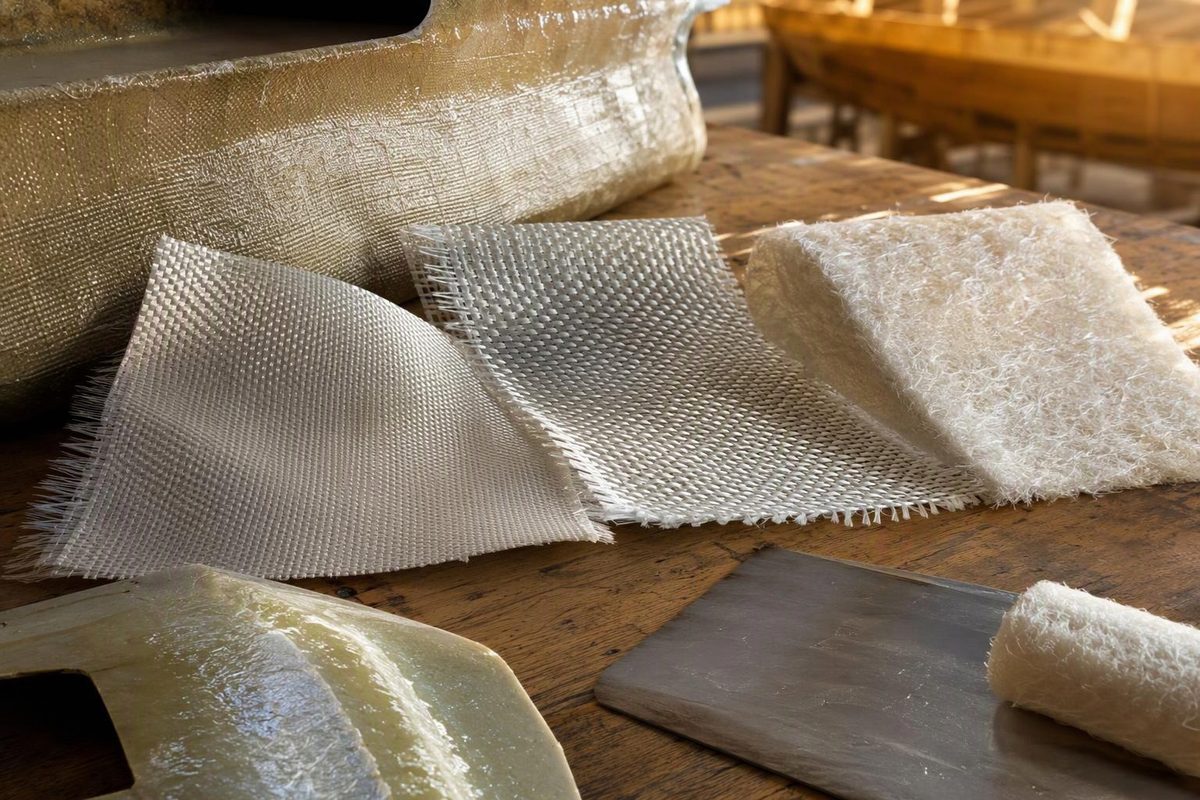
“Woven mat” is an imprecise fiberglass term. A seller may mean woven roving, a lighter woven cloth, or a combination mat that joins woven reinforcement to chopped fibers. Those materials do not handle, finish or wet out in the same way.
Do not choose from the product title alone. Check the construction, areal weight and resin-compatibility statement on the manufacturer’s technical data sheet.
Three materials sold under similar names
| What the material looks like | Likely product | Practical implication |
|---|---|---|
| Heavy, coarse checkerboard made from thick bundles | Woven roving | Fast thickness buildup on broad, relatively simple shapes |
| Fine, textile-like weave | Woven fiberglass cloth | Better conformity and a finer surface than heavy roving |
| Woven layer with a fuzzy, randomly oriented layer attached | Woven-roving combimat | Two reinforcement forms supplied as one product |
| Random short strands with no repeating weave | Chopped-strand mat (CSM) | It is mat, but it is not woven |
Woven roving is made by interlacing continuous glass-fiber rovings into a heavy fabric. CSM consists of short, randomly oriented fibers. Woven material carries load mainly along its warp and fill directions, so ply orientation matters; random mat is less direction-dependent but is not a substitute for continuous fibers in a load path. Fibre Glast’s reinforcement overview explains this directional difference.
A true combimat intentionally combines forms. For example, SKAPS describes its woven-roving combimat as a woven main layer with an added chopped-strand layer. This differs from buying separate rolls and choosing the stacking sequence during layup.
For a broader side-by-side comparison, see fiberglass cloth vs. mat.
When heavy woven roving fits
Woven roving is useful when a laminate needs substantial reinforcement and thickness over a large area. Typical applications include mold construction and traditionally built solid-fiberglass hulls. A WEST SYSTEM guide shows that a typical hull laminate may contain alternating layers of mat and woven roving, while also emphasizing that repairs must reach sound material and restore damaged reinforcement (Fiberglass Boat Repair & Maintenance PDF).
Heavy roving is a poor default when:
- the surface has tight corners or compound curves;
- the repair is small and requires precisely staggered patches;
- the weave must disappear beneath a thin cosmetic finish;
- the required fiber directions are not simply 0° and 90°; or
- the original laminate used a different reinforcement schedule.
One 16–18.5 oz/yd² woven-roving product has a listed thickness of 0.030 inch and is expressly described as unsuitable where conformability is required. Its heavy weave also needs a finer surface fabric to limit print-through (Fibre Glast woven-roving specifications). Those figures describe that product, not every roll sold as woven mat.
A gelcoat scratch or shallow cosmetic chip does not justify heavy roving merely because it is strong. Conversely, a punctured hull skin, damaged stringer tabbing, wet core or flexing shower pan needs diagnosis before reinforcement is selected. Adding glass over movement or deteriorated core can conceal the cause without restoring the structure.
Resin compatibility is product-specific
The safest rule is simple: the reinforcement data sheet must name the resin system you plan to use.
Binder-held CSM is commonly intended for polyester or vinyl ester resin. One current FGCI mat listing says its binder is compatible with polyester and vinyl ester but not epoxy (product details). This issue is covered further in fiberglass with epoxy resin.
Do not extend that warning to every product containing chopped fibers. A stitched or specially manufactured combimat may be approved for epoxy. SKAPS WM 1709, for example, combines an 18 oz/yd² woven layer with an 8.85 oz/yd² chopped layer and lists polyester, vinyl ester and epoxy compatibility (WM 1709 data). The exact construction and compatibility statement—not the word “mat” alone—settle the question.
Six checks before ordering
- Find the exact construction. Look for woven roving, woven cloth, CSM, stitched mat or combimat.
- Read the full weight unit. Woven fabrics are commonly specified in oz/yd², while CSM is often sold in oz/ft². “1.5 oz mat” and “18 oz roving” cannot be compared until the area units are confirmed.
- Verify resin compatibility. Look for your exact resin family on the manufacturer’s sheet rather than relying on a marketplace title.
- Check width and usable area. Include overlap, staggered patch sizes, trimming and a reasonable waste allowance.
- Check drape and surface needs. Heavy roving builds quickly but can bridge corners and leave a pronounced weave pattern.
- Match the laminate, not just its total thickness. A structural repair also has to restore appropriate fiber directions and bond to sound material.
For a rough fabric estimate, multiply area in square yards by fabric weight in ounces per square yard. Three square yards of 18 oz/yd² roving contains 54 oz of glass by weight. Jamestown Distributors uses a 1:1 resin-to-fabric weight estimate for wetting its woven roving, so its method would start that example at 54 oz of resin by weight (calculation guidance). Add an allowance for material left in rollers and containers. Use the reinforcement and resin manufacturers’ figures when available because combimats and different layup processes can require another ratio.
Stop before making a structural guess
Do not design a load-bearing hull, transom, stringer, deck or pressure-containing laminate from fabric weight alone. First establish the sound-laminate boundary, core condition, original ply schedule, load directions, resin system and required cure conditions. If these cannot be determined—or the damaged area moves, leaks or carries hardware loads—obtain a manufacturer-approved or qualified structural repair specification rather than buying a heavier roll of “woven mat.”
During cutting, mixing, laminating and sanding, follow the resin and reinforcement safety data sheets. Control dust and uncured-resin contact, provide the ventilation specified for the system, and use the stated skin, eye and respiratory protection. OSHA identifies skin, eye and respiratory contact as potential exposure routes during composite formulation and notes that reinforcing fibers can irritate the eyes, skin and upper respiratory tract (OSHA Technical Manual).