
Can You Recycle a Fiberglass Boat? How to Find an Accepting Recycler
Learn how fiberglass hull recycling works, what cement co-processing recovers, and what to confirm before dismantling or delivering an old boat.
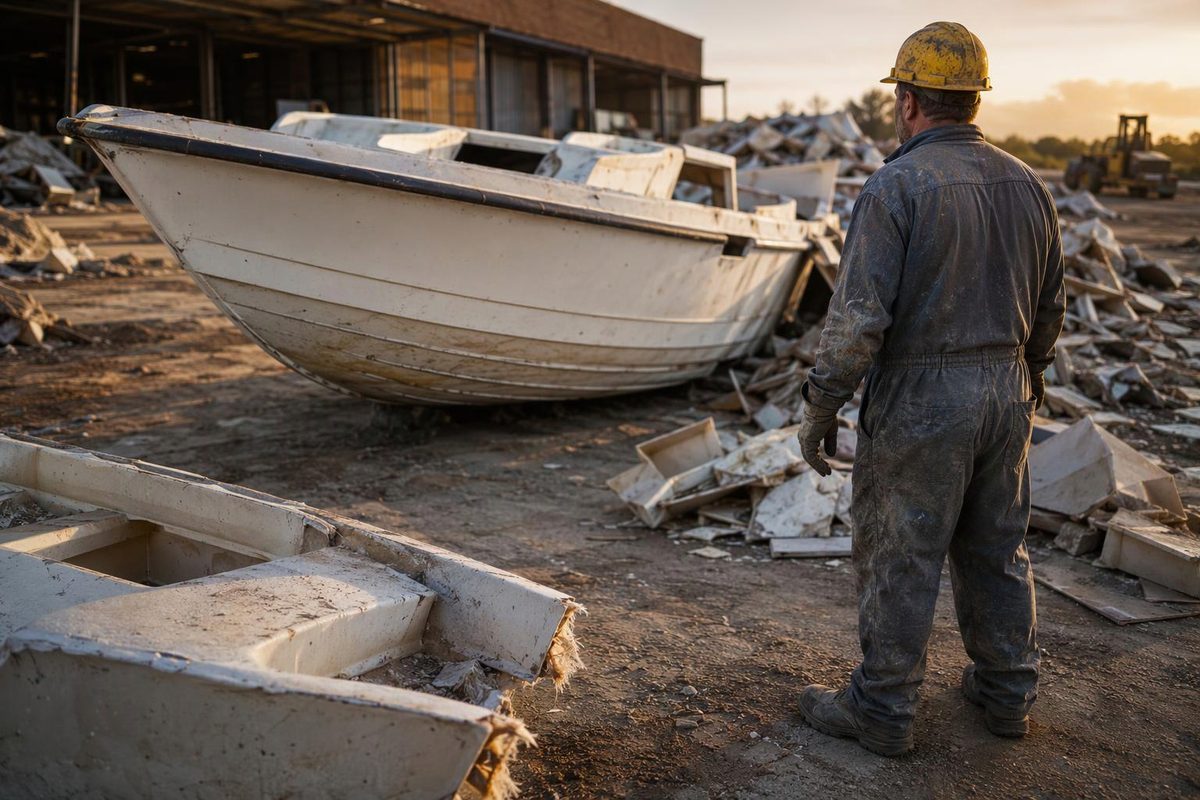
Yes, fiberglass boat hulls can be recycled through specialized processing—but you need an accepting outlet before dismantling the boat. A documented U.S. route is cement-kiln co-processing: prepared fiberglass supplies both energy and mineral ingredients for cement production. It does not turn an old hull into new fiberglass cloth or another boat hull. NOAA describes this process in its Rhode Island pilot-program results.
The practical question is not simply whether a company “recycles boats.” It is whether that company sends the fiberglass laminate itself to a verified end user, rather than recycling the metal and landfilling the hull.
Why a fiberglass hull needs special processing
Fiberglass combines glass reinforcement with a cured polymer resin. Conventional thermoset resin has a crosslinked structure; it cannot simply be melted and molded again like a thermoplastic. The University of Bath’s explanation of thermosets, published by ScienceDaily, describes this distinction. Separating reinforcement from the polymer is also technically difficult, as Composites UK explains.
That leaves several different outcomes that should not be confused:
- Parts reuse: engines, winches, fittings and other usable equipment are recovered for further use.
- Separate-material recycling: removed metals, batteries and electronics go to suitable outlets.
- Hull recycling or beneficial reuse: the composite laminate enters a process such as cement co-processing.
The RIMTA End-of-Life Vessel Material Management Guide treats these as separate material streams. Recovering valuable fittings alone does not establish that the fiberglass was recycled.
What happens to the laminate in cement co-processing?
In the Rhode Island model, partners collect the boats, remove hazards and unwanted materials, reduce the hulls in size, shred the composite, and transport it to a cement manufacturing facility. The fiberglass can replace mineral resources such as silica and alumina, while its combustible portion displaces some conventional fuel. NOAA’s report summary documents this use.
Preparation matters. RIMTA’s guide identifies metal removal as a priority because metal interferes with composite processing. Its pilot required shredded pieces no larger than two inches in length or width; that was an end-user specification, not a universal rule or an instruction to cut up your own boat. Embedded wood could remain in that particular material stream, while separable wood was handled separately. Other receivers may set different requirements. Source: RIMTA’s material-management guide.
How to find a recycler that accepts your boat
1. Start with a program coordinator or your boatyard
For U.S. owners, useful starting contacts are the boat’s marina or boatyard, a regional marine trade association, and the state environmental agency. RIMTA’s guide identifies these groups as potential sources of end-of-life management help and recycling partnerships.
In Rhode Island and New England, ask RIMTA’s Fiberglass Vessel Recycling Program about current collection partners. Its published program contact is info@rimta.org.
As of November 3, 2026, NOAA lists the WAVES Initiative as a June 2025–May 2027 project expanding collection, dismantling, shredding and transportation systems. That project listing is not a promise that any particular boat is eligible or that a public drop-off site is open.
2. Ask about the fiberglass destination explicitly
Before agreeing to removal, ask:
- Do you currently accept whole fiberglass boats, stripped hulls, or only processed composite?
- Will my hull laminate be recycled, and at which receiving facility?
- What restrictions apply to wood or foam cores, coatings, embedded metal and contamination?
- Who handles tank pump-out, batteries, electronics and other hazardous items?
- What preparation, delivery appointment and ownership documents do you require?
- Can the agreement identify the hull’s destination and distinguish recycled material from landfilled residue?
RIMTA recommends verifying material destinations before deconstruction and establishing written requirements for processing, delivery and timing. Do not assume an ordinary scrap yard or a boat-removal service has a composite-recycling outlet.
3. Send enough information for an acceptance decision
Provide the boat’s make and model if known, dimensions, location, transportation needs, and known tank contents or other hazards. Include proof of ownership and ask what additional documentation is needed. These details are recommended in RIMTA’s owner and marine-business guidance. Photographs and information about trailer condition or lifting needs can also help the receiver assess the job.
Stop before cutting, crushing or stripping the hull until the receiver confirms its requirements. Arrange professional handling of hazards and hull reduction; the guide calls for suitable processing equipment and warns against boarding vessels with visibly compromised structure.
If the hull must be landfilled, describe that accurately as hull disposal, even if parts and metals are recovered—not fiberglass recycling. For the separate question of removal charges and disposal options, see how much it costs to scrap a fiberglass boat.