
Is Fiberglass Dust Dangerous? Risks and PPE
See how fiberglass dust affects skin, eyes and lungs, why the Baxter saline recall is different, and which controls fit sanding and grinding.
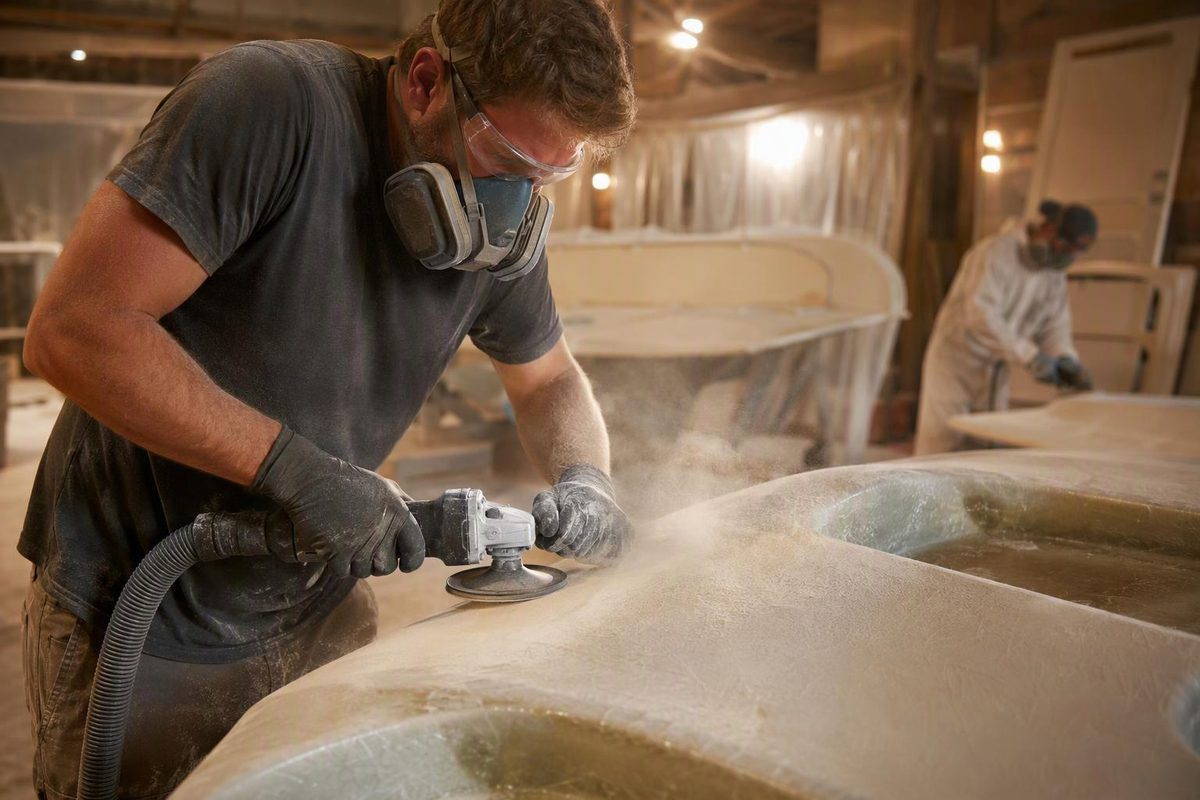
Yes. Fiberglass dust can irritate your skin, eyes, nose, throat and respiratory system, especially when you cut, drill, sand or grind a cured laminate. That garage or boatyard exposure is different from the Baxter saline recall: the recalled IV product could introduce fiberglass particulate directly into the bloodstream, while repair dust primarily reaches you through inhalation, skin contact or the eyes.
Choose your task, PPE and ventilation; the checker shows the likely irritation risk and the next control to add.
Fiberglass Exposure Risk Checker
This screens for short-term dust and fiber irritation. It does not measure airborne concentration or evaluate chemical vapors.
Next fix: Switch to wet-sanding where the repair system permits it, and contain the slurry.
Dry sanding in an enclosed space can put fine composite dust close to your face. Ventilation does not replace capture at the tool.
Source note: Qualitative task-control screen based on Washington State Department of Health and NIOSH fiberglass guidance. Ratings are not exposure limits or air-sampling results.
The checker is a qualitative planning aid, not an exposure measurement. It deliberately rates grinding and dry sanding more cautiously than handling an intact panel. It also treats particulate protection separately from the vapor and skin hazards of uncured resin.
The Baxter Recall Involved Injected Particles, Not Workshop Dust
Baxter issued a nationwide recall on August 25, 2026, for two lots of 0.9% Sodium Chloride Injection in VIAFLEX containers after finding fiberglass particulate matter in the solution. The affected lots were Y495523 and Y495523A. They had been distributed to 14 states between July 31 and August 3, 2026 (FDA recall notice).
The route of exposure is the crucial distinction. An IV solution bypasses the skin and lungs and enters the circulatory system. Cutting a fiberglass panel creates airborne and settled composite dust that can contact skin, eyes and airways. The recall therefore does not establish that touching a cured fiberglass object carries the same hazard as receiving contaminated saline.
It also does not make repair dust harmless. Short-term irritation is often temporary, but high airborne exposure can aggravate asthma or bronchitis. A repair can expose you to cured resin, filler, gelcoat, paint or contamination as well as glass fibers. Dust control needs to begin before abrasion, not after the room is coated with debris.
Match Dust Controls to the Work
| Task | Main Concern | Practical Response |
|---|---|---|
| Inspecting an intact cured panel | Little airborne dust unless damaged or disturbed | Avoid unnecessary abrasion |
| Handling dry cloth or mat | Loose fibers on skin or in eyes | Wear gloves, long sleeves and eye protection |
| Hand-sanding a cured patch | Fine composite dust close to the face | Capture dust, ventilate and wear a particulate respirator |
| Power-sanding, grinding or cutting | Rapid production and wider dust spread | Isolate the area, capture at the tool and use suitable PPE |
| Mixing or applying resin | Uncured resin, hardener, catalyst or solvent | Follow the product safety data sheet |
| Sanding an unknown coating | Fiberglass plus unidentified coating hazards | Identify the coating or stop work |
The Washington State Department of Health says damaged or disturbed fiberglass can release airborne fibers. Contact with fiberglass or inhalation of its dust may cause itching, coughing or wheezing, and high exposure may worsen existing respiratory conditions (Washington State Department of Health). NIOSH identifies the eyes, skin and lungs as target areas and says risk depends on the dose, duration and work being performed (NIOSH).
A cured boat hull, shower pan or fiberglass door is a composite rather than bare glass. Abrading it can release material from the glass reinforcement, cured resin, gelcoat, fairing compound and anything applied over the surface.
Old bottom paint and unidentified coatings require their own hazard assessment. A particulate respirator chosen for fiberglass does not resolve an unknown lead, metal, biocide or chemical hazard. If you do not know whether boat damage is confined to the finish or extends into the reinforcement, diagnose it before enlarging the ground area; the boat hull damage and repair guide explains that distinction.
Cancer Classifications Depend on the Fiber Type
Fiberglass is not asbestos, but the word “fiberglass” covers more than one type of glass fiber.
In its 2002 evaluation, the International Agency for Research on Cancer placed insulation glass wool and continuous glass filament in Group 3: not classifiable as to carcinogenicity in humans. It placed certain special-purpose glass fibers, including E-glass and “475” fibers, in Group 2B: possibly carcinogenic to humans (IARC evaluation).
OSHA’s fibrous-glass page likewise reports IARC Group 3 for fibrous glass dust generally while pointing to separate literature for specific materials (OSHA). These classifications must not be applied more broadly than the materials evaluated.
“Not classifiable” does not mean proven safe. “Possibly carcinogenic” also does not quantify the risk from one brief home repair. The practical response is to avoid inhaling composite dust and consult the SDS or technical documentation when the reinforcement, coating or resin system is known.
Source Control Comes Before Respiratory PPE
Removing less material creates less dust. Mark the repair boundary and abrade only what is required to expose sound material or prepare the bonding surface. Diagnose cracks, flexing and impact damage before grinding across a broad area.
Where the material and repair method permit it, wet-sanding can keep dust from becoming airborne. The slurry still requires controlled collection and disposal. Do not let contaminated runoff spread through a yard, drain or living space.
For dry work, use a vacuum-equipped sander or grinder with filtration suitable for fine dust. Capture at the tool is more effective than placing a fan across the room after dust has escaped. Ventilation should move residual contamination away from people, doors, neighboring property and air intakes—not blow it through the rest of the building.
Separate the work from living areas and HVAC returns where practical. Keep children, pets and unprotected people outside the work zone. Outdoor work reduces enclosure but does not prevent dust at the operator’s face or eliminate the need to capture debris.
Cover the Eyes and Skin
Wear gloves, long sleeves, long pants and safety glasses with side shields. Use sealed goggles where grinding or overhead work could send dust around ordinary safety glasses.
Dry fiberglass and composite dust can remain in cuffs, shoes and clothing. Disposable coveralls can simplify cleanup during heavy grinding. Whatever clothing you use should come off before you enter a clean living area.
Glove selection becomes more specific during wet layup. A glove that blocks irritating fibers is not automatically compatible with resin, hardener, catalyst or solvent. Use the chemical-resistance information in the product’s SDS rather than choosing by glove thickness alone.
Choose a Respirator for the Actual Contaminant
NYC Health recommends a NIOSH-approved N95 particulate respirator for fiberglass work (NYC Health). It must seal to the face; facial hair in the sealing area can create leakage.
An N95 should not be treated as a blanket answer for heavy grinding, persistent visible dust or an unknown coating. Stop and improve extraction, containment or the respiratory-protection plan instead of continuing in a visibly dusty cloud. Higher-efficiency particulate protection such as a P100 filter may be appropriate for dust-intensive work, but it still depends on a properly fitted respirator and the hazards present.
N95 and P100 designations concern particles. They do not mean the respirator protects against gases or vapors from solvents, resin ingredients or coatings. OSHA states that particulate respirators do not protect against chemicals, gases or vapors; selecting a cartridge requires identifying the contaminant (OSHA respirator guidance).
Follow the resin or coating SDS instead of guessing at a cartridge. Workplace respirator programs may also require a hazard assessment, medical evaluation, fit testing and training.
Clean Without Releasing the Dust Again
Do not dry-sweep fiberglass dust or use compressed air. Both methods put settled particles back into the breathing zone and spread them beyond the original repair area.
NYC Health recommends wet mops or cloths, or a HEPA-filtered vacuum, to prevent settled fibers from being stirred into the air. Keep respiratory and eye protection on during dusty cleanup. Empty or service the vacuum according to its instructions without releasing the collected material.
Remove dusty clothing without shaking it. Keep it out of living areas and wash it separately. Wash exposed skin with soap and water. Avoid aggressive rubbing, which can push irritating fibers across the skin.
Respond Promptly After an Exposure
If dust gets in your eyes, do not rub them. Rinse immediately with clean water. If you inhale a visible dust cloud or begin coughing, leave the contaminated area and get fresh air. Wash exposed skin with soap and water and change out of dusty clothing.
Seek medical advice for eye pain, rash, coughing or wheezing that continues after the exposure ends. Substantial breathing difficulty, chest tightness or a significant eye injury warrants prompt medical help, especially if you have asthma or another lung condition.
The NIOSH Pocket Guide lists immediate eye irrigation and fresh air as first-aid measures for fibrous-glass dust (NIOSH Pocket Guide). If uncured resin, hardener, catalyst or solvent was involved, use that product’s SDS because its first-aid instructions may differ.
An intact cured panel presents little dust exposure until it is disturbed. Cutting and abrasion change the situation: contain the work, capture dust where it is generated, protect the eyes and skin, and put on a properly fitted particulate respirator before the tool touches the surface.