
Amazon Fiberglass Pool Shell: What Else Do You Need?
See what Amazon's $9,800 fiberglass pool shell excludes, estimate your real project cost, and check its buried saltwater installation specs.
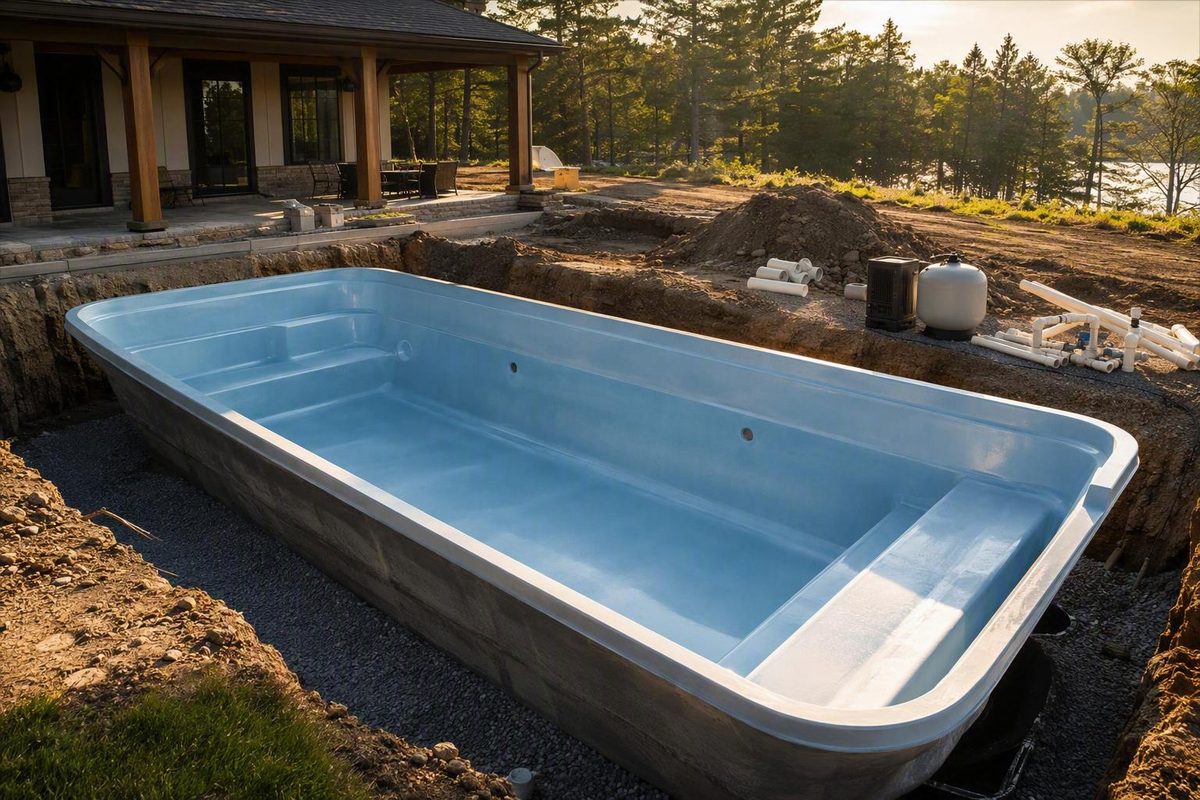
The $9,800 Koalaime fiberglass pool shell is only the vessel. Unless the seller confirms otherwise in writing, you still need freight and unloading, excavation, a prepared base, crane or forklift placement, backfill, drainage, plumbing, a pump and filter, electrical work and bonding, permits, barriers, coping or decking, fill water, startup, and restoration. The listing also lacks enough laminate, gelcoat, installation, and warranty detail to conclude that the shell is suitable for a buried, salt-chlorinated installation.
The captured Amazon listing does not clearly establish that those products or services are included. Treat every unconfirmed item as excluded, and treat the displayed price as a historical shell price rather than a finished-pool estimate.
Enter local quotes and mark each installation stage; the estimator totals the project and compares it with a dealer-installed quote.
Enter written local quotes rather than relying on a shell-price multiplier. Blank costs remain unresolved and are not silently treated as included.
Investigate soil and groundwater, obtain the lifting distance, and decide who will perform excavation and plumbing.
Rule Every blank cost is unresolved, not free.
Shell evidence Historical displayed price: $9,800.
Technical status Gelcoat, laminate and installation specifications: — not established.
| Project Item | Evidence or Scope | Your Cost ($) |
|---|---|---|
| Shell | Historical Amazon display | |
| Tax and freight | Seller or checkout quote | |
| Crane or unloading | Lift plan and local quote | |
| Excavation and hauling | Soil, machinery and disposal | |
| Base and backfill | Manufacturer-approved material | |
| Drainage or groundwater | Site-specific design | |
| Plumbing materials and labor | Fittings, pipe, valves and testing | |
| Pump, filter and sanitizer | Designed from verified volume | |
| Electrical and bonding | Qualified electrician quote | |
| Permits and inspections | Enter local fees | |
| Fill water and startup | Water, testing and balancing | |
| Coping and decking | Structure, finish and drainage | |
| Barrier and alarms | Local compliance scope | |
| Restoration | Fence, lawn and landscaping | |
| Contingency | User-entered allowance |
0 of 9 stages confirmed.
Sources: captured Amazon listing; River Pools historical DIY examples of ~$2,000 equipment rental for one week, ~$1,000 per crane day, $700–$1,200 trucked water, $1,000–$2,000 backfill, $300–$600 miscellaneous plumbing and $700–$1,200 pool equipment. These are not current local quotes.
No dependable nationwide dealer-installed comparison figure appears in the available evidence. The useful comparison is the Amazon project total against a written local dealer quote covering the same pool size, equipment, decking, barriers, permits, and site conditions.
What the Amazon Listing Appears to Include
The captured listing identifies a rectangular Koalaime fiberglass inground vessel, with blue and white options, at a displayed price of $9,800. Its stated dimensions are 168 by 88 by 55 inches, or approximately 14 feet by 7.3 feet by 4.6 feet.
The page does not provide a dependable comprehensive packing list. It therefore does not confirm inclusion of a skimmer, suction fittings, returns, pipe, valves, pump, filter, sanitizer, salt chlorine generator, lights, controls, lifting hardware, installation materials, coping, or deck components.
The listing also contains specification conflicts. One selector reportedly describes the final dimension as 4.6 inches, although the separate 55-inch measurement is approximately 4.6 feet. Its stated capacity of eight cubic feet is inconsistent with the displayed dimensions. The page shows a 30-day refund or replacement policy, warns that return shipping may apply, and displays three ratings. None of those details substitutes for engineering specifications, installation instructions, completed-project references, or a structural and surface warranty.
Ask the seller to identify the exact model or SKU and distinguish among exterior dimensions, interior dimensions, packaged dimensions, overall shell depth, operating water depth, and operating capacity. Nominal marketplace dimensions are not sufficient for excavation, equipment sizing, lifting, or permitting.
The Shell Price Leaves Seven Major Scopes Unpriced
| Scope | What You Still Need |
|---|---|
| Site work | Layout, utility locating, excavation, soil removal and restoration |
| Placement | Freight, unloading, rigging and crane or suitable equipment |
| Support | Approved base, backfill, drainage and groundwater measures |
| Pool systems | Fittings, pipe, valves, pump, filter and sanitizer |
| Regulated work | Permits, inspections, electrical service, GFCI protection and bonding |
| Completion | Coping, deck interface, barriers, grading and landscaping |
| Commissioning | Fill water, leak testing, startup, balancing and instruction |
Freight deserves separate written confirmation. Determine whether delivery is residential, curbside, terminal pickup, or jobsite service; what vehicle will arrive; where it will stop; whether the driver unloads; and how long the carrier will wait.
A lifting contractor needs the shell weight, packaged dimensions, approved lifting points, center of gravity and rigging instructions. The lift also depends on crane position, working radius, ground support, overhead hazards and the route between the trailer and excavation. Manufacturer installation descriptions commonly show one-piece shells arriving on specialized trailers and being lifted into place, but they are not model-specific instructions for this product. Leisure Pools illustrates the general sequence.
Do not select crane capacity or improvise rigging from the Amazon dimensions alone.
Request the Technical File Before Ordering
Make receipt and review of these documents a purchase condition:
- Model-specific dig sheet and installation manual
- Exact exterior profile, including steps, ledges and floor slopes
- Shell weight and packaged shipping weight
- Packaged dimensions and freight classification
- Approved lifting points, slings and spreader-bar requirements
- Locations and sizes of plumbing openings
- Compatible skimmers, suction fittings and returns
- Approved adhesives, gaskets, sealants and fasteners
- Base and backfill specifications
- Filling and backfilling sequence
- Level and wall-alignment tolerances
- Groundwater and drainage provisions
- Perimeter reinforcement and deck-interface details
- Structural, surface and workmanship warranties
- Installation records required to preserve warranty coverage
Get a packing list tied to the exact SKU. It should identify every fitting, gasket, fastener, plumbing component, piece of equipment, lifting accessory, manual and warranty document. If touch-up material is supplied, confirm its chemistry and storage limits rather than assuming a generic fiberglass pool repair kit is compatible.
Clarify who pays return freight if the shell arrives damaged, differs from the written specifications or cannot be accepted because the carrier’s delivery information was wrong. Ask whether installing, drilling, plumbing, filling or backfilling the shell ends marketplace return eligibility.
The Gelcoat and Laminate Cannot Yet Be Approved
The available listing information is insufficient to determine whether this shell’s gelcoat and laminate are suitable for permanent burial and salt chlorination. Dimensions, color and a general fiberglass description do not establish the laminate schedule or installation limits.
Request the resin system, reinforcement types, laminate schedule, nominal thickness by area, gelcoat system, quality-control tolerances and repair procedure. Also request written confirmation that the exact model is designed as an inground shell rather than a vessel requiring a separate supporting structure.
For the surface, obtain written limits for operating chemistry, water temperature, salt concentration, startup and winterization. The warranty should separately identify structural and gelcoat coverage, exclusions, duration, claim procedures and any requirement for professional installation.
“Saltwater compatible” would not mean saltwater equipment is included. A salt-chlorinated installation still needs a correctly selected chlorine generator, cell, controls, plumbing integration, electrical connection, commissioning and continuing water testing. Compatibility also must cover the installed fittings, lights, fasteners, heater and other wetted components—not only the visible shell surface.
Pause the purchase if the seller cannot provide a coherent technical file or will not correct the dimensional and capacity conflicts in writing.
Site Approval Must Come Before Delivery
Confirm property boundaries, easements, setbacks, buried and overhead utilities, septic components, wells, slopes and the proposed equipment-pad location. Physically measure the route for the delivery truck, excavator and lifting equipment. Include gate openings, driveway turns, soft ground, retaining walls, trees, eaves and overhead power lines.
Soil and water conditions can change the installation scope. Rock may require different excavation equipment and disposal. Expansive or unstable soil may require project-specific support. Seasonal groundwater can require temporary dewatering and a long-term pressure-control or monitoring provision. Surface drainage must direct water away from the excavation and completed deck.
Ask the authority having jurisdiction which building, zoning, electrical, plumbing, environmental and barrier approvals apply. Applications may require a site plan, product specifications, contractor information and structural or equipment documents. Inspections may occur before plumbing, electrical work, reinforcement or other components are concealed.
The Pool & Hot Tub Alliance publishes pool standards through an ANSI-accredited consensus process, but those standards do not replace local codes, approved plans, inspections or manufacturer instructions.
Base and Backfill Must Follow the Shell Specification
Excavate from the model-specific dig sheet, not the marketplace dimensions. The hole may need working clearance for plumbing, alignment checks, base correction and controlled backfill. Account for spoil storage, unsuitable-soil removal, hauling, weather and restoration of machinery routes.
Commercial installers do not publish one universal base or backfill rule. River Pools identifies clean crushed rock in the general 3/8- to 3/4-inch range as its preferred backfill. It separately recommends clean crushed stone of 3/4 inch or smaller rather than rounded pea gravel while acknowledging that many fiberglass pools have historically been installed with sand. Its sand-versus-gravel guidance reflects that company’s installation practice, not a specification for the Koalaime shell.
Use only the material required by the shell manufacturer’s written instructions, approved plans, site engineering, soil and groundwater conditions, drainage design and local rules. Do not substitute another installer’s preference for a missing manufacturer specification.
Placement, leveling, filling and backfilling are connected operations. Commercial fiberglass-pool guides commonly describe adding water while placing backfill to control pressure on the shell. The manufacturer must still specify layer depth, compaction method, permitted equipment, the water-to-backfill relationship, wall checks, plumbing support and stop-work conditions.
Plumbing and Equipment Require a Separate Design
Budget independently for the skimmer, approved suction fittings, returns, pipe, valves, unions, gaskets, supports, pressure-test equipment, pump, filter, sanitizer, controls and equipment pad. Confirm whether shell openings arrive cut, marked or absent and whether field modification affects the warranty.
The listing dimensions do not establish actual water volume, design flow, pipe diameter, pump head, filter capacity, sanitizer output, heater capacity or electrical load. Equipment must be selected from verified volume, plumbing geometry, features, climate and local requirements.
Pressure-test the plumbing using an agreed written procedure before it is buried. Define the test method, acceptance criteria, documentation, inspection requirements and responsibility for correcting leaks. Keep connections accessible until testing and required inspections are complete.
Electrical scope commonly includes the pump, sanitizer, lights, cover, heater and controls. A qualified electrician and the local authority must determine circuit, disconnect, GFCI, grounding and bonding requirements. Coordinate bonding with fittings, equipment, reinforcement, coping and decking before concrete conceals the work.
Compare Complete Scopes, Not Headline Prices
River Pools’ commercial DIY guide provides historical examples of approximately $2,000 for one week of equipment rental, $1,000 per crane day, $700–$1,200 for trucked water, $1,000–$2,000 for backfill, $300–$600 for miscellaneous plumbing, and $700–$1,200 for pool equipment. These are not current quotes for this shell or your location. They may omit labor, delivery, permits, electrical work, barriers, concrete, difficult access and corrections. The underlying historical estimates are published here.
A dealer comparison must use matching scopes. Check whether each proposal includes freight, crane service, excavation, rock removal, soil hauling, base, backfill, drainage, plumbing, equipment, electrical work, bonding, permits, inspections, coping, decking, barriers, water, startup and restoration.
DIY can remove some labor charges, but it does not remove machinery, lifting, materials, licensed work, permits or correction risk. Owner-managed installation gives the buyer more scope control while creating handoff risks among the excavator, crane operator, installer, plumber, electrician and concrete crew. A turnkey contract reduces coordination only to the extent that its written inclusions are complete.
Do not order until the exact shell is documented, the local authority can approve it, access has been checked, the lift is feasible, base and backfill requirements are known, every trade has accepted responsibility, and the itemized project total still compares favorably with a dealer-installed alternative.