
Gelcoat Scratch Repair: When to Polish, Sand or Fill
Choose polishing, cautious wet sanding or filling for a gelcoat scratch, with stop points that protect the finish and flag laminate damage.
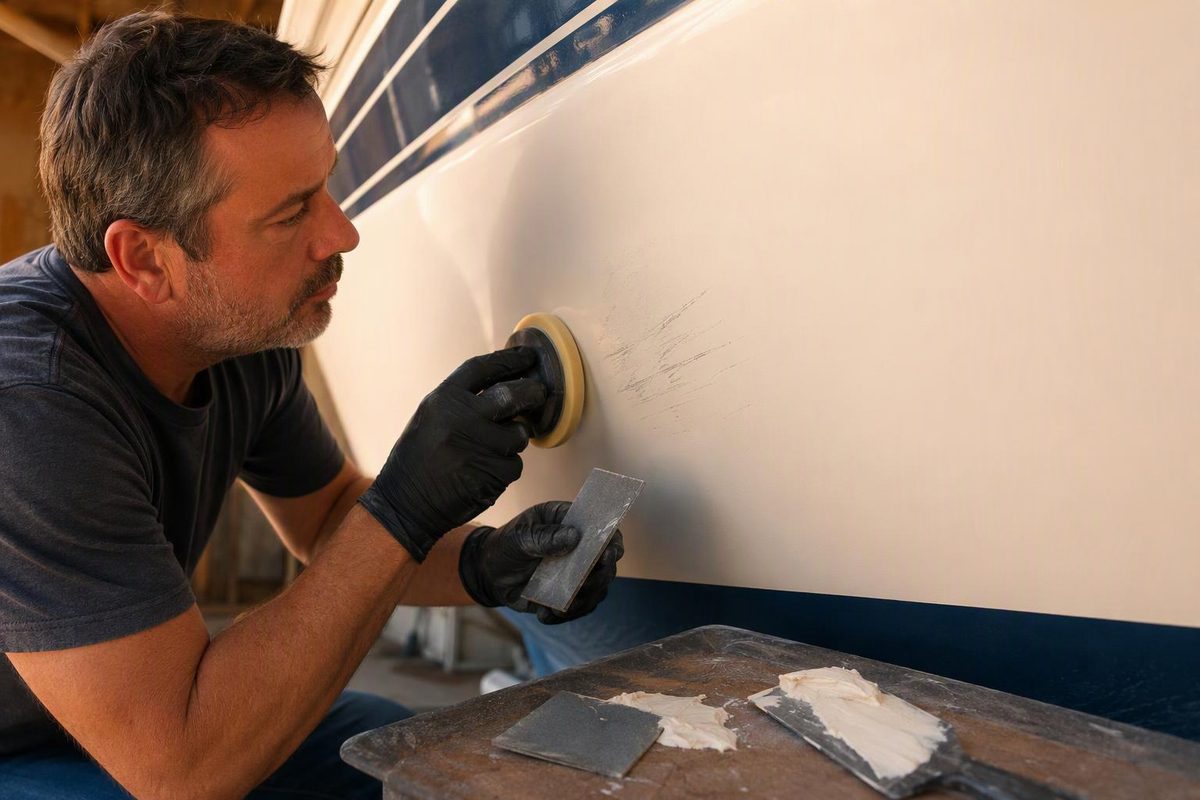
Try polishing a superficial mark, wet-sand a shallow scratch cautiously, and fill a deeper groove with compatible gelcoat. Sanding every scratch until it disappears can remove the surrounding finish before reaching the bottom of the damage.
This sequence is for localized scratches in smooth gelcoat over sound composite laminate. Confirm the surface first: do not assume that a painted boat or an acrylic-surfaced, fiberglass-backed fixture should receive a gelcoat patch. Keep this smoothing process off molded nonskid unless you also plan to restore its texture.
1. Clean and choose a starting approach
Wash away dirt, rinse and let the area dry. Inspect it under good light before using abrasives.
| What you can observe | Starting approach |
|---|---|
| A surface scuff with no obvious groove | Try a gelcoat-compatible polishing product on a small area. |
| A shallow scratch contained within the finish | Consider careful wet sanding, then compound and polish. |
| A distinct groove or missing gelcoat | Prepare and fill rather than flattening the surrounding finish. |
| Broken fibers, cracking beyond the scrape, movement or leakage | Stop cosmetic work and assess the laminate. |
A fingernail catching in the scratch is a warning, not a measurement of remaining gelcoat thickness. Peinert’s boat-repair instructions distinguish scratches that can be sanded from those needing new gelcoat—and warn that sanding a deep scratch first can make it harder to fill. Peinert gelcoat repair instructions
Stop point: Gelcoat filler does not replace load-carrying reinforcement. WEST SYSTEM’s manual distinguishes finish-only damage from damage entering the laminate; cracks extending into woven reinforcement require structural repair before cosmetic finishing. If hull integrity is uncertain, use the boat hull stress-crack triage guide before returning the boat to service. WEST SYSTEM fiberglass repair manual, Section 2
2. Try polishing before sanding
Use a polishing product approved for gelcoat and follow its applicator instructions. Light-cutting gelcoat polishes can remove light scratches and swirl marks; they are not a way to fill missing finish. 3M gelcoat polish guidance
Inspect the small trial area before continuing. If the mark improves enough, there is no need to sand merely to chase an invisible repair.
If you later decide to fill, remove any wax or other residue left by the polishing product before abrading the bonding area. TotalBoat requires removal of surface contamination before sanding for a gelcoat patch. Use the cleaner specified by your repair system. TotalBoat surface-preparation instructions
3. Wet-sand only when the scratch is shallow enough
For a scratch that remains within the gelcoat:
- Use wet/dry paper on a small sanding block suited to the surface contour.
- Start with the finest grit that makes useful progress. Keep the paper wet and inspect frequently.
- Progress through finer grits, removing the previous sanding marks before moving on.
- Finish with compatible rubbing compound, then polish.
Peinert specifies the finest effective grit—typically 600 for its boats—followed by finer papers to 2000. That is a manufacturer example, not a universal starting grit for an unknown or previously sanded finish. Its central warning is to avoid sanding through the thin gelcoat layer. Peinert gelcoat repair instructions
Use the eye, skin and respiratory protection specified for the preparation materials and collect sanding residue. WEST SYSTEM also calls for protective equipment when cutting or grinding fiberglass. WEST SYSTEM repair safety guidance
Stop point: If removing the groove would require substantial sanding of intact gelcoat, switch to filling. Stop immediately if the underlying laminate begins to show. Accepting a faint cosmetic line is preferable to enlarging the repair unnecessarily.
4. Fill a deeper groove instead of sanding down the panel
A deep scratch, missing gelcoat or an accidental sand-through needs replacement finish, not more abrasion of the surrounding surface. Peinert’s procedure removes loose edges, opens the groove so fresh gelcoat can reach its bottom, slightly overfills it to allow for cure shrinkage, and then levels and polishes the cured patch. Peinert filling instructions
Before preparing the groove, select a repair material approved for the substrate and application. Check its color, catalyst measurement, surface-cure treatment and sanding cure. Do not assume polyester gelcoat can go directly over any epoxy filler: TotalBoat, for example, requires its specified barrier-primer procedure over epoxy repairs. TotalBoat gelcoat compatibility instructions
For the complete preparation, mixing, curing and leveling sequence, follow the gelcoat repair guide. If opening the scratch reveals damaged reinforcement, leave the finish-only process and address the laminate first.