
Gelcoat Oxidation Remover: Choose by Cut and Protection
Compare cleaner wax, M49 oxidation remover, M67 compound and restorer wax by oxidation severity, application method and protection needs.
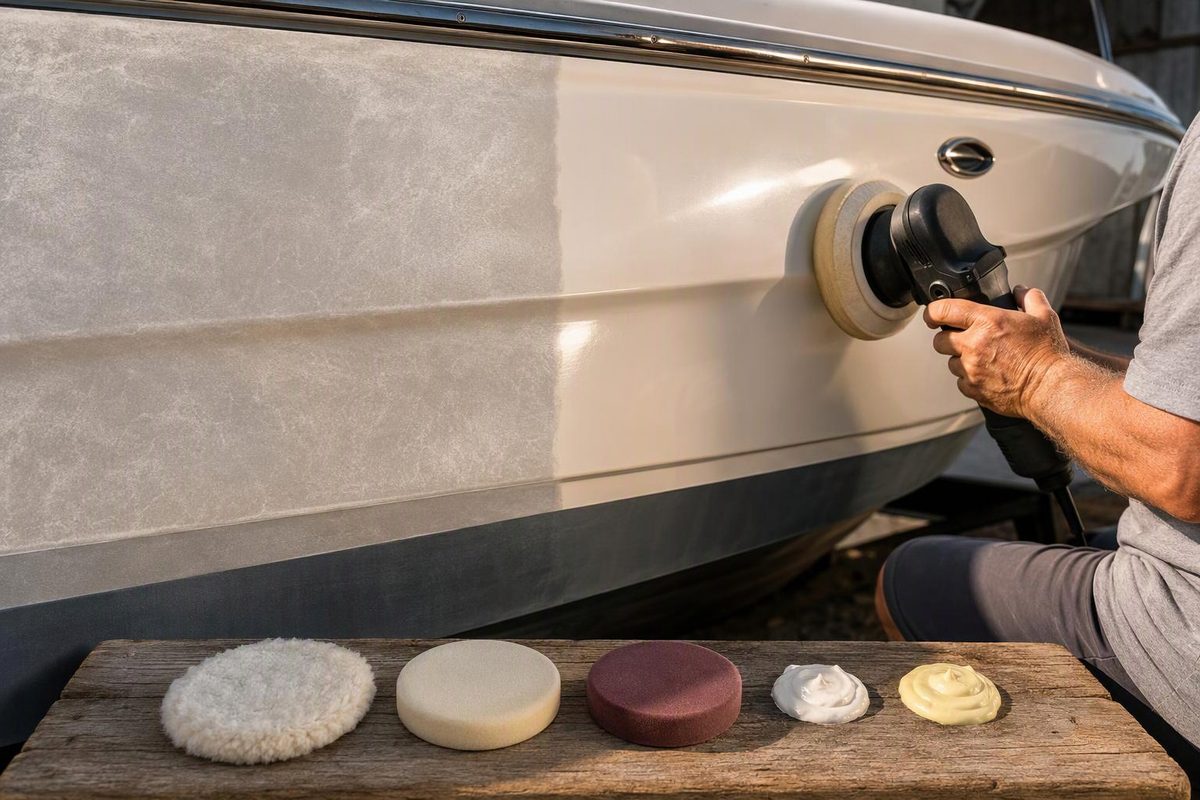
For light oxidation on sound boat gelcoat, start with a cleaner wax rated for light defects. For moderate oxidation, consider a dedicated abrasive remover such as Meguiar’s M49. For heavier oxidation, a gelcoat compound such as M67 is a candidate to test.
The useful distinction is not which bottle says “restorer” most prominently. It is how much correction the product is intended to provide, how you can apply it, and whether it also supplies protection.
Match the product to the job
These are label-based buying options, not a tested performance ranking. Manufacturer severity terms help narrow the choice; a small test area determines whether the product suits your finish.
| Product | Manufacturer’s stated role | When to consider it |
|---|---|---|
| Meguiar’s M50 One-Step Cleaner Wax | Non-abrasive cleaners and polishing oils for light oxidation, haze and minor defects, with wax protection | A lightly dulled surface where you want cleaning and protection in one application |
| Meguiar’s M49 Oxidation Remover | Diminishing abrasives for moderate oxidation, stains and scratches on gelcoat and fiberglass | A dedicated correction product when a light-duty cleaner wax is insufficient |
| Meguiar’s M67 One-Step Compound | Aggressive cutting compound with polish for moderate-to-heavy oxidation; intended to clean and restore gloss together | Heavier oxidation on an intact finish, with protection planned separately |
| Star brite Premium Restorer Wax | One-step restoration and protection for medium-to-heavy oxidation, particularly on colored fiberglass hulls | A combined restorer/protectant option when reducing separate applications is a priority |
Do not treat this table as a mandatory sequence. You need not buy and apply every product. Choose a candidate for the observed condition, test it, and stop escalating once the result is satisfactory.
Two label traps worth checking
“Heavy Duty” does not tell you the intended oxidation severity. M49 carries that name, but its product description identifies moderate oxidation as its intended job. M67 explicitly targets moderate-to-heavy oxidation. Read the description rather than assuming the largest wording means the strongest appropriate product.
“One-step” does not always mean correction plus protection. M67’s stated one-step role is cleaning and producing gloss. M50 and Star brite Restorer Wax explicitly include protection. Do not rely on “one-step” alone when deciding whether another wax or sealant belongs in the purchase.
If you prefer separate products, Meguiar’s M4965 restoration kit contains oxidation remover, high-gloss polish and pure wax in three 16-ounce bottles. Compare that complete system with what you already own; buying only the remover is not the same purchase as buying correction, gloss enhancement and protection together.
Do you need an oxidation remover—or a stain cleaner?
A yellow waterline or rust-colored mark should not automatically send you toward stronger abrasives. For example, Star brite Instant Hull Cleaner is an oxalic-acid stain cleaner intended for rust, yellowing and scum lines. Its wipe-on, rinse-off role differs from abrasive surface correction.
Clean the surface and reassess it before selecting the cutting product. A stain-removal claim alone does not establish that a cleaner will restore a dull, oxidized finish.
Check these before buying a larger bottle
- Confirm the exposed finish. Select for gelcoat, not simply for “fiberglass.” If the hull has been painted, wrapped or recoated, check that finish manufacturer’s care requirements. Do not automatically transfer marine restorer recommendations to acrylic tubs, refinished showers or pool interiors.
- Match the application method. M50 and M67 allow hand or machine use. M49’s manufacturer page lists hand, dual-action and rotary application, recommending rotary for best results. Hand suitability is useful for small areas, but does not establish equal effort or results across methods. See the gelcoat polisher selection guide before choosing a machine, pad and product combination.
- Test before committing. Star brite’s rubbing-compound guidance notes that rubbing compounds are abrasive and calls for a small-area test. Inspect the result after removing residue, rather than judging only while the surface is wet with product.
- Buy the whole finishing plan. Include compatible pads or cloths, any needed finishing polish, and protection where the selected product does not explicitly provide it. Follow the bottle directions and safety data sheet for ventilation and protective equipment. For example, M67’s safety data sheet says not to use it in a confined area with minimal air exchange and specifies glove selection according to exposure conditions.
If the test area does not respond satisfactorily, or you find cracks, blisters or exposed laminate, pause the product escalation. Use the boat gelcoat restoration guide to decide whether the next task is further finishing, repair or refinishing—not simply another oxidation remover.