
Florida Garage Door Wind-Mitigation Credit: 2026 Checklist
Check whether a Florida garage door can support 2026 opening-protection credit, what documents matter and why a fiberglass patch cannot create a rating.
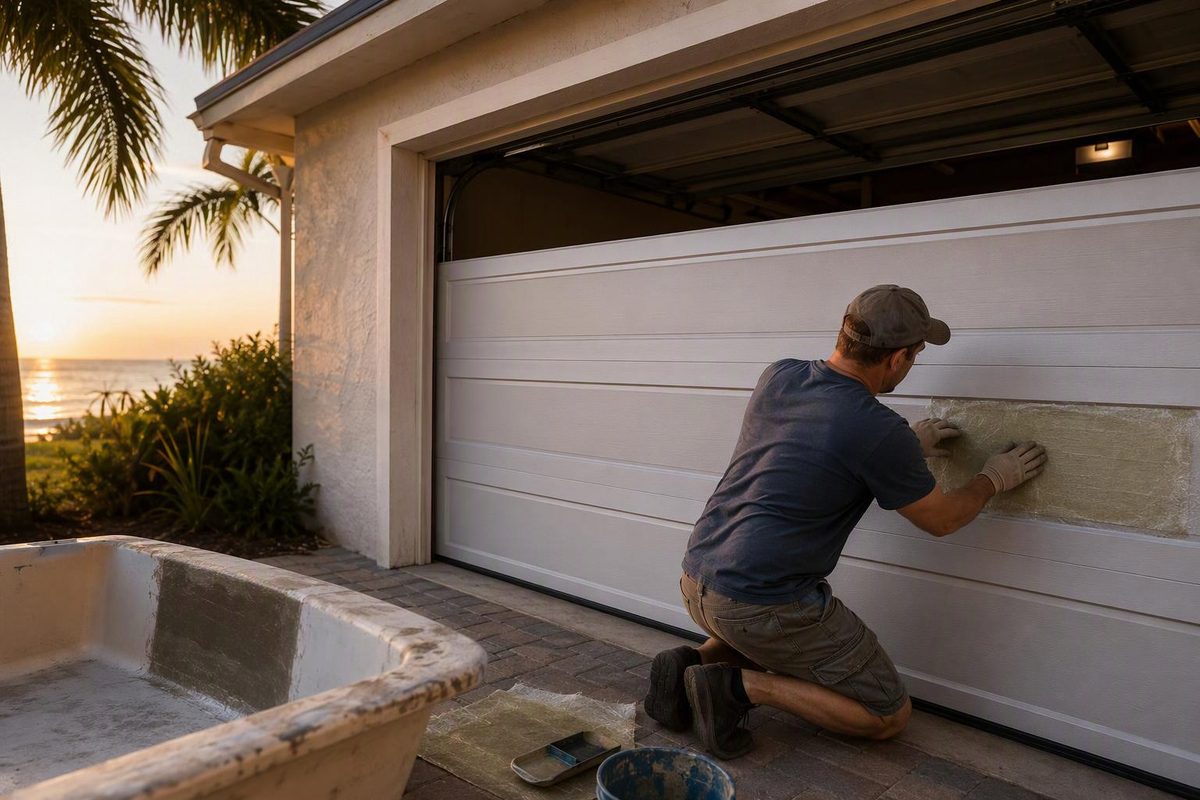
A garage door can affect a Florida wind-mitigation credit, but there is no universal, stand-alone “garage door discount.” The door is evaluated within the home’s opening-protection classification, along with windows, entry doors, skylights and other exterior openings.
Whether it helps the premium depends on its documented pressure and impact performance, whether it contains glazing, the protection on the home’s other openings, the property’s location and the insurer’s approved rating plan. Installing a door advertised as “hurricane rated” does not guarantee savings.
What changed in 2026
Any inspection performed on or after April 1, 2026, must use the six-page OIR-B1-1802 (Rev. 04/26) Uniform Mitigation Verification Inspection Form. The Florida Office of Insurance Regulation says the revision followed a 2024 residential wind-loss study. A completed form is valid for up to five years if the structure has not materially changed and no inaccuracies are found (Florida OIR wind-mitigation resources).
The revised form makes the garage door’s role explicit. Its opening-protection chart has separate columns for glazed and non-glazed garage doors. The inspector records the protection level for each applicable opening type, and the classification is based on the weakest protection. The form also adds Level Z for a damaged opening that needs repair or replacement (OIR-B1-1802 Rev. 04/26).
This does not mean every homeowner needs another inspection immediately. If an existing report is still within its five-year validity period and nothing material has changed, ask the insurer whether it remains acceptable before paying for a new one.
Wind-rated is not the same as impact-rated
A garage door may satisfy a wind-pressure standard without satisfying a large-missile impact standard. The revised form distinguishes among these levels:
- Level A: verified cyclic pressure and specified 9-pound large-missile performance for doors.
- Level B: verified cyclic pressure and specified 4- to 8-pound large-missile performance for doors.
- Level D: a verified non-glazed entry or garage door complying with an accepted pressure-resistance standard: ASTM E330, ANSI/DASMA 108 or PA/TAS 202.
- Level N: protection that appears to qualify but cannot be verified, or another protective covering that cannot be identified.
- Level X: no windborne-debris protection.
- Level Z: an opening is damaged and needs repair or replacement.
For garage doors, the form identifies ANSI/DASMA 115 as an accepted testing route under Levels A and B. Level D establishes pressure resistance, not large-missile impact resistance. “Wind rated,” “reinforced” and “impact rated” therefore should not be treated as interchangeable descriptions.
The insurance result also varies by location and carrier. Citizens’ April 2026 guide, for example, says only the A.1 combination receives its Class A discount in the Miami-Dade and Broward High-Velocity Hurricane Zone. Outside the HVHZ, Citizens can recognize A.1, A.2 or A.3. It also says the weakest opening protection controls and assigns no opening-protection credit when N, X or Z applies (Citizens Wind Loss Mitigation Guide). Those are Citizens’ implementation rules; ask another carrier how it applies the state form.
Gather proof before replacing the door
Start with identification, not demolition. Look for permanent labels on the door and frame, then gather as much of the following as possible:
- Manufacturer and exact model or series.
- Door dimensions and whether any panel contains glazing.
- Florida Product Approval number or Miami-Dade Notice of Acceptance, if applicable.
- Listed design pressures and impact-test information.
- Permit and final-inspection records from the local building department.
- Installation instructions identifying the required tracks, fasteners, reinforcement and attachment details.
- An invoice or contract identifying the installed product.
- Clear photographs of the labels, complete door, tracks, brackets, reinforcement and glazing.
The model, size and hardware configuration matter because an approval may cover only specified assemblies. The Florida Product Approval search accepts an FL number or searches by criteria such as manufacturer and code version. Check the approval applicable to the installed door rather than assuming a current approval covers an older model.
The revised OIR form requires at least one photograph or document validating each attribute claimed in questions 2 through 9, and it permits the insurer to ask follow-up questions. Citizens’ personal-lines guidance also says qualifying impact-resistant coverings must meet the Florida or Miami-Dade approval system (Citizens opening-protection guidance).
Do not confuse a fiberglass finish repair with rating verification
On a fiberglass-skinned garage door, fading, chalking or a shallow finish scratch may be cosmetic. A split panel, delaminated skin, broken stile, damaged glazing, loose hardware or distorted track warrants evaluation as damage to the door assembly.
Do not apply resin, body filler or a fiberglass patch merely to conceal a defect before inspection. The revised form places an opening needing repair or replacement in Level Z. Citizens says damaged openings must be remediated before it applies opening-protection credit and requires a new form when credit is requested after remediation. A cosmetic patch alone does not document that the complete door still conforms to its tested approval.
Before repairing a rated door:
- Ask the manufacturer whether the specific damage is repairable under its instructions.
- Preserve every rating label and photograph it before work begins.
- Do not drill panels, alter tracks or add improvised braces unless the applicable approval or manufacturer instructions allow it.
- If a panel or structural component must be replaced, obtain written confirmation that the replacement configuration retains the applicable rating.
A garage door is an assembly of panels, stiles, hinges, tracks, fasteners, glazing and attachments—not merely a fiberglass surface. The same whole-system principle matters when comparing fiberglass and steel exterior doors.
Use this order before spending money
- Ask the agent or insurer which opening-protection classification is currently applied and what evidence it accepts.
- Check the existing wind-mitigation report for its inspection date and garage-door entry.
- Identify the installed door and recover its approval, permit and installation records.
- Have significant damage evaluated before cosmetic work hides it.
- Estimate the insurance effect before replacement; request a premium comparison if the carrier offers one.
- Use an authorized inspector for the OIR form after work and documentation are complete.
Florida law requires residential rate filings to include actuarially reasonable mitigation credits or other rate adjustments for qualifying features, including opening protection. The dollar result comes from the insurer’s approved plan and the home’s combination of features—not the garage door alone (Florida Statutes §627.0629).
The form must be signed by an inspector authorized under §627.711, such as a properly qualified home inspector, building-code inspector, licensed general, building or residential contractor, professional engineer or architect (Florida Statutes §627.711).
The practical decision is to verify the existing door first, address genuine damage correctly and replace the assembly only when its rating, condition or documentation cannot support the protection the home needs.