
Fiberglass Exterior Doors vs. Steel: Compare the Complete System
Compare fiberglass and steel exterior doors by weather exposure, dents, efficiency, finish, repairability, ratings and installed cost.
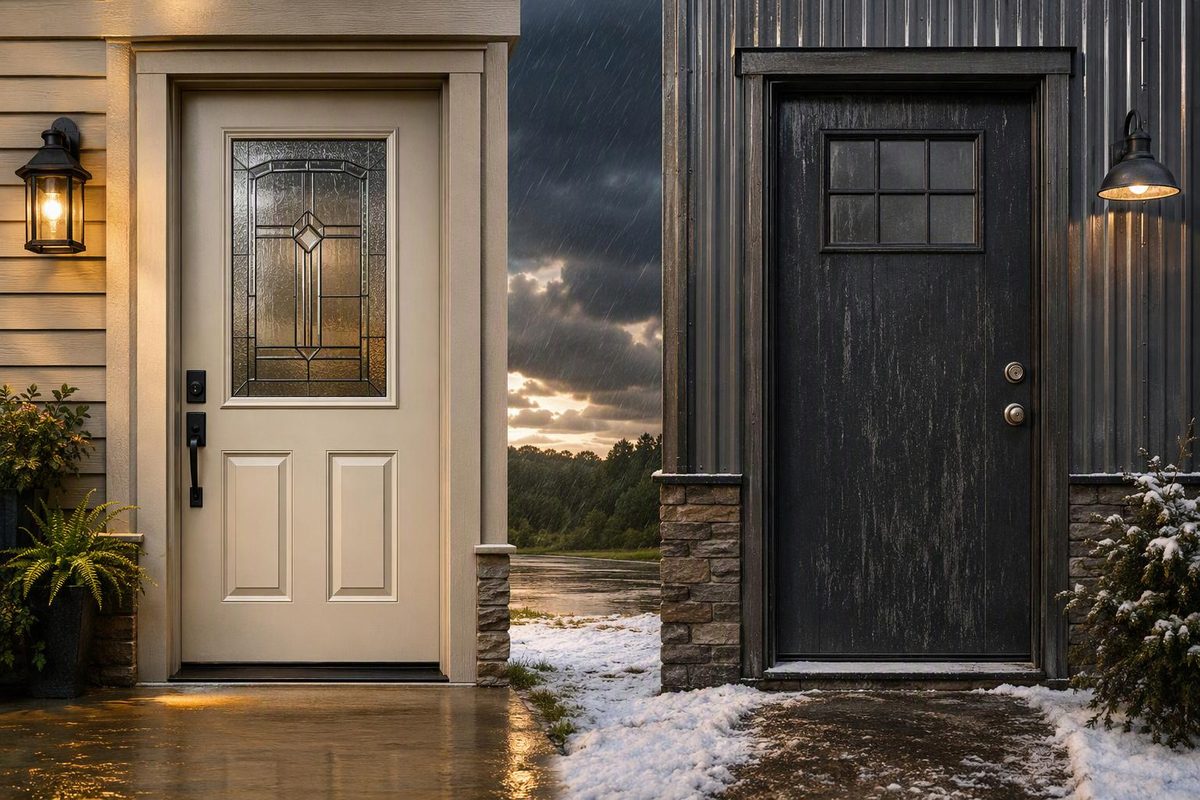
Fiberglass is usually the stronger default for a wet, salty or highly exposed entrance because its skin does not rust and is less prone to visible denting. Steel remains a practical option for a smooth painted door, particularly at a sheltered opening or where its lower quoted price leaves room for better hardware and installation.
Neither material automatically wins on energy efficiency, security, fire resistance or storm performance. Those are properties of the complete door system—slab, core, glass, frame, threshold, seals, hardware and installation—not simply the face skin.
The short comparison
| Decision point | Fiberglass exterior door | Steel exterior door |
|---|---|---|
| Rain, humidity and salt air | Skin does not corrode, making it the safer default for sustained exposure | Coating must remain intact because exposed steel can rust |
| Everyday impacts | Resists ordinary denting, although a hard impact can gouge or crack it | Tough surface, but a dent can remain visible in reflected light |
| Appearance | Best suited to molded wood grain and stain-like finishes | Well suited to a smooth painted finish |
| Finish care | Paint or clear finish still needs inspection and eventual renewal | Scratches and failing paint need prompt attention to prevent corrosion |
| Energy performance | Depends on the core, glass, seals and complete rated configuration | Depends on the core, glass, seals and complete rated configuration |
| Damage repair | Small stable chips may be filled and refinished; molded texture is hard to reproduce | Shallow dents may be filled and painted; rust requires removal and sealing |
| Cost | Often carries a premium for convincing grain or factory finishing | Basic smooth painted models may provide a lower starting quote |
Favor fiberglass for sustained exposure
Fiberglass avoids steel’s material-specific corrosion risk. That matters at an uncovered entry, near coastal salt, beside irrigation spray or anywhere scratches are likely to stay wet. By contrast, steel-door care must account for rust: Masonite recommends regular cleaning, with more frequent cleaning in coastal environments, and repainting when the finish requires it (Masonite).
Fiberglass is not maintenance-free. Its paint or clear finish can still deteriorate under ultraviolet light, moisture and pollutants. The jamb, glazing frame, sweep, threshold and edges can also fail independently of the face skin. Masonite’s general guidance says an exposed fiberglass door may need its topcoat renewed annually, while a milder, shaded exposure may allow a longer interval; the instructions for the exact door and finish should control.
Fiberglass is also the clearer choice when the goal is a molded wood appearance. Buy a stain-grade model and use a finish system approved for it—a smooth paint-grade slab is not automatically suitable for gel stain. See how finish grade changes the gel-stain decision.
Keep steel in the comparison for sheltered, painted openings
A steel door can make sense at a protected side entrance, utility room or budget-conscious front entry. Its smooth skin takes an opaque painted finish without needing to imitate wood grain.
The important comparison is installed cost, not the advertised price of a bare slab. Obtain quotes for equivalent prehung systems with the same dimensions, glass area, jamb material, threshold, hardware, finish, delivery and installation. A low-cost slab may not remain the cheaper option after fitting an old frame or replacing worn seals and hardware.
Inspect steel doors where corrosion usually starts: scratches, lock preparations, glazing edges and the bottom of the slab. Bubbling paint can conceal rust. A shallow stable dent may be a refinishing problem; perforation, a severely creased lock area or separation of the skin from the core requires a replacement assessment rather than cosmetic filler alone.
Compare energy performance model by model
Residential steel and fiberglass doors generally use thin face skins over an insulating core. Consequently, “fiberglass insulates” and “steel conducts heat” are poor buying rules for a finished door.
Compare the label for the exact size, glass and configuration. NFRC certification covers complete door products and reports ratings used to compare energy performance (NFRC). A lower U-factor indicates less heat transfer; where a door contains substantial glass, solar heat gain also matters.
The U.S. Department of Energy likewise recommends choosing fenestration for the applicable climate and using NFRC performance values rather than assuming one construction type is always more efficient (DOE). A large decorative lite can change the result more than switching between fiberglass and steel skins.
Installation still matters. A well-rated door in a racked frame, with an uneven threshold or worn sweep, can leak air and water. A prehung replacement allows the frame, sill and seals to be addressed together. A slab-only replacement requires the hinge locations, lock preparation, edge clearances and existing frame to match. Check the manufacturer’s instructions before trimming, drilling or repainting because modification and finishing limits vary by model.
Treat security, fire and storm claims as assembly ratings
A steel face does not by itself guarantee a more secure entrance. Forced-entry resistance also depends on the jamb, strike reinforcement, fastener embedment, lock, hinges, glass and installation. If security is a priority, ask for the test standard or documented rating of the selected assembly rather than accepting a material claim.
Apply the same rule to fire and storm requirements. Verify that the label or approval covers the exact door, frame, hardware and installation. In wind-borne-debris regions, confirm the selected size, glass, swing direction, anchoring schedule and design pressures with the local code authority or project professional. A product family containing an approved model does not make every configuration approved.
Diagnose damage before repairing either skin
For steel, expose the real extent of corrosion before filling. Loose coating and rust must be dealt with using products compatible with the door maker’s finish system. If corrosion has perforated the skin or reached a critical edge or lock area, replacement may be more appropriate than a surface repair.
For fiberglass, distinguish a finish scratch from damage through the composite skin. A shallow, nonmoving chip may accept a compatible filler and paint. Stop and obtain model-specific guidance if a crack moves when pressed, reinforcement is exposed, damage reaches a hinge or lock, the skin has separated from the core, or water appears to be inside the slab. Filling movement without correcting its cause is only a cosmetic patch.
Molded wood grain is particularly difficult to repair invisibly because filler and sanding can flatten the texture. Check for a manufacturer touch-up system and review the warranty before starting.
A five-check buying decision
- Rate the exposure. Direct rain, coastal salt and irrigation favor fiberglass; a deep overhang makes coated steel more practical.
- Choose the finish. Molded stain-like grain favors fiberglass; a smooth opaque color keeps steel competitive.
- Compare equivalent systems. Include frame, threshold, glass, hardware, finish, delivery and installation.
- Verify required ratings. Check the exact energy values and any fire, forced-entry, wind or impact listing.
- Read the warranty before ordering. Look for finishing deadlines, color restrictions, overhang requirements and field-modification limits.
For an exposed residential entrance, fiberglass usually earns its premium through corrosion resistance, dent resistance and stronger wood-look options. For a sheltered painted opening, a properly coated steel system can be the better value. The decisive product is the assembly that fits the exposure, carries the necessary ratings and can be installed correctly.