
Fiberglass vs Wood Doors: Exposure and Fit
A suitably designed overhang can reduce direct rain and UV, making wood more practical. Upkeep, custom sizing and repairability can also shift the choice.
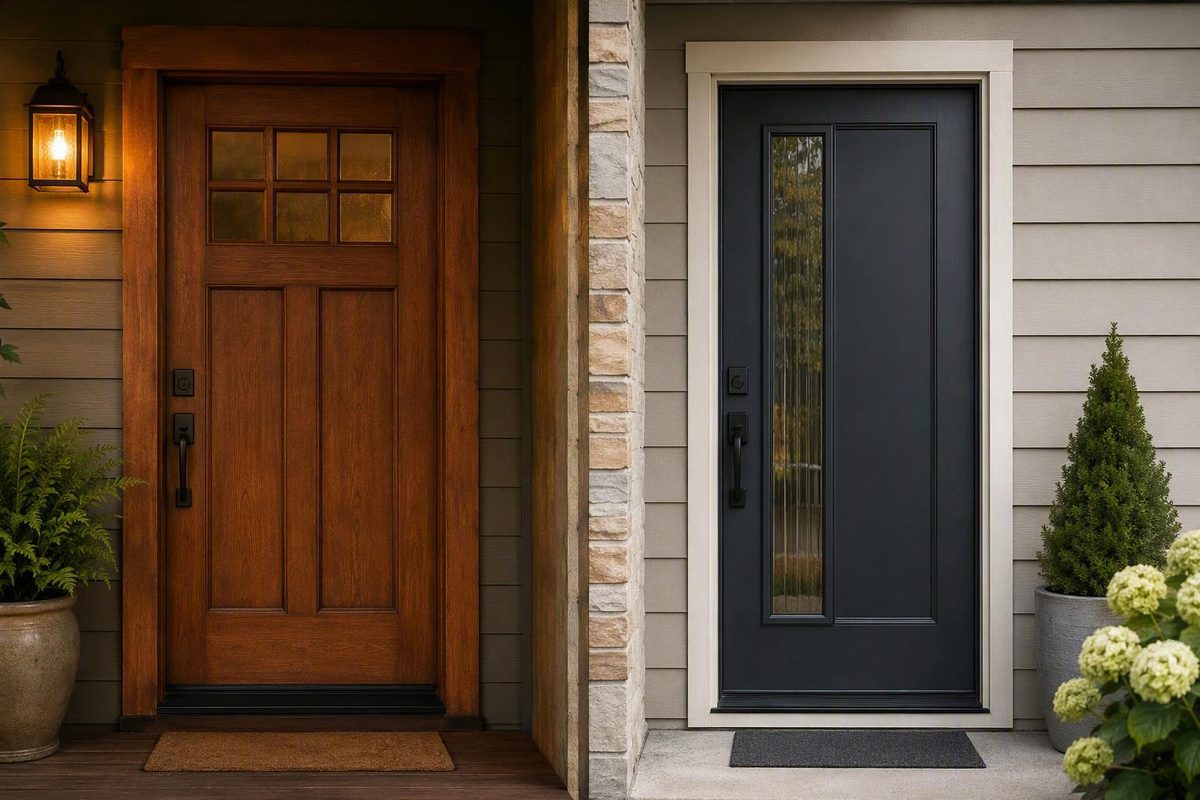
Choose the right entry door for your climate, style, and upkeep tolerance.
The short answer: fiberglass for easier ownership, wood for authentic character
For most uncovered or weather-exposed entrances, fiberglass is the more practical starting point. It generally handles moisture with less routine finish care and is available in insulated, wood-look configurations. Wood is usually the better choice when genuine grain, custom dimensions, detailed craftsmanship, and the ability to sand, repair, or refinish the surface matter most.
Neither material wins every category. Product grade, construction, finish, glass area, climate, exposure, installation quality, and maintenance can reverse a broad material-level advantage. A premium custom hardwood door should not be judged against an economy fiberglass slab, nor should a premium fiberglass system be compared with a poorly finished wood door.
The following table summarizes general tendencies rather than guaranteed performance:
| Decision factor | Fiberglass tendency | Wood tendency |
|---|---|---|
| Routine upkeep | Usually lower; cleaning and finish inspection are still required | Usually higher, especially for stained or exposed doors |
| Moisture resistance | Generally better resistance to moisture-related deterioration | Depends heavily on complete, intact protective finishing |
| Authentic appearance | Smooth or molded wood-grain looks; realism varies | Genuine grain, color variation, texture, and tactile character |
| Customization | Many factory styles, but individual models may be standardized | Broad flexibility in species, dimensions, shapes, carving, and panel layouts |
| Repairability | Finish damage may be repairable, but structural cracks can be difficult | Scratches, dents, and finish defects are often easier to sand, patch, or refinish |
| Insulation potential | Many models use insulated foam cores | Depends on construction and thickness; compare whole-door ratings |
| Security | Depends on the complete entry system | Also depends on the complete entry system |
| Price predictability | Standard configurations can simplify comparison, but premium options can be expensive | Species, dimensions, craftsmanship, and finishing create a broad price spread |
Consumer Reports similarly characterizes fiberglass as a lower-maintenance, weather-resistant choice and wood as the option with authentic appearance and extensive design possibilities. It also notes that solid wood generally resists dents and that superficial scratches can often be sanded out. Performance still varies by construction, climate, installation, and upkeep.
Here is the quickest recommendation by homeowner profile:
- Uncovered entry in a wet or humid location: Start with fiberglass, then compare the exact product’s exposure rules, finish coverage, and applicable ratings.
- Protected entrance on a traditional home: Wood becomes much more practical if you accept regular inspections and finish care.
- Nonstandard or unusually shaped opening: Investigate custom wood first, or verify a fiberglass model’s exact available dimensions and permitted trimming before ordering.
- Household seeking low routine upkeep: Favor a factory-finished fiberglass system, while recognizing that seals, hardware, and finishes still need inspection.
- Buyer focused on genuine wood grain: Choose wood rather than expecting a molded surface to reproduce every visual and tactile detail.
The best final choice is not merely a fiberglass or wood slab. It is a complete installed system comprising the slab, frame, threshold, seals, glass, hardware, finish, reinforcement, warranty, and installation.
What you are actually comparing: door construction, grade, and finish
“Fiberglass door” and “wood door” are category labels, not construction specifications.
A typical fiberglass entry door uses molded or smooth fiberglass skins over an internal structure. That structure may include an insulated foam core and wood or composite reinforcement at the perimeter, hinge locations, or lock area.
Wood is equally varied. “Wood” alone does not tell you whether a particular door is suitable for a wet, sunny, or highly exposed entrance.
When inspecting fiberglass doors at different price levels, look beyond the molded design:
- Economy products: Check whether the skin flexes, how the edges are built, how clearly the panels are defined, and whether the finish looks thin or inconsistent.
- Midrange products: Examine grain definition, finish adhesion, reinforcement around locks and hinges, edge sealing, and available glass and frame options.
- Premium products: Evaluate finish depth, grain variation, panel detail, rigidity, interior and exterior finish choices, approved repair provisions, and the quality of the complete prehung system.
These are inspection priorities, not automatic performance rankings. A higher price does not by itself prove superior weather resistance, energy performance, security, or longevity.
Finish must also be treated as a separate variable:
- Painted wood conceals the natural color and grain but provides a renewable protective surface when properly maintained.
- Stained wood showcases genuine grain while making finish condition especially important.
- Painted fiberglass can provide a consistent appearance and may be simpler to touch up than a layered simulated-stain finish.
- Factory-finished fiberglass benefits from controlled preparation and application, although coverage for fading or weather exposure depends on the exact warranty.
- Field-stained fiberglass depends on compatible preparation, stain, topcoat, and application technique.
Fiberglass can be molded into many styles, including traditional panels and simulated wood textures. Yet an individual finished model is often standardized.
Wood is commonly more accommodating when a door must be built to an unusual size, sanded, reshaped, or refinished. However, permissible alterations remain product-specific for both materials. A manufacturer comparison likewise describes fiberglass products as commonly standardized and wood doors as generally easier to custom-size, trim, repair, and refinish. Review DSA Doors’ material and construction comparison.
The fair comparison is therefore:
One complete fiberglass system and one complete wood system of similar quality, dimensions, glass area, finish level, hardware, warranty coverage, and installation scope.
Comparing an economy fiberglass slab with a custom hardwood entry system—and then generalizing about both materials—produces little useful information.
Let climate and entry exposure narrow the choice first
Before selecting a style or stain color, stand outside the entrance and document what the door will face. Consider:
- Direction and duration of direct sunlight, especially intense afternoon sun
- Wind-driven rain rather than rainfall alone
- Humidity and nearby irrigation
- Seasonal temperature and humidity swings
- Freeze-thaw conditions
- Snow or water accumulation at the threshold
- Porch or overhang protection
- Existing signs of leaks, peeling finish, swelling, sticking, or fading
Exposure often matters more than a generic claim that one material is “durable.”
| Climate or exposure | Qualified starting point | Why |
|---|---|---|
| Uncovered, wet, or humid entry | Usually fiberglass | Less dependence on a continuously maintained wood finish for moisture protection |
| Strong direct sun | Compare exact finishes, colors, warranties, and exposure limits | Either material’s finish can deteriorate under ultraviolet exposure |
| Protected porch or deep overhang | Either material; wood becomes more practical | Reduced precipitation and sunlight can ease demands on the finish |
| Large seasonal humidity changes | Fiberglass often has a practical advantage | Conventional wood can move as moisture conditions change |
| Freeze-thaw or very cold conditions | Compare complete rated systems and impact limitations | Seals, thresholds, glazing, and installation matter; severe impact can crack fiberglass |
| Dry, sheltered climate | Either material | Appearance, dimensions, repairability, and upkeep tolerance may drive the choice |
| Custom or historic entrance | Often wood, subject to local requirements | Custom shape, species, panel layout, and authentic material may be decisive |
When a wood finish fails, moisture can enter exposed surfaces and joints. Swelling, sticking, gaps, cracking, and eventually decay can follow. That does not mean every wood door will warp or rot; it means the protective finish, edge sealing, drainage, and installation details must remain effective.
Fiberglass generally resists moisture-related deterioration better than conventional wood, but it is not unaffected by exposure. Paint or simulated stain can scratch, fade, weather unevenly, or lose adhesion. Severe impact can crack the skin, and Consumer Reports cautions that high-impact cracking is a particular concern in extreme cold. Fiberglass should therefore be described as lower-maintenance and moisture-resistant—not invulnerable. See the Consumer Reports entry-door buying guide.
An overhang can reduce direct precipitation and ultraviolet exposure, potentially extending finish life and making wood more practical. Its value depends on depth, door orientation, wall height, prevailing weather, and the manufacturer’s rules. Do not assume that any porch satisfies warranty conditions. Obtain the selected door’s exposure, overhang, finishing, and storm-door requirements in writing.
Homeowner experiences illustrate why exposure and finish quality deserve attention, but they do not establish typical performance. In one long-running discussion, participants described protected wood doors remaining serviceable for decades, an exposed wood door warping and peeling, a fiberglass finish scratching easily, and another fiberglass door fading in strong sun. Those doors differed in age, brand, climate, finish, protection, and installation, so the reports show possible outcomes rather than comparative test results. Read the homeowner discussion in context.
General material comparisons are also insufficient for coastal, hurricane-prone, wildfire, or tightly regulated locations. Ask the applicable building authority and installer which product-specific impact, pressure, fire, egress, accessibility, or other requirements govern the opening. The relevant question is whether the exact assembly is approved where necessary and installed in its tested or specified configuration.
Maintenance, durability, and repairability over time
Wood has a renewable surface, but preserving it requires attention. Inspect the exterior face, top and bottom edges, panel joints, glazing details, lock and hinge areas, and any location where water can collect. Clean the door without damaging its finish, and renew paint, stain, or clear protection when its condition or the manufacturer’s instructions indicate that work is necessary.
There is no responsible universal refinishing interval. A sheltered painted door in a mild climate and a dark-stained door facing afternoon sun and rain may have very different needs. Finish type, species, construction, climate, overhang, orientation, workmanship, and product instructions all affect the maintenance cycle.
Fiberglass usually needs less routine finish work, but “less” does not mean “none.” It still needs cleaning, finish inspection, weatherstripping checks, threshold care, hardware adjustment, and timely attention to scratches or coating failure. A simulated stained finish may also require specialized touch-up materials.
The materials tend to fail in different ways.
Possible wood issues include:
- Surface scratches and dents
- Swelling or sticking
- Seasonal gaps
- Finish checking or peeling
- Cracks at joints or panels
- Moisture damage where protection has failed
- Localized decay if wet conditions persist
Possible fiberglass issues include:
- Scratched paint or simulated stain
- Fading or uneven weathering
- Loss of finish adhesion
- Damage around improperly modified edges
- Localized punctures or cracks from severe impact
- More complicated structural repair when the skin or reinforcement is compromised
Wood’s repairability is one of its strongest long-term advantages. Superficial scratches can often be sanded, while local defects may be patched, filled, refinished, or addressed through conventional woodworking. Movement or moisture damage still needs a cause-based repair; hiding it with filler or paint will not correct leaking, failed flashing, or poor threshold drainage.
Fiberglass finish damage may also be repairable, but the method must be compatible with the skin and coating system. One manufacturer’s general comparison acknowledges that damaged fiberglass can require specialized repair, reinforcing the need to ask about approved methods before buying. See Trimlite’s discussion of fiberglass repair limitations.
Properly protected and maintained wood can remain serviceable for decades, but that is not a guaranteed material-wide lifespan. Commercial comparisons cite this as a possibility rather than a promise, and actual service life depends on construction, exposure, finish care, installation, and repair. Review the qualified durability discussion. Avoid universal lifespan claims for fiberglass for the same reason.
Use this inspection-based maintenance checklist:
| Finish and material | What to inspect | Appropriate response |
|---|---|---|
| Stained wood | Fading, dry-looking areas, checking, open joints, exposed bottom edge, water marks | Clean as approved; renew stain or protective topcoat before bare wood is exposed |
| Painted wood | Cracking, peeling, bubbling, open seams, soft spots, exposed end grain | Correct moisture sources; prepare and repaint with an approved exterior system |
| Stained fiberglass | Scratches, fading, flaking, loss of adhesion, uneven topcoat | Use approved cleaners, preparation, stain, topcoat, and touch-up methods |
| Painted fiberglass | Chalking, scratches, peeling, impact damage, edge exposure | Clean and touch up as directed; evaluate cracks before refinishing |
Follow the door manufacturer’s preparation instructions and use its approved stain or finishing system. Test the process on a sample when possible.
Appearance, customization, sizing, and showroom inspection
Wood’s central aesthetic advantage is straightforward: it is genuine wood. Species-specific color, grain variation, texture, figure, end grain, and tactile character become part of the design. Depending on the manufacturer and product line, wood can also support carved details, unusual panel arrangements, custom thicknesses, arches, Dutch-door configurations, and tailored stile-and-rail proportions.
Fiberglass is available with smooth skins and molded wood-grain textures. Premium combinations of texture, color, glazing, panel definition, and topcoat can look convincing, especially from the street. Up close, however, grain repetition, surface feel, edge treatment, and finish depth may reveal the difference. Realism varies by product and price level.
Neither preference is objectively correct. Some buyers value authentic grain and natural variation; others prefer a consistent wood-like appearance without the same finish-care demands. Beauty is a design preference, not proof of durability or performance.
For a nonstandard opening, wood commonly offers more flexibility. It may be custom-built, sanded, trimmed, repaired, or refinished to suit the project. Some wood-door manufacturers offer custom sizes, shapes, thicknesses, arch tops, clipped corners, and specialized configurations, although the available choices and alteration limits remain specific to the selected line. See Simpson Door’s overview of wood customization.
Molded fiberglass can likewise be manufactured in numerous designs and sizes. The distinction is between what a factory can produce and what an installer may alter after production. A particular fiberglass model may permit only minimal trimming—or none at all.
Before ordering, obtain written answers to these questions:
- How much may be trimmed from the top, bottom, and each side?
- Are the allowances different for width and height?
- Does trimming expose the core or remove reinforcement?
- Must altered edges be resealed in a specified way?
- May hinges or lock preparations be relocated?
- Could a proposed modification affect warranty coverage or product ratings?
- Can the door be ordered in the required size instead?
Whether it also affects warranty coverage or a product rating depends on the exact manufacturer documents and approved configuration, so verify those consequences before alteration. Consult the manufacturer comparison and product-specific instructions.
Resolve dimensions before selecting a standardized model rather than assuming the installer can make it fit.
At the showroom, inspect the actual product or the closest available sample:
- View the finish under indoor lighting and natural daylight.
- Look across the surface at a low angle for waviness or inconsistent sheen.
- Check grain realism and obvious repetition.
- Press gently on broad areas to assess skin rigidity.
- Examine panel definition and transitions around molded details.
- Inspect the hinge edge, lock edge, top, and bottom construction.
- Ask how the top and bottom are sealed.
- Test a display sample for easy scratching only with the retailer’s permission.
- Ask which cosmetic and structural repairs are approved.
- Compare factory-finished and field-finished samples.
- Request the exact touch-up materials and process.
- Inspect the frame, threshold, weatherstripping, and glass—not only the slab.
Wood often makes sense for a custom arch, restoration-style entry, unusual opening, carved design, or species-specific stain when those options are available from the selected manufacturer. Fiberglass often makes more sense when the goal is a wood-like appearance with less routine finish care and a readily available standard configuration.
Energy efficiency and security depend on the complete entry system
Many fiberglass entry doors contain insulated foam cores and may outperform a conventional solid-wood slab thermally. That tendency does not prove that every fiberglass door is more efficient than every wood door. Core construction, slab thickness, glass, frame, threshold, weatherstripping, fit, and installation all affect the result.
Use product-specific whole-door information:
- U-factor describes heat transfer through the rated assembly. A lower whole-door U-factor means less heat transfer when comparing equivalent configurations.
- R-value describes resistance to heat flow. Higher indicates greater resistance, but a generic slab R-value should not be compared with a whole-door rating.
- Air leakage indicates how much air passes through or around the rated assembly under specified test conditions.
- Glazing information helps distinguish among clear, coated, double-pane, triple-pane, and other glass configurations.
Decorative glass, sidelights, and transoms can reduce insulating performance in either material. They also add frames, seals, and joints that must remain properly fitted. Compare equal glass areas and equivalent glazing rather than an unglazed fiberglass door with an elaborate wood entry containing multiple glass panels.
Air passing around an entry can matter more than heat conducted through the slab. Consumer Reports notes that entry-door air leakage typically causes more heat loss than transmission through the door itself. The same guide says ENERGY STAR-qualified doors undergo independent testing and certification. Precise installation, intact weatherstripping, an adjusted threshold, and a square frame are therefore critical regardless of material. Consult Consumer Reports’ energy and installation guidance.
Where available, compare the exact product’s National Fenestration Rating Council information and applicable ENERGY STAR qualification. Do not substitute a brochure’s best-performing unglazed model for the configuration in your quote.
Security also resists simple material rankings. Forced-entry resistance depends on:
- Jamb strength and condition
- Strike-area reinforcement
- Fastener type and anchorage
- Deadbolt and lock quality
- Hinge attachment and exposed-pin protection
- Reinforcement around the lock area
- Frame attachment to the structure
- Glass location and accessibility
- Correct alignment and installation
Consumer Reports’ prior battering-ram testing found a common vulnerability in wood, fiberglass, and steel doors: the jamb split near the strike plate. The finding illustrates why a strong-looking slab cannot compensate for a weak strike area or poorly secured frame.
For a more secure entry, evaluate the strike area, locks, hinges, nearby glazing, frame, and installation as one system. Specify hardware and attachment methods that are compatible with the exact tested or manufacturer-approved assembly rather than assuming one universal fastening detail fits every wall and frame. Manufacturer guidance likewise treats security as a function of the lock area, hardware, frame, and construction rather than slab material alone. Review the complete-system security factors.
Cost and long-term value: compare equivalent installed systems
Fiberglass often costs less than premium custom wood, but that is only a broad tendency. High-end fiberglass with elaborate glass, sidelights, premium finishes, reinforced frames, and upgraded hardware can cost as much as—or more than—some wood systems. Published comparisons also show that prices vary with slab size, configuration, glass, hardware, jamb material, and customization, making material-only conclusions unreliable. See the qualified cost comparison.
A universal national price range would be misleading. Published figures often mix slab-only prices with installed systems and combine different years, regions, sizes, brands, glass packages, and labor scopes.
Separate the door’s advertised price from the complete project cost:
- Slab or prehung unit
- Jamb or frame
- Threshold and weatherstripping
- Glass, sidelights, or transom
- Hinges and lockset
- Factory or field finish
- Interior and exterior trim
- Removal and disposal
- Installation labor
- Framing or opening correction
- Flashing, sealing, and water management
- Permits or inspections where applicable
- Post-installation adjustment
- Warranty and labor coverage
Quotes are comparable only when they match dimensions, glass area, glazing, frame, threshold, hardware, finish, removal, opening preparation, installation, and warranty. A lower quote may simply omit finishing, trim repair, disposal, or correction of an out-of-square opening.
Lifecycle cost should be considered qualitatively rather than converted into a promised payback. Wood may require recurring finish materials and labor. Fiberglass may reduce routine finish work but can be less straightforward to repair after some cracks or structural damage. Neither material justifies a guaranteed lifespan, annual energy saving, resale return, or fixed payback period without product- and project-specific evidence.
Use a worksheet to collect three equivalent quotes:
| Item | Quote 1 | Quote 2 | Quote 3 |
|---|---|---|---|
| Exact product and model | |||
| Dimensions and configuration | |||
| Glass and sidelights | |||
| Frame and threshold | |||
| Hardware and reinforcement | |||
| Factory or field finish | |||
| Removal and disposal | |||
| Opening corrections | |||
| Installation and sealing | |||
| Initial installed cost | |||
| Manufacturer-specified maintenance | |||
| Cosmetic repair coverage | |||
| Structural and glass-seal coverage | |||
| Labor coverage | |||
| Exclusions and replacement implications |
Read the warranty before paying a deposit. The headline duration matters less than what the document covers and excludes. Look specifically for provisions concerning:
- Finish fading, chalking, peeling, or discoloration
- Cracking, warping, or water intrusion
- Glass-seal failure
- Direct sunlight and weather exposure
- Required overhang dimensions
- Storm-door use
- Field finishing and approved products
- Trimming or hardware modification
- Maintenance documentation
- Labor, shipping, finishing, and reinstalling
- Installer qualifications and installation methods
- Transferability to a future owner
Do not assume that a modification, exposure condition, or maintenance omission automatically has the same warranty consequence across all products. The exact warranty and installation documents control.
Environmental comparisons are similarly conditional. Relevant considerations include the source and certification of wood, resin- and energy-intensive fiberglass manufacturing, maintenance coatings, repairability, service life, transport, and end-of-life options. Without a complete lifecycle assessment of equivalent products, neither material can responsibly be declared the universal environmental winner.
A step-by-step checklist for choosing the right door
Step 1: Document the entry’s exposure. Record orientation, hours of direct sun, wind-driven rain, humidity, temperature swings, freeze-thaw conditions, and overhang depth. Photograph peeling finish, staining, soft trim, threshold corrosion, drafts, or water entry around the existing system.
Step 2: Rank your priorities. Put authentic appearance, low upkeep, custom dimensions, repairability, thermal performance, security, and initial budget in order. A clear ranking prevents an attractive showroom sample from displacing the requirements that matter every day.
Step 3: Measure and diagnose the opening. Determine the rough opening, finished opening, wall thickness, swing, sill condition, and whether the frame is square and plumb. Decide whether the project needs a standard prehung unit, custom system, permitted trimming, or framing changes. Confirm measurements with the installer who will be responsible for the fit.
Step 4: Shortlist equivalent complete systems. Match dimensions, glass, frame, threshold, finish, hardware, reinforcement, and installation scope. Do not compare bare slabs if the actual project requires a new frame, sidelights, trim, and extensive opening work.
Step 5: Compare product-specific performance. Review whole-door U-factor, air leakage, glass configuration, applicable ENERGY STAR information, and any local impact, fire, egress, or accessibility requirements. A retailer’s broad statement about fiberglass or wood is not a substitute for documentation covering the ordered configuration. Commercial buying guidance also recommends evaluating the complete entry system and rated information rather than relying on slab material alone. Read the complete-system comparison.
Step 6: Inspect physical samples. Check finish quality, grain realism, rigidity, edges, panel detail, and approved repair methods. Compare the sample under natural and artificial light. Ask whether it represents the exact factory finish you will receive, and investigate any evidence of easy scratching or poor adhesion.
Step 7: Read warranty and installation documents before buying. Pay close attention to exposure, overhang, storm-door, finishing, trimming, maintenance, labor, and installer requirements. Obtain written clarification for anything that affects your opening.
Step 8: Obtain itemized installed quotes. Make sure every quote includes removal, disposal, finishing, hardware, trim, opening corrections, sealing, and post-installation service. Identify who is responsible if the opening is damaged, out of square, or affected by hidden water intrusion.
The resulting recommendations should remain conditional:
- Favor fiberglass for a heavily exposed entrance or a household prioritizing lower routine upkeep, subject to the selected finish and exposure rules.
- Favor wood for a protected custom, historic-style, unusually shaped, or species-specific entrance when added finish care is acceptable.
- If energy performance is the main concern, compare specific rated systems with matching glass, dimensions, frames, and thresholds.
- Resolve unusual opening dimensions before selecting a standardized fiberglass model.
- For either material, prioritize a properly installed frame, durable finish, effective weather seals, a well-designed lock and strike area, and clear warranty coverage.
A well-specified and correctly installed entry system can matter more than the broad material label stamped on a sales proposal.
Frequently asked questions about fiberglass vs wood doors
Is a fiberglass door better than wood in direct sun and rain?
Fiberglass is generally the more practical starting point for an uncovered entrance exposed to rain because it is less dependent on a maintained wood finish for moisture protection. That does not establish a universal ultraviolet advantage: fiberglass finishes can still fade, scratch, weather unevenly, or lose adhesion in strong sun.
Compare factory finishes, color limitations, exposure exclusions, and warranty terms for the exact models. If wood is preferred, provide as much protection as practical and accept closer finish inspection and maintenance.
Are fiberglass doors always more energy-efficient than wood doors?
No. Many fiberglass doors use insulated foam cores and may outperform conventional solid-wood slabs, but material alone does not determine efficiency.
Compare whole-door U-factor, air leakage, glass area, glazing type, frame, threshold, weatherstripping, fit, and installation. Use equivalent configurations; a solid fiberglass door and a wood door with extensive decorative glass are not an apples-to-apples comparison.
Can a fiberglass door be trimmed to fit a nonstandard opening?
Sometimes, but trimming allowances are model-specific and may be very limited. Cutting can expose the core, remove edge reinforcement, or interfere with hardware.
Obtain the permitted top, bottom, and side trimming dimensions in writing before ordering. Verify any consequences for warranty coverage or product ratings in the exact manufacturer documents. If the opening is significantly nonstandard, a factory-sized fiberglass unit, framing alteration, or custom wood door may be more appropriate.
Can scratches, fading, or cracks in a fiberglass door be repaired?
Some cosmetic scratches and finish defects can be repaired with compatible preparation and touch-up products. A crack through the skin—especially near a hinge, lock, edge, or glass opening—can be more complicated and may require specialist evaluation or replacement.
Use only manufacturer-approved materials and methods. First determine whether the problem is cosmetic or structural, then verify whether the proposed repair is compatible with the warranty and any applicable product rating.
Does an overhang make a wood front door a practical choice?
It can. A suitably designed overhang can reduce direct rain and ultraviolet exposure, easing demands on the finish and making wood more practical for an entrance that would otherwise be highly exposed.
Protection is not absolute. Wind-driven rain, low-angle sun, humidity, splashback, and threshold drainage still matter. Confirm that the overhang meets the chosen manufacturer’s exposure and warranty requirements, then inspect and maintain the wood finish according to its condition and approved instructions.