
Fiberglass vs Gunite Pool Cost 2026: The Real Total
Fiberglass and gunite pool prices overlap in 2026. Itemize site work, patio, fencing and upkeep to compare installed and 10-year totals.
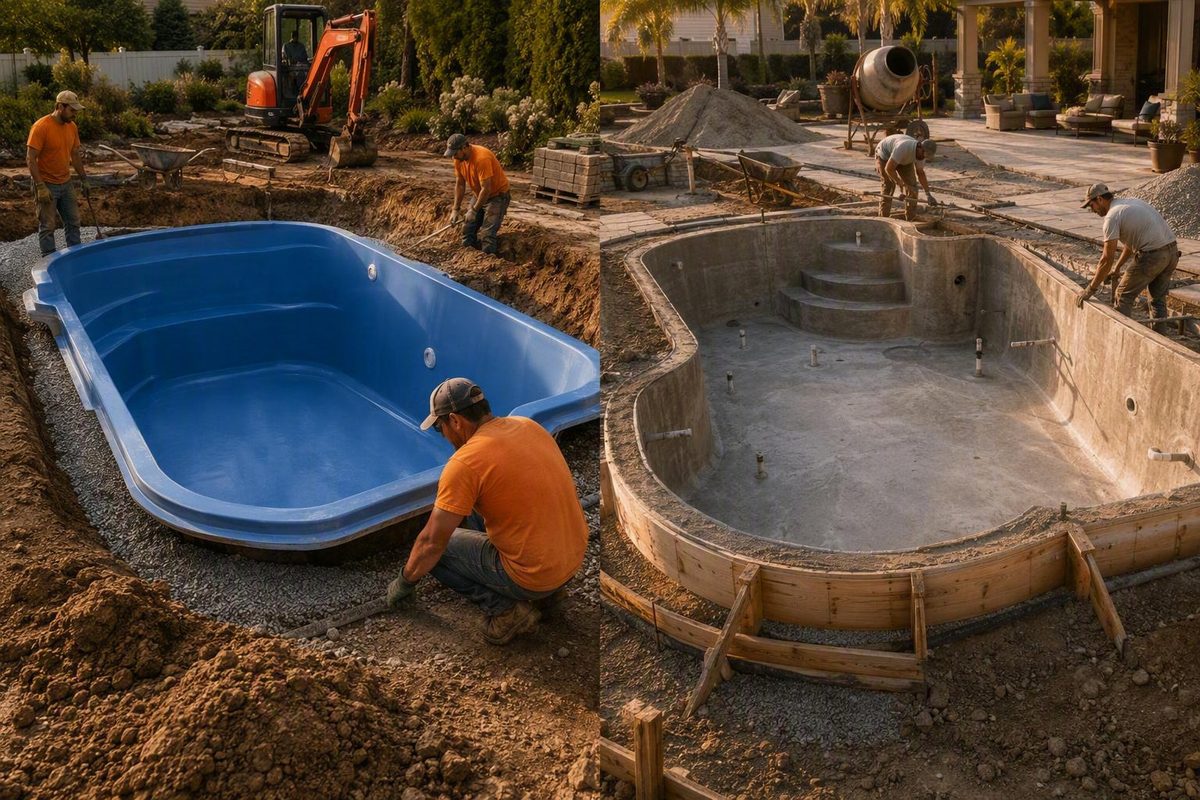
Turnkey fiberglass pools now run about $85,000–$200,000, overlapping gunite at $95,000–$225,000. Fiberglass is also approaching 80% of Latham’s 2026 in-ground pool sales, so strong demand and successful price increases are not producing bargain installations. Buy fiberglass for a weeks-not-months build and lower expected upkeep—not because an online average promises a pool for one-third of gunite’s price (River Pools; Latham’s SEC-hosted Q2 release).
The shell is only one part of the bill. Delivery and lifting, excavation, backfill, electrical work, patio, fencing, drainage and restoration can consume tens of thousands of dollars. River Pools says electrical work, patios, fencing and accessories excluded from a base proposal may add $25,000–$50,000.
The Budget-Pool Argument Is Fair but Outdated
The received wisdom has a real basis. Angi publishes averages of about $31,000 for fiberglass and $100,000 for gunite. Fiberglass shells are factory-molded, arrive with a finished surface and require fewer on-site structural stages. Gunite requires reinforcement, concrete application, curing and an interior finish. Standard fiberglass designs therefore often start lower than custom concrete projects (Angi).
That comparison is useful only as a starting-price observation. Angi does not identify common dimensions, geography, site conditions or package scope behind those two averages. It cannot establish that equivalent completed fiberglass projects cost one-third as much as gunite.
Published 2026 estimates show why the rule fails:
| Source | Fiberglass | Gunite | Basis |
|---|---|---|---|
| River Pools | $85k–$200k | $95k–$225k | Fully installed or turnkey |
| Thursday Pools | $45k–$100k | $50k–$120k+ | Typical installed estimates |
| Angi | $31k average | $100k average | Scope not specified |
| East Tennessee contractor | $70k–$190k+ | $95k–$350k+ | Regional projects |
River Pools’ guide was updated in December 2025, while Thursday Pools labels its figures as 2026 estimates. Neither is a statistically representative national survey with both pool types controlled for size, location and completion standard. The figures are planning ranges, not promises.
The defensible conclusion is narrower: fiberglass commonly has a lower starting point, but its completed-project range overlaps gunite substantially. A straightforward gunite pool can cost less than a large fiberglass installation requiring difficult crane access, retaining work and extensive decking.
Enter both package quotes and every shared project cost; the calculator shows which option wins at installation and after 10 years.
Default scenario: a 16 × 32 pool with editable package quotes and $25,000 of separately itemized site, patio and fencing work. These are planning inputs, not a national average.
Installation winner: Gunite by $5,000.
10-year winner: Fiberglass by $20,500. Fiberglass costs $135,000 versus $155,500 for gunite in the default scenario.
| Cost Line | Fiberglass | Gunite | How It Is Used |
|---|---|---|---|
| Pool package | $100,000 | $95,000 | Separate bid input |
| Shared site/backyard work | $25,000 | $25,000 | Site + patio + fence + restoration |
| Selected options | $0 | $0 | Heater and automatic cover |
| Installed total | $125,000 | $120,000 | Before ownership costs |
| 10 years of routine care | $10,000 | $27,500 | Annual input × 10 |
| Repair/surface reserve | $0 | $8,000 | Editable planning reserve |
| 10-year total | $135,000 | $155,500 | Install + care + reserve |
16 × 32 ft 400 sq. ft. patio
Both installed totals fall inside River Pools’ published turnkey ranges.
Site flag: ordinary access and soil. Confirm all assumptions after a site inspection.
Other utilities/restoration remain $0; verify whether the package includes them.
Sources: River Pools turnkey ranges of $85,000–$200,000 fiberglass and $95,000–$225,000 gunite; excluded-work estimate of $25,000–$50,000; published routine-care ranges of $500–$1,500 fiberglass and $1,500–$4,000 gunite; commercial gunite resurfacing estimates of $6,000–$20,000 every 8–15 years. Default quote values are editable scenarios, not market averages.
Where the Money Beyond the Shell Goes
A detailed fiberglass guide separates $60,000–$100,000 for basic installation, $85,000–$135,000 with approximately 400–800 square feet of concrete patio, and $85,000–$200,000 for a turnkey project. Its basic package generally includes the shell, delivery, pump and filter, permit, excavation, backfill, initial fill, cleaning equipment and possibly rough grading. Electrical work, patio construction and optional features are commonly outside that package (River Pools’ fiberglass pricing guide).
Those labels are not standardized. “Delivery included” may mean transport to the property but not a large crane. “Excavation included” may cover ordinary soil while excluding rock, buried concrete, groundwater and disposal. “Electrical included” may cover an equipment hookup but not a panel upgrade or long trench.
Delivery, Excavation and Backfill
A fiberglass shell is delivered in one piece. The proposal must identify who pays for unloading, crane service, staging and any access preparation. A shell can fit the yard but remain expensive or impractical to lift over a house, trees or utility lines.
Excavation assumptions matter for both materials. Ask the bidder to state what soil conditions are included, where excavated material will go and how rock, groundwater, unstable soil or buried debris will be priced. Imported structural fill, dewatering, drainage and retaining walls should be separate lines rather than vague potential extras.
Backfilling a fiberglass shell is part of the installation system, not casual landscaping. Responsibility for placement, plumbing, backfill and filling should remain clear from the moment the shell arrives until startup.
Patio, Coping and Drainage
Patio area can change a proposal by far more than a small difference between pool structures. Compare square footage, material, base preparation, reinforcement, finish, drainage and steps—not the word “patio.”
A River Pools planning example says a complete backyard involving features and complex site work may add $20,000–$60,000 or more beyond the underlying installation. That estimate should not be stacked automatically on top of its separate $25,000–$50,000 excluded-work range; the bundles may overlap.
Fencing, Utilities and Restoration
Pool barriers, gates, alarms, electrical bonding and other safety provisions depend on local requirements. Follow the applicable code and safety guidance, and make the contract identify who handles permits, inspections and each required component.
The quote should also name the pump, filter, heater, controls and sanitation equipment. Confirm electrical trenching, service capacity, bonding, gas work, water supply and the equipment pad. “Equipment included” does not establish equivalent capacity or connection work.
Construction may require fence removal, lawn and irrigation repair, driveway protection, final grading, debris removal and drainage restoration. A contract ending at “rough grade” leaves those costs with the owner.
Strong Demand Is Not Making Fiberglass Cheaper
Latham reported that second-quarter 2026 in-ground pool sales rose 22.5%, led by fiberglass. Management expected fiberglass to represent approximately 80% of full-year in-ground pool sales.
The release also credited net-sales growth partly to “the full year benefit of the 2025 price increase” and raised full-year guidance to 11.7% sales growth. Demand accelerated faster than the normal seasonal ramp, contributing $2.8 million of incremental quarter-specific costs.
These are manufacturer results, not homeowner installation-price data. They do not prove that every dealer raised quotes or that fiberglass is universally preferred. They do show why buyers should not assume manufacturing scale or popularity will restore the old bargain-price gap in 2026.
Fiberglass Pulls Ahead More Clearly Over 10 Years
Commercial planning estimates put routine fiberglass care at approximately $500–$1,500 per year and gunite care at roughly $1,500–$4,000 per year. The scopes vary and may mix DIY supplies with professional service, so these are scenario inputs rather than validated national averages (Thursday Pools).
The draft calculator defaults use the published example inputs of $1,000 per year for fiberglass and $2,750 for gunite. Over 10 years, that produces a $17,500 routine-care difference before surface work.
Commercial guides commonly estimate gunite resurfacing every 8–15 years, with published costs spanning approximately $6,000–$20,000. A specific pool may have no resurfacing event during the first decade, one event, or work just beyond the selected period. The calculator therefore uses an editable reserve instead of claiming that every owner receives the same bill (Ferrari Pools).
Fiberglass is not repair-free. Shell, finish, plumbing, drainage or settlement work can occur, but the available evidence does not provide a reliable national incidence rate or repair price. Enter a nonzero reserve based on the warranty, local advice and site risk rather than assuming perfect performance.
Keep shared expenses out of the material comparison when they truly are identical. Electricity, heating, equipment replacement, water and seasonal service may differ by design and use, but shell material alone does not determine them. Add them separately when the proposals specify a difference.
Installation Speed Is Fiberglass’s Clearest Upfront Advantage
A cautious complete-project planning range is two to six weeks for fiberglass and two to six months for gunite. One East Tennessee contractor estimates three to four weeks for fiberglass and eight to 12 weeks for gunite, while other commercial guides put gunite around three to six months (Morales Outdoor Living).
Fiberglass gains time because the finished shell is manufactured off-site and placed into a prepared excavation. Gunite is formed on-site through excavation, reinforcement, plumbing, concrete application, curing and interior finishing.
Shell placement in a day is not a completed pool in a day. Plumbing, backfill, filling, equipment work, utilities, patio, barriers, inspections and restoration remain. Permitting, weather, access and contractor scheduling can delay either material.
The trade-off is design freedom. Fiberglass is generally constrained to available molds and transportable dimensions, with a commonly cited approximate screening limit of 16 feet wide by 40 feet long. Actual catalogs, routes and delivery restrictions may be tighter. Gunite can accommodate custom depths, lap-lane proportions, beach entries, integrated spas, infinity edges and site-specific geometry.
If a catalog shell already supplies the required swimming area, depth, steps and seating, custom concrete may add cost and time without adding much function. If exact geometry is essential, gunite’s flexibility can justify the premium.
Normalize Both Bids Before Choosing
Give fiberglass and gunite bidders the same written specification. Match usable swimming dimensions, depth zones, equipment performance, heating, lights, controls, patio area, coping, barriers, restoration and options.
Then classify every amount as fixed price, allowance, exclusion, optional upgrade, owner responsibility or potential change order. An allowance without a quantity and unit price does not make a bid comparable.
The most consequential lines are usually:
- Delivery, unloading and crane service
- Excavation assumptions and rock pricing
- Groundwater control, haul-off and imported fill
- Shell placement or gunite structural work
- Plumbing and named equipment
- Electrical, gas, bonding and inspections
- Coping and specified patio area
- Drainage and retaining work
- Required fencing, gates and alarms
- Final grading, landscaping and cleanup
Review warranties before signing. Separate coverage for the fiberglass shell or gunite structure, surface finish, equipment, plumbing, workmanship, decking and drainage. Check labor coverage, transferability, maintenance requirements and exclusions involving groundwater, soil movement, water chemistry, freezing or emptying the pool.
Fiberglass deserves the first quote when an available mold fits, crane access works, schedule matters and lower routine upkeep is a priority. Gunite deserves the premium when custom dimensions, depth or integrated features provide real value. The 2026 evidence supports that choice between speed and upkeep versus design freedom; it does not support a $31,000-versus-$100,000 shortcut.