
Fiberglass vs. Acrylic Tubs: Use, Cost and Build Quality
A well-made, correctly supported fiberglass tub can outperform thin or poorly installed acrylic, so the material label alone should not decide your choice.
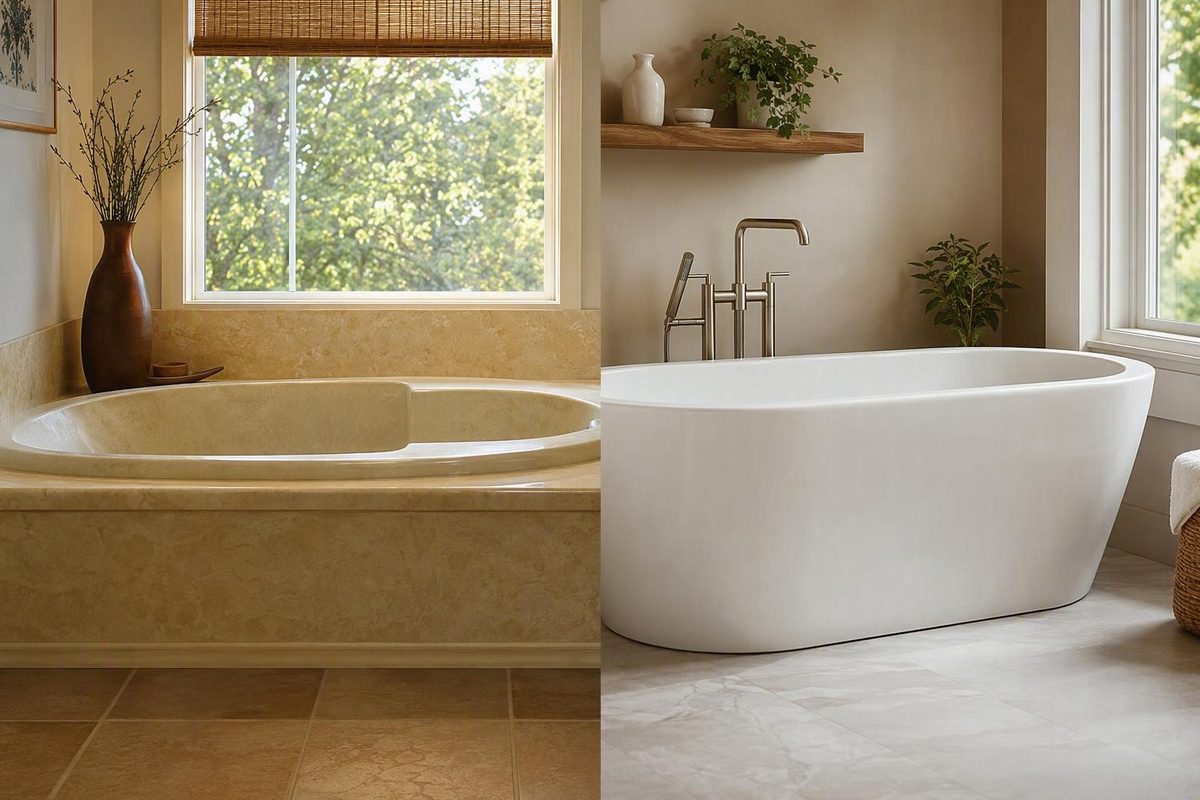
The short answer: acrylic for long-term use, fiberglass for minimum cost and weight
For a frequently used primary bathroom, acrylic is generally the better candidate when you value a smooth finish, greater rigidity, wider design selection, and a longer ownership horizon. Fiberglass is a practical alternative when the immediate priorities are a lower purchase price and easier handling.
That is a conditional recommendation, not proof that every acrylic tub is superior. A well-made, correctly supported fiberglass tub can outperform a thin or poorly installed acrylic tub. Compare models with similar dimensions and configurations, then examine their reinforcement, base design, installation instructions, and warranties. Construction quality and installation can matter as much as the material label, a qualification also emphasized in HOROW’s acrylic-tub buying guide.
| Factor | Acrylic tub | Fiberglass tub |
|---|---|---|
| Construction | Formed acrylic bathing surface, commonly reinforced on the back with fiberglass and resin | Fiberglass-and-resin shell protected by a gel-coat surface |
| Relative upfront cost | Generally higher among comparable basic tubs | Generally lower among comparable basic tubs |
| Weight | Lightweight, though usually heavier than comparable fiberglass | Usually the lighter option |
| Rigidity | Generally more rigid, subject to shell thickness, reinforcement, and support | More frequently associated with noticeable flex |
| Finish aging | Tends to retain a smooth, glossy appearance better, but can scratch or dull | Gel coat is more often associated with fading, dulling, staining, and surface wear |
| Reported heat retention | Commercial sources generally report better retention, without a standardized quantified difference | Generally reported to lose heat faster |
| Design variety | Usually available in more shapes, colors, finishes, and feature configurations | Usually concentrated in basic shapes and colors |
| Cleaning | Approved mild cleaners and soft tools; avoid abrasives | Approved mild cleaners and soft tools; protect the gel coat from abrasives |
| Repair considerations | Light scratches may sometimes be polished; deeper damage can require patching or refinishing | Local damage may sometimes be patched, but worn gel coat and color matching can complicate the result |
| Reported lifespan and value tendency | Often positioned for frequent use and longer ownership, but no universal lifespan is established | Lower initial expense may suit shorter or lighter-duty use; earlier visible wear is possible |
| Best-fit uses | Primary baths, frequent use, longer remodel horizons, design-led projects | Guest baths, strict budgets, rentals, short-term upgrades, access-sensitive projects |
These are commercial-source tendencies rather than standardized performance rankings. Specialty retailers generally describe fiberglass as lighter and less expensive, while associating acrylic with more design choice and better resistance to visible wear (Mobile Home Outfitters’ comparison).
Acrylic therefore makes sense as the starting point for a frequently used bathroom, provided the model is adequately reinforced and its required support can be installed correctly. Fiberglass makes sense for a lightly used guest bath, a budget-focused rental renovation, a shorter-term project, or a difficult access route where every reduction in weight helps.
Claims about durability, heat retention, service life, and long-term value should consequently be treated as shopping guidance—not guarantees about every tub in a category.
What acrylic and fiberglass tubs are actually made from
The phrase “fiberglass vs acrylic tub” makes the materials sound more separate than they are. Many acrylic tubs contain fiberglass. The practical distinction is usually the finished bathing surface and the construction of the shell beneath it.
An acrylic tub commonly begins as a sheet of acrylic. The sheet is heated, vacuum-formed into the tub shape, cooled, and reinforced on the back with fiberglass and resin. Acrylic is the surface the bather sees and touches; the backing helps stiffen the formed shell. Kohler describes this heating, forming, and reinforcement sequence in its construction comparison.
A tub sold as fiberglass generally uses glass fibers combined with resin to form the shell. Its visible surface is normally gel coat: a resin-based finish applied to create a comparatively smooth, colored, cleanable face over the fiberglass-resin laminate. Gel coat is not automatically a separate premium category. Its performance depends on the complete product, including the finish, laminate, reinforcement, base, installation, use, and care.
In simple terms:
- Acrylic tub: acrylic bathing surface over a reinforced backing.
- Fiberglass tub: gel-coat bathing surface over a fiberglass-resin shell.
This layered construction explains why the underside can be misleading. Visible fibers, mesh, or rough reinforcement do not prove that the bathing surface is fiberglass. An acrylic tub may show similar backing underneath.
That distinction matters when selecting cleaners, repair products, or refinishing systems. A product designed for one surface may not be approved for another, even if both tubs contain fiberglass somewhere in the assembly. Use the model documentation to identify the finished surface rather than inferring it from the backing.
Construction also varies within each category. Fiberglass tubs likewise vary in gel-coat quality, laminate construction, reinforcement, and floor support.
Neither category should be described as scratch-proof, crack-proof, or maintenance-free. Acrylic can be scratched by abrasive tools and may flex when its shell or support is inadequate. Fiberglass gel coat can wear, dull, or crack, but a substantial, correctly supported fiberglass unit may perform better than a lightly reinforced acrylic model.
When comparing products, look for a description of the entire assembly. “Acrylic” without information about reinforcement and support is incomplete. So is “fiberglass” without information about the gel coat, shell, and base.
Cost, weight, installation, and total project scope
Commercial sellers consistently position fiberglass as the less expensive and lighter material at purchase. Acrylic usually sits above it in upfront price while remaining lightweight compared with steel or cast iron. That comparison is useful only when the products have similar dimensions, configurations, and included components.
A universal dollar difference would be misleading. Published prices often mix alcove tubs, freestanding tubs, walk-in models, liners, inserts, and complete tub-and-surround systems. Brand, size, finish, reinforcement, included hardware, and special features can change the price substantially. Compare a fiberglass alcove tub with an acrylic alcove tub of the same size and configuration—not a bare insert with a complete remodeling package.
Separate the tub-only price from the total installed project price. Depending on the project, the completed scope may include:
- Removal and disposal of the existing tub
- Delivery and movement through the home
- Drain, overflow, valve, or supply-line changes
- Framing or opening modifications
- Subfloor inspection or repair
- Leveling and model-specified base support
- Wall preparation and waterproofing
- New surround panels, tile, backer, trim, or finish work
- Plumbing and installation labor
Commercial buying guidance also notes that installation expense varies with plumbing, framing, subfloor conditions, and surround work, so a lower shell price does not necessarily produce the lowest completed estimate (HOROW’s cost and installation overview).
The reverse is also true. A basic fiberglass tub that matches the existing opening and plumbing may be financially sensible when broader design choice or a more polished finish offers little practical benefit.
Both categories are light relative to cast iron or steel, but “lightweight” does not mean that any model can be installed anywhere without evaluation. Use the exact model’s specifications and installation instructions rather than a category-level description.
Low weight also does not eliminate installation requirements. The installer may still need to verify:
- Rough-opening dimensions
- Drain location and handedness
- Floor condition and level
- Wall preparation and flange details
- Plumbing connections
- Required base support
- Surround and transition details
- Manufacturer-specified fastening methods
Measure:
- The finished alcove or installation area
- Doors, stairs, halls, turns, and landings
- The tub’s overall length, width, and height
- Flange and apron configuration
- Drain orientation and location
- Clearance needed to rotate or tilt the tub into place
- Working access for plumbing and fastening
Frame value around expected use. Fiberglass reduces initial spending and may be appropriate for a low-use room or short remodel horizon. Acrylic may justify a higher purchase price when the bathroom is used frequently and finish quality, rigidity, or model selection carries more weight. Neither material guarantees a lower total cost of ownership.
Durability, flex, finish wear, and bathing comfort
Commercial comparisons broadly associate acrylic with a smoother, glossier surface and greater rigidity. Fiberglass is more frequently associated with flex and visible aging of the gel-coat finish. These are useful screening tendencies, but they are not substitutes for model specifications or physical inspection.
Commonly reported signs of aging on fiberglass tubs include:
- Fading or color change
- Loss of gloss
- Staining
- Fine scratches
- Surface wear
- Localized chips or cracks
- Roughness where gel coat has worn
- Noticeable flex under use
Not every fiberglass tub will develop all these conditions. Finish formulation, shell construction, support, frequency of use, impact exposure, and cleaning practices can affect the result.
Acrylic has vulnerabilities too. It can scratch when cleaned with gritty powders or abrasive pads. Its gloss may dull, and a thin or lightly reinforced shell can flex. Acrylic should therefore be described as generally more resistant to visible aging—not fade-proof, scratch-proof, or crack-proof.
Heat retention is a reported tendency, not a guaranteed experience
Multiple sellers and remodelers report that acrylic retains bathwater heat better than fiberglass. Aquatica, for example, places acrylic ahead of fiberglass for heat retention while also describing differences in rigidity and surface feel (Aquatica’s bathtub-material comparison).
The supplied evidence does not include standardized independent testing that quantifies a category-wide temperature difference. It would therefore be unreasonable to promise a specific improvement or assume that every acrylic model will outperform every fiberglass model.
Actual and perceived comfort may also vary with:
- Shell and backing thickness
- Added insulation
- Tub size, shape, and exposed surface area
- Water volume and starting temperature
- Room temperature and air movement
- Bath duration
- Back angle, depth, rim shape, and floor texture
For some users, tub geometry will matter more than the material.
Avoid fixed lifespan promises
Seller-provided lifespan estimates vary considerably and generally do not compare equivalent products under controlled installation, use, and maintenance conditions. Some figures describe complete wall systems, inserts, or proprietary products rather than ordinary standalone tubs.
Acrylic is commonly positioned as the longer-lasting category, while fiberglass is more often associated with earlier visible finish wear. That is a reported tendency, not a settled service-life rule.
For a more useful comparison, inspect the actual model’s:
- Shell and surface construction
- Reinforcement
- Base design
- Installation method
- Finish and structural warranty
- Warranty exclusions
- Cleaning restrictions
Then consider the household’s use. An occasional guest tub faces a different duty cycle from a tub used every day by several people. Material-level tendencies can narrow the shortlist, but product construction should control the final choice.
Why reinforcement and base support can outweigh the label
A bathtub performs as a complete assembly, not as a sample of surface material. Relevant elements include the bathing surface, shell, backing, reinforcement, base design, floor condition, leveling, fastening, and the manufacturer’s required support method.
The evidence does not support one universal installation method for every acrylic or fiberglass tub. Consult the manual for the exact model before deciding how it should be supported.
Movement, squeaking, or noticeable flex may be associated with:
- Thin construction
- Weak reinforcement
- Uneven flooring
- Inadequate base support
- A base that is not installed as specified
These symptoms do not prove that a tub is fiberglass. Acrylic can also flex when the shell is thin or the installation does not provide the required support. MonBlari’s acrylic guide similarly associates flexing and squeaking with construction, floor, and support conditions rather than the acrylic label alone (MonBlari’s construction guide).
Before installation, obtain the instructions for the exact model number—not merely a generic manual for the brand. Determine:
- What supports the tub floor
- Whether leveling is required and how it must be done
- Whether the model specifies a full base, integral feet, bedding material, adhesive, framing, or another method
- How the flange must be positioned and fastened
- Which installation conditions affect warranty coverage
Do not substitute a support method used on another tub unless the manufacturer approves it for the model at hand. Model-specific instructions should take precedence over generic advice.
If a crack returns or changes when the tub is loaded, have the support and installation evaluated before choosing another surface repair.
Ask these questions before buying:
- What material forms the finished bathing surface?
- Is shell or surface thickness disclosed?
- How is the shell reinforced?
- Is the floor or drain area reinforced?
- Does the tub have integral feet, runners, or a molded base?
- What support method does the manual require?
- Does the documentation discuss expected flex?
- Which framing, leveling, and fastening details are mandatory?
- What installation conditions limit warranty coverage?
- Are the shell, finish, labor, removal, and reinstallation treated separately under the warranty?
This is how a premium fiberglass tub can beat a budget acrylic model. The fiberglass unit may have a substantial laminate, a stable base, and clear installation requirements. The acrylic alternative may have an attractive surface but a thin shell or limited reinforcement. Shopping by label alone can produce the wrong result.
Cleaning, scratches, cracks, refinishing, and repair decisions
There is no universal repair winner. Some commercial sources describe fiberglass as less expensive to patch, while others emphasize the difficulty of blending a repair into aged gel coat. Acrylic may be polishable when damage is light, but deeper damage can require patching or professional refinishing. The answer depends on the defect, the tub’s construction, and the approved repair process.
Start by classifying the problem.
Light surface scratches
Light acrylic scratches may sometimes be reduced with polishing or a manufacturer-approved restoration system. Suitability depends on the surface construction, texture, coating, and depth of the mark.
Fine marks in fiberglass gel coat may also be repairable. If the finish is already worn, however, polishing may not restore the surrounding surface.
Worn, faded, or broadly dull finish
Widespread dulling is different from a localized scratch. On a fiberglass tub, it may reflect broader gel-coat wear, making a small spot repair insufficient. Refinishing or replacement may be more appropriate when deterioration covers a large area.
Acrylic can also lose gloss or discolor. Whether it can be polished, repaired locally, or refinished depends on the model and the depth of damage.
Localized chips or cracks
Minor localized damage may sometimes be repaired with a compatible, approved system. Do not assume that a generic kit labeled “acrylic” or “fiberglass” will match every finish, resin, coating, or warranty.
Color matching can be difficult, particularly on an older or faded tub. A repair may be functionally acceptable while remaining visible.
Recurring cracks or movement
A crack that returns after repair or changes under load requires evaluation beyond cosmetic filling. Check the tub’s support, stability, and installation before deciding whether another repair is appropriate.
Signs of leakage or water intrusion
If there is evidence of moisture outside the bathing area, defer the cosmetic repair decision until the source has been identified by an appropriate professional. The visible defect may not be the only issue involved.
Commercial guidance illustrates why repairability cannot be reduced to one material label: Kohler says fiberglass may cost less to repair while also noting that acrylic can be reglazed (Kohler’s repair overview). The supplied sources do not establish predictable repair prices, invisible results, permanent outcomes, or a standard refinishing service life for either category.
Care principles for both materials
Begin with the tub manufacturer’s instructions. At category level:
- Use an approved mild cleaner.
- Use a soft cloth or nonabrasive sponge.
- Rinse away cleaner residue.
- Avoid abrasive pads and steel wool.
- Avoid gritty powders unless specifically approved.
- Avoid solvents and unapproved harsh chemicals.
- Follow any separate instructions for textured surfaces.
- Confirm that repair and restoration products are compatible with the model.
A homemade cleaner is not automatically safe merely because its ingredients are common household products. The manufacturer’s care instructions should control.
A repair-versus-replace framework
Repair is more attractive when:
- Damage is small and localized.
- The shell remains stable under use.
- The surrounding finish is in good condition.
- The problem has not recurred after earlier repairs.
- A compatible, approved repair method is available.
- The underside is accessible if the approved repair requires it.
- Warranty service or a qualified repair provider is available.
Replacement becomes more attractive when:
- Cracks are extensive, branching, or recurring.
- The tub floor moves substantially.
- Broad areas of finish are worn.
- There are several previous repairs.
- Leakage or moisture damage is suspected.
- Correcting the support would require extensive access work.
- The tub’s size, shape, or configuration no longer suits the household.
Compare complete scopes rather than a patch price with the price of a bare replacement shell. Repair quotes may include access, support correction, surface work, and finish blending; replacement quotes may include removal, plumbing, installation, and surround reconstruction. The better decision depends on the actual estimates and condition of the bathroom.
How to tell whether an existing tub is acrylic or fiberglass
Begin with documentation, not physical testing. Receipts, manuals, renovation records, product labels, model numbers, and serial numbers are more reliable than appearance. If you recently bought the property, ask the previous owner or installer whether records remain.
Inspect only locations that are already accessible, such as:
- A visible area near the drain trim
- An accessible rim
- A removable service opening
- The underside, where access already exists
- Labels left on nearby framing or documentation
Use any model number to check official product information or contact the manufacturer. That may identify not only the surface material but also the approved cleaner, repair process, and warranty terms.
Appearance can provide clues. Acrylic commonly appears smooth, glossy, and uniform and may feel comparatively rigid. Aged fiberglass may feel rough where the gel coat has worn, show fading, or flex more noticeably.
Treat all of the following as clues rather than proof:
- Surface texture and gloss
- Rigidity or flex
- Tapping sound
- Edge appearance
- Apparent weight
- Color uniformity
- Damage pattern
- Visible reinforcement
- Approximate installation age
Both materials can sound hollow. Both can flex. Both can include visible fiberglass reinforcement. Installation support and previous resurfacing can also change how a tub looks and feels.
A magnet may help distinguish many steel or cast-iron tubs from nonmetallic tubs. Strong attraction suggests a magnetic metal beneath the finish; no attraction leaves acrylic, fiberglass, and other nonmetallic materials as possibilities. A magnet cannot distinguish acrylic from fiberglass. Identification guidance from Get A Grip likewise treats magnet response, sound, flexibility, labels, and underside appearance as combined clues rather than a definitive acrylic-versus-fiberglass test (Get A Grip’s identification guide).
Do not scratch the tub to expose its layers. Scratch testing can permanently damage the finish and complicate later repair. Avoid drilling, prying at the rim, disconnecting plumbing, or removing bonded wall components solely to identify the material.
Contact the manufacturer, original installer, or a qualified repair professional when accurate identification will affect:
- Cleaner selection
- Polishing or sanding
- Repair-product compatibility
- Refinishing preparation
- Warranty coverage
- Replacement planning
If the tub has been resurfaced, tell the professional. The visible coating may no longer be the original bathing surface.
A room-by-room decision guide and buying checklist
The best material depends on the room, expected use, installation, and actual model—not simply on which category wins a general comparison.
Frequently used primary bathroom
Start with a well-reinforced acrylic model when frequent use, a polished finish, rigidity, and design choice are priorities. Acrylic also tends to offer more options in shape, depth, color, and molded features.
Do not stop at the word “acrylic.” Compare reinforcement, base design, support instructions, finish coverage, and warranty exclusions. A thin acrylic shell with vague installation requirements is not automatically a long-term choice.
Guest bathroom
Fiberglass is a sensible candidate where use is occasional and cost control matters. A basic shape and color may be entirely adequate. Approved cleaning remains important because abrasive products can accelerate visible finish wear.
Acrylic may still be worthwhile when the guest bath is prominent, serves as the household’s only tub, or requires a particular shape or finish.
Rental property
For a rental, weigh initial cost against use frequency, cleaning practices, repair access, and expected turnover. Fiberglass can reduce the initial purchase price, while a more rigid acrylic model may be preferable where daily use and finish retention matter more.
Whichever material you choose, provide the approved care instructions to tenants or cleaners.
Upstairs or hard-to-access bathroom
Both categories are relatively lightweight, and fiberglass is generally the lighter of the two. Handling weight is only one part of the decision.
Verify the access route, exact dimensions, drain position, floor condition, and installation requirements before ordering. A tub that fits the room may still be impossible to turn through a stairwell or doorway.
Mobile home
Do not choose by weight alone. Verify:
- Exact rough-opening and finished dimensions
- Drain side and center location
- Plumbing clearances
- Flange and apron configuration
- Floor and wall conditions
- Required base support
- Whether the model is intended for the installation
- Warranty and installer conditions
A specialty fiberglass model that fits the opening and plumbing may be a better purchase than an acrylic tub requiring extensive alterations. Conversely, a reinforced acrylic model designed for the space may justify its price in a frequently used bathroom.
Homes with children or heavy daily use
Prioritize rigidity, base design, finish-care restrictions, impact exposure, and repair access. Review what the warranty says about scratches, impacts, improper cleaning, and installation.
Material matters, but the actual shell and support system may matter more.
Bathrooms using accessibility equipment
When seats, transfer benches, grab bars, lifts, or other equipment are planned, check the compatibility and installation instructions for both the tub and the equipment. Do not assume that a tub rim, shell, surround, or existing wall is an approved attachment point. Have the complete installation planned by an appropriately qualified provider.
Final buying checklist
Compare model specifications, installation manuals, and warranty documents side by side.
Surface and shell
- What forms the finished bathing surface?
- Is the tub acrylic-surfaced or gel-coated fiberglass?
- Is shell or surface thickness disclosed?
- How is the shell reinforced?
- Is the floor reinforced?
- Is drain-area construction described?
Base and installation
- Does the tub use integral feet, runners, or a molded base?
- What support method is specified?
- What floor condition and leveling method are required?
- What framing, flange, and fastening details apply?
- Does the manual prohibit any common installation methods?
- Do installer requirements affect warranty coverage?
Fit and access
- What are the exact overall and rough-in dimensions?
- Where is the drain?
- Is the tub left- or right-handed?
- Will it pass through doors, halls, stairs, and turns?
- Is there working access for plumbing and fastening?
- Will future service access be available?
Use and care
- Which cleaners are approved?
- Which tools or chemicals are prohibited?
- Are textured areas treated differently?
- Does the documentation address flex?
- Are accessories integral, optional, or separately installed?
- Is the shape comfortable for the intended users?
Warranty
- How long are the shell and finish covered?
- Are cracks, fading, staining, and loss of gloss treated differently?
- Are impact and cleaning damage excluded?
- Are labor, removal, shipping, and reinstallation covered?
- Is the warranty transferable?
- Is registration required?
- Must installation follow a documented method?
- Can an unapproved cleaner, patch, or refinishing system affect coverage?
The decision rule is straightforward: choose fiberglass when minimizing initial cost and weight is the leading priority; choose acrylic when frequent use, finish quality, rigidity, and design choice justify the higher expected purchase price. Reject poorly built or poorly supported examples of either.
Neither label is a complete quality grade. The final choice should depend on the actual shell, reinforcement, base, installation instructions, warranty, and expected use.
Frequently asked questions
Does an acrylic tub contain fiberglass?
Usually. Many acrylic tubs use a formed acrylic sheet as the bathing surface and fiberglass with resin as reinforcement on the back. The product is called acrylic because acrylic forms the finished surface.
Visible fiberglass underneath therefore does not identify the bathing surface. Check the model documentation or ask the manufacturer.
Does acrylic keep bathwater warmer than fiberglass?
Commercial sources generally report better heat retention for acrylic; Re-Bath, for example, lists it as an acrylic advantage (Re-Bath’s comparison).
However, the supplied evidence does not provide standardized comparative testing or a dependable category-wide temperature difference. Treat the claim as a tendency, not a promise that every user will notice an improvement.
Can a fiberglass or acrylic tub be repaired instead of replaced?
Sometimes. Light acrylic scratches may be suitable for an approved polishing system, while deeper damage may require patching or refinishing. Localized fiberglass damage may sometimes be repaired, but broad gel-coat wear, recurring movement, extensive cracking, or difficult color matching can favor refinishing or replacement.
Evaluate support before repairing a recurring crack, and confirm that the repair method is compatible with the surface and warranty.
Can a magnet tell whether a tub is acrylic or fiberglass?
No. A magnet generally will not stick to either material. It may help identify many steel or cast-iron tubs, but a nonmagnetic result can also indicate other nonmetallic materials.
Use labels, receipts, model numbers, and manufacturer documentation for reliable identification. Texture, flex, sound, and visible reinforcement are only supporting clues.
How long do fiberglass and acrylic tubs last?
There is no settled universal lifespan for either category. Seller estimates vary and generally do not compare equivalent products under identical installation, use, support, and maintenance conditions.
Acrylic is commonly positioned as the longer-lasting choice, while fiberglass is more often associated with earlier visible finish wear. Shell construction, reinforcement, support, cleaning, frequency of use, impact exposure, and repair history can all alter the outcome.
Instead of buying on a category-wide lifespan number, compare the actual model’s construction, installation requirements, and warranty.