
Fiberglass Hardener: Match the Resin Before You Mix
Choose the right fiberglass hardener, measure polyester catalyst or epoxy ratios correctly, and distinguish surface tack from a failed cure.
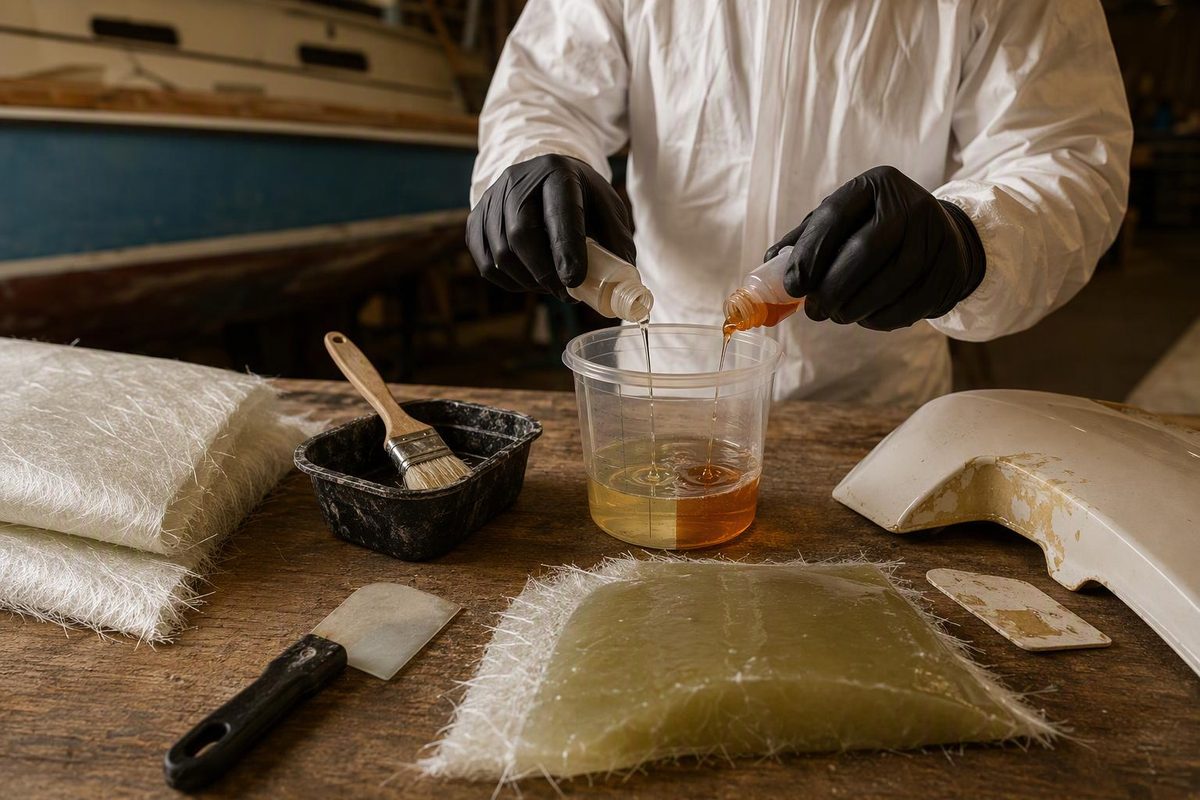
“Fiberglass hardener” is not one interchangeable product. For polyester fiberglass resin, it commonly means liquid MEKP catalyst. For epoxy, it means the hardener specifically approved for that epoxy resin. A cream hardener supplied with a fiberglass-reinforced filler is another product again.
If you are replacing a missing bottle or troubleshooting a sticky patch, start with the resin’s exact name—not the word fiberglass on the package.
1. Identify what you are trying to cure
| Material on the label | What to look for | What not to assume |
|---|---|---|
| Polyester laminating or finishing resin | The specified MEKP catalyst and dosing instructions | Any bottle labeled “hardener” will work |
| Vinyl ester resin or polyester gelcoat | The catalyst specified in that product’s instructions; MEKP is used in many systems | Its catalyst percentage matches your polyester repair resin |
| Epoxy resin | Its approved epoxy hardener and exact resin-to-hardener ratio | MEKP will cure it, or extra hardener will speed it up |
| Fiberglass-reinforced filler or repair putty | The curing agent named for that particular filler | A filler’s cream hardener also works in liquid laminating resin |
TotalBoat identifies MEKP as a catalyst for polyester resin, gelcoat and vinyl ester resin. WEST SYSTEM’s troubleshooting guidance warns that its epoxy will not cure properly with polyester catalysts or other brands’ epoxy hardeners. These are different curing systems, not alternative brands of the same ingredient.
For a familiar example, 3M lists cream hardener for several Bondo fillers, including fiberglass-reinforced fillers, but specifically says its blue cream hardener is not for Bondo Liquid Resin for Fiberglass. Match the exact product pairing rather than the filler’s fiber content. (3M product guidance)
Stop if the resin or filler cannot be identified. Do not test random hardeners on the actual repair. Replace an unidentified kit with a documented system.
2. Measure the product’s dose—not a universal ratio
Polyester: use its stated catalyst percentage
The resin’s instructions should identify the catalyst formulation, acceptable percentage and temperature range. MEKP is not MEK: methyl ethyl ketone solvent is not a substitute for methyl ethyl ketone peroxide catalyst.
For example, TotalBoat’s polyester laminating and finishing resin instructions specify MEKP labeled “9% active” and a catalyst range of 1–2.2% by weight, depending on conditions and working time. The manufacturer warns that over-catalyzing can harm the cured resin’s physical properties. That range belongs to those products; it is not a recipe for every fiberglass resin. (TotalBoat instruction sheet)
When instructions specify catalyst as a percentage of resin weight:
Catalyst mass = resin mass × percentage ÷ 100
At a specified 1% dose, 100 g of resin needs 1 g of the specified catalyst. Use measuring equipment suitable for the small quantity involved. Do not turn a weight percentage into a volume percentage, or borrow a drops-per-ounce chart from another product.
Epoxy: keep the ratio fixed
Epoxy cure speed is controlled through the approved hardener choice and working conditions—not by changing the ratio. Even one resin can have different ratios with different hardeners: WEST SYSTEM specifies 105 resin with 205 or 206 hardener at 5:1 by weight or volume, while 105 with 207 or 209 is 3:1 by volume. (WEST SYSTEM mixing instructions)
Check whether your ratio is by weight or volume. If using pumps, verify that they are calibrated for that resin/hardener combination; equal pump strokes do not necessarily dispense equal volumes. See the separate guide to matching, measuring and mixing epoxy.
3. Prepare before adding hardener
Have the surface, reinforcement and application tools ready before catalyzing the batch. Mix only what you can apply within the product’s working limits. For liquid resins, blend thoroughly, scraping the container’s sides and bottom. For fillers and putties, follow their specified mixing method rather than assuming the same stirring technique applies. (WEST SYSTEM resin mixing instructions; 3M filler mixing guidance)
Both polyester and epoxy generate heat as they cure. A deep mass left in a mixing cup can become dangerously hot; a larger batch is not simply a smaller batch with more working time. Follow the product’s batch-size and container guidance. (TotalBoat polyester instructions; WEST SYSTEM mixing guidance)
4. Diagnose stickiness before adding anything else
- Firm polyester laminate with a tacky exposed surface: Check whether you used unwaxed laminating resin. Air exposure can leave its surface tacky even though the bulk has become firm. Use the manufacturer’s specified final-cure method, such as finishing resin with wax or an approved PVA barrier—not extra catalyst brushed onto the patch. (TotalBoat cure guidance)
- Epoxy still soft or gummy: Check the ratio, hardener compatibility, mixing and cure temperature. Correctly mixed epoxy may need more time in cool conditions. For an off-ratio or poorly mixed batch that is not curing, WEST SYSTEM instructs users to remove the uncured material rather than coat over it. (Epoxy problem solver)
- Hard epoxy with a waxy film: This may be amine blush rather than uncured resin. WEST SYSTEM describes it as water-soluble and directs users to wash it off before subsequent preparation. It is not a reason to add more hardener. (Amine-blush guidance)
A hard surface alone is not proof that a repair is structurally adequate. For a load-bearing hull, moving deck or flexing shower pan, diagnose the damage and support before choosing the patch; start with matching the repair to the damage.
Handle the hardener as a hazardous chemical
MEKP deserves particular care: 3M’s November 2021 Canadian SDS for Bondo MEKP liquid hardener identifies severe skin-burn and eye-damage hazards and warns that heating may cause a fire. Read the current SDS for both components in your kit, use its specified gloves and eye/face protection, provide adequate ventilation, and keep materials away from heat and ignition sources. Keep catalyst in its original labeled packaging. (3M safety data sheet)