
Core Material for Fiberglass: Types and Repair Selection
Compare balsa, plywood and structural foam cores for fiberglass repairs. Check thickness, density, resin compatibility and damage before replacing a core.
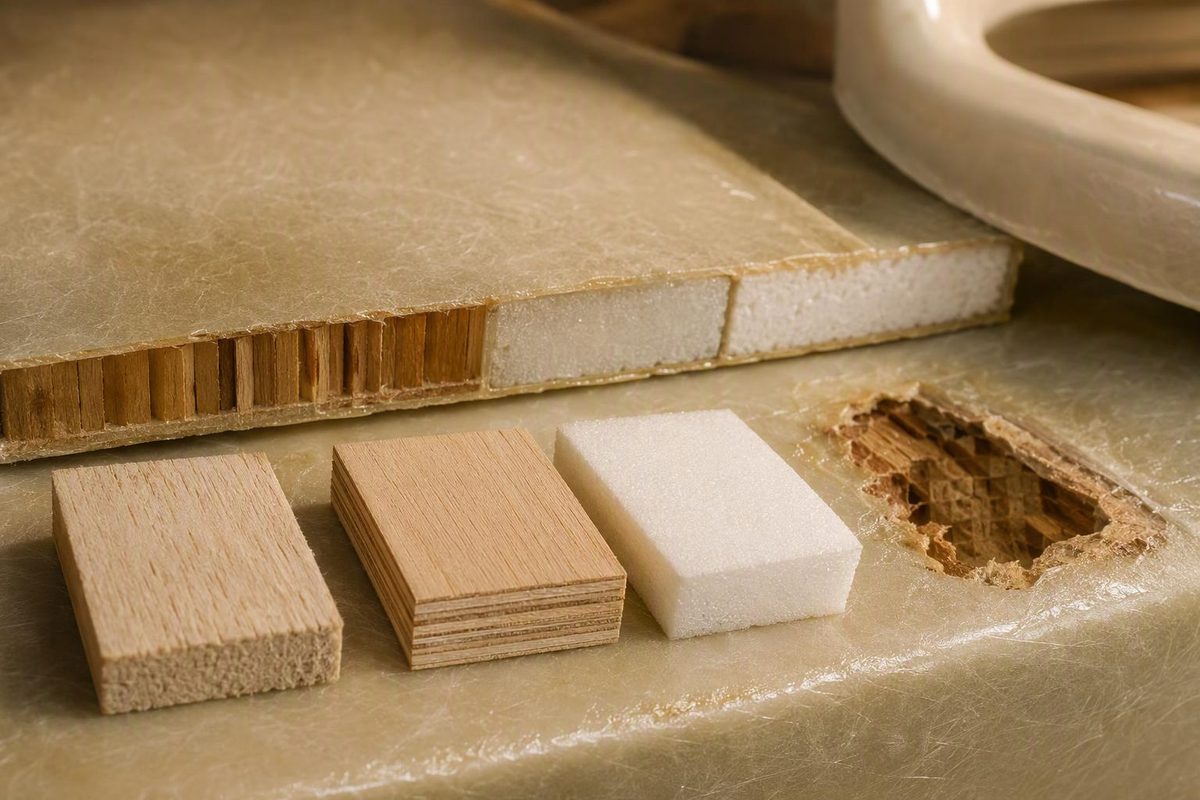
In a fiberglass sandwich panel, core material is the middle layer bonded between two reinforced skins. It increases panel stiffness without the weight of an equally thick solid fiberglass laminate. In a repair, the replacement must restore both the core’s properties and its bond to the skins—not simply fill the empty space. WEST SYSTEM’s boat repair manual explains this construction and its repair requirements.
For a boat deck, hull panel or transom, start with the original construction. Matching the builder’s core is the safest starting point; changing material is not automatically an upgrade.
What the core does—and what it does not
Under bending, the fiberglass skins carry tensile and compressive loads. The core holds them apart, supports them against collapse and must remain bonded to both. A failed skin-to-core bond can therefore leave a panel flexible even when the surface looks intact. WEST SYSTEM, Sections 1 and 5.
Core material is not fiberglass cloth, gelcoat or fairing putty. Replacing a core does not repair broken reinforcement, and smoothing the surface does not restore a deteriorated core. If the construction is unfamiliar, first identify the fiberglass composite part and separate finish damage from skin or core damage.
The word core also appears in stringer construction, where some cores carry structural loads and others mainly form the shape of the fiberglass reinforcement. Do not assume a sandwich-panel specification applies to a stringer. WEST SYSTEM, Section 3.1.
Common core materials
| Material | Where it fits | What to check before using it in a repair |
|---|---|---|
| End-grain balsa | Lightweight structural sandwich panels requiring good compressive properties | Use structural end-grain core, not ordinary flat-grain wood. Keep it dry and address water-entry points. |
| Plywood | Existing plywood-cored transoms, soles and other boat components | Match the specified construction and thickness. Wet plywood may delaminate or rot; do not assume lightweight foam is an equivalent replacement. |
| Cross-linked PVC foam | Structural sandwich panels such as decks, hull sides and bulkheads | Check the exact grade, density and resin pairing. “PVC foam” alone is not a sufficient specification. |
| SAN foam | Structural panels, including marine applications; Gurit Corecell M is one example | Compare the grade’s shear, compression and toughness properties with the repair specification. |
| PET foam | Structural sandwich panels; Gurit Kerdyn is one example | Check density, mechanical properties, processing limits and resin uptake—not just recycled content. |
The wood-core applications and moisture failure modes are described in WEST SYSTEM’s repair manual. The foam families and applications are documented in Gurit’s core-material overview. These are material categories, not interchangeable repair specifications.
Check these specifications before ordering
Thickness and fit. WEST SYSTEM recommends matching the replacement’s shape, thickness and density, preferably using the builder’s original material. Dry-fit it: the new piece should not stand above the surrounding core and force a bulge into the skin. Section 5.2.
Mechanical properties. Thickness and density are useful checks, but do not establish equivalence between different materials. Compare the specified shear and compression properties as well; these are separate performance measures in Gurit’s core-material overview. For a load-bearing panel, have a proposed substitution reviewed rather than choosing by sheet size or price alone.
Sheet format. Plain sheets suit flat areas; contour-cut or scrim-backed sheets can conform to curves. Grooves, perforations and opened cuts also consume resin. Gurit instructs users to account for this in resin quantity, weight and structural calculations. Allow for filling opened gaps as the specified process requires. Gurit’s processing guide, “Core Formats”.
Resin compatibility. Check the exact core and resin combination. Gurit’s December 2025 processing guide lists its Balsaflex, Corecell and Kerdyn products as compatible with epoxy, polyester and vinyl ester for wet laminating and infusion, but warns that some polyester and vinyl ester resins can attack Gurit PVC through their styrene content, especially during infusion. It recommends compatibility checks using representative materials and conditions. Do not extend a generic compatibility claim to every foam grade or processing method. Gurit’s resin-compatibility guidance.
Compatibility with the core is only one check: the adhesive must also suit the existing skin and the intended repair process.
Diagnose the damage before choosing a repair
- Look for movement and water entry. A spongy deck, skin movement, loose hardware or water emerging at a crack warrants core assessment. Light tapping can help map a suspect area, but it does not establish whether the core is dry, sound or decayed. WEST SYSTEM uses further inspection and core sampling to make that distinction. Do not drill inspection holes in an unfamiliar panel without knowing the opposite skin’s location and how the holes will be repaired. Section 5.1.
- Separate bond failure from core failure. Dry, firm core with a detached skin may be suitable for rebonding if adhesive can reach the failed interface and the skin can be clamped back into contact. Wet but sound wood core must be thoroughly dried before rebonding; soft, decayed or crushed core needs replacement. Injecting adhesive is not a substitute for removing failed material. WEST SYSTEM’s pattern-hole drying and injection method is not intended for highly loaded or critical laminates such as hull bottoms. Core-damage procedures, Section 5.
- Plan the whole repair before cutting. Establish access, support, replacement core, adhesive, clamping, skin reconstruction and cure requirements. Core replacement often requires skin repair, even if the skin was initially intact. The finished repair must restore skin continuity as well as the core bond. Sections 4 and 5.
Stop before opening a highly loaded hull panel or transom if you cannot define the repair construction and support method. An outboard transom carries concentrated motor and hardware loads, and WEST SYSTEM calls for supporting the hull before substantial skin removal. This is a structural repair—not a cosmetic patch or a generic foam-filling job. Transom repair planning, Section 5.3.